Wednesday, October 31, 2012

Israel establishes two new settlements and plans 180 new homes for Jews only in East-Jerusalem


Nahalei Tal, between the settlements of Nerya (Talmon B) and Nahliel.

Peace Now reports: For the first time since 2005, new unauthorized outposts were established in the West Bank: “Nahalei Tal”, north-west of Ramallah, and “Tzofin North” (or “Tzofim North”), adjacent to the settlement of Tzofin, north of Qalqiliya. As opposed to the sporadic outposts that are created by the hill-top youth and evacuated every few weeks by the security forces, it is evident that the two new outposts are highly supported by the authorities. They include mobile homes, infrastructure, electricity, water and roads (and even air conditioning). From the civil administration’s response to Peace Now’s complaint it is apparent that at this stage there is no intention to evacuate the outposts.
Peace Now: “PM Netanyahu began his tenure with the Bar Ilan Speech promising to promote the 2-State-Solution, and is now ending his term, after breaching almost all his promises, with a discordant chord. After the government rewarded the lawbreakers that built on private Palestinian lands in Migron and the Ulpana with alternative homes and other benefits, the government continues to make a mockery of the rule of law and to allow a radical minority to establish new outposts, which create facts on the ground that harm the possibility of an agreement with the Palestinians”

Hagit Ofran of Peace Now reports on her blog 'Eyes on the Ground in East Jerusalem' The Israeli Land Administration announced last week the allocation of 180 new housing units in East Jerusalem for families of people from the Israeli security forces (the army and police). The decision was made in accordance with the Israeli Government’s decision from 20.5.12 to allocate units for security people in Jerusalem in “places with special characteristics that can justify such allocations, according to the ILA considerations”.
Since almost no Palestinians serve in the Israeli security forces, this decision is clearly intended to prevent from Palestinian families the possibility to buy homes in the new neighborhood, which is located between two Palestinian neighborhoods, Sur Baher and Um Lison.
The plan, number 7977A, is on lands that were confiscated by the Israeli Government back in 1970 as part of the confiscations for the East Talpiyot (AKA Armon Hanatziv) neighborhood. On July 2012, the plan was officially announced valid after the final approval by the regional planning committee.

Monday, October 29, 2012

Egypt starts struggle against sexual harassment in the streets

Anti-harassment
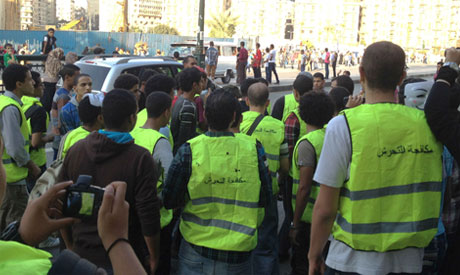
Volunteers in yellow vests with the words 'against harassment' on them patrol the streets of Cairo (AP).

An Egyptian movement started to thwart sexual harassment during Eid Al-Adha has recorded 300 attempted attacks during the first two days of the holiday. The initiative, dubbed 'Catch the Harasser', began on the first day of Eid, with volunteers working across central Cairo in a bid to prevent lewd attacks on women.
Also the Ministry of the Interior announced a few days earlier that surveillance cameras will be installed in streets and squares in Cairo to detect incidents of sexual harassment. The cameras will be used to catch the harassers and display their photos on public television and the Internet, according to a ministry representative.
Both steps came after the National Women Council started a national campaign, "Patrols Against Sexual Harassment," in August 2012 to combat sexual harassment in Cairo, specifically during Eid. Sexual harassment of women has been steadily on the increase in recent years in the Egyptian streets. And during the Eid, when crowds makes it easier for culprits to act unpunished, it is usually at its worst. .According to a survey issued in 2008 by the Egyptian Centre for Women Rights, 83 per cent of women in Egypt and 98 per cent of foreign women have been exposed to sexual harassment at least once.
Prime Minister Hisham Qandil stated on 21 October using his official Facebook page that his cabinet, along with the National Council for Women, are working on finding ways to wipe out sexual harassment in Egypt. Qandil revealed in the statement that a law is currently being drafted to combat harassment on the streets through imposing harsh penalties.

Lakhdar Brahimi does not give up in spite of failure of Eid al-Adha truce


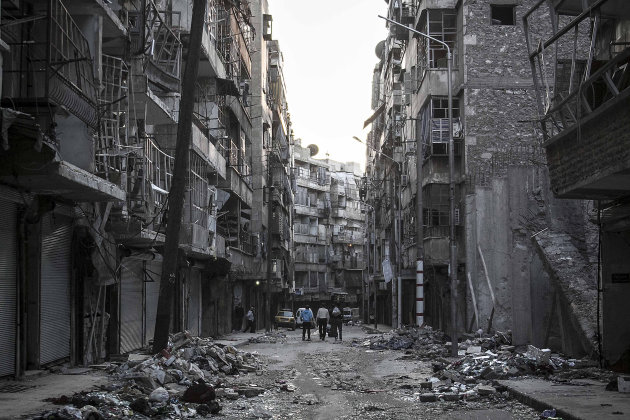
In this Saturday, Oct. 27, 2012 photo, Syrian residents walk on a street among the debris of buildings damaged by heavy shelling in the southeast of Aleppo City. (AP Photo/Narciso Contreras).
Damaged buildings in the southeast of Aleppo (AP) 

Opposition activists in Syria said forces loyal to President Bashar al-Assad had renewed their heavy bombardment of major cities on Saturday and Sunday, in spite of the four day truce that was reached by the envoy of the UN ad the Arab League, Lakhdar Brahimi, on the occcasion of the religious feast of Eid al-Adha.  Activists said at least 110 people were killed Sunday, a toll similar to previous daily casualty tolls.
The Syrian army said it had responded to attacks by insurgents on its positions on Friday, in line with its earlier announcement that it would cease military activity during the holiday while reserving the right to react to rebel actions.
In spite of the fact that the truce collapsed, Brahimi is expected to come to the UN Security Council in November with new proposals aiming to push President Bashar al-Assad and the Syrian opposition into political talks, UN diplomats told AFP.
The former Algerian foreign minister will head this week for Russia and China -- the two leading doubters about international pressure on the Syrian rivals -- to discuss the crisis.
Just as with the attempted truce of Kofi Annan in April it did not take long to see that Syria is not yet ready for peace. Nineteen months of conflict has now left more than 35,000 dead, according to Syrian activists. Little is known of what possible negotiating tactic Brahimi is preparing. But behind the scenes, the United Nations is drawing up plans to quickly assemble a peacekeeping or truce monitoring force if a new ceasefire can be agreed.
It also had humanitarian teams and aid ready to go into the stricken cities of Aleppo, Idlib and Homs if the Eid ceasefire had worked.
Brahimi faces multiple challenges -- Assad's apparent determination to cling to power, the fractured opposition and arrival of Islamist fighters.
"He has to persuade key countries in the Middle East not to support the rebels with arms," told a senior UN diplomat, speaking to AFP on condition of anonymity. "But if there is to be Security Council action there has to be agreement from Russia and China," added the diplomat. "If they don't agree to action then of course Turkey, Saudi Arabia and western nations will step up their help for the opposition."
Russia and China have used their powers as permanent Security Council members three times to block resolutions that could have led to Syria sanctions.

Sunday, October 28, 2012

Human Rights Watch: Israel unlawfully stopped dozens of Eritrean refugees at the Egyptian border

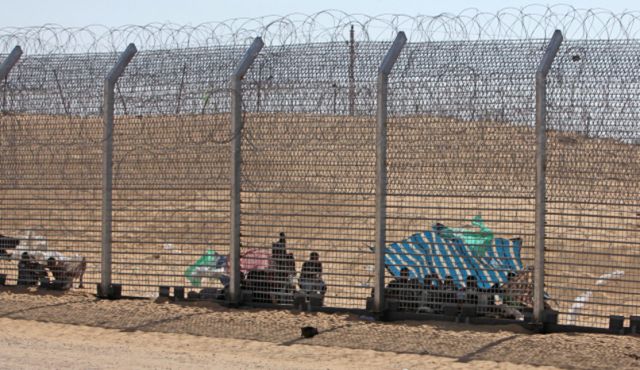
 In September a group of 21 Eritreans was trapped at the Israeli border fence for more than a week, before they were chased away in the direction of Egypt. (See also here).
The Israeli military has since June 2012 prevented dozens of asylum seekers, most of them Eritreans, from crossing Israel’s newly constructed fence on its border with Egypt, Human Rights Watch, the Hotline for Migrant Workers, and Physicians for Human Rights – Israel said today. Israel has also unlawfully deported dozens more back to Egypt, the three groups said.
Israel should stop rejecting asylum seekers at the fence unless its officials determine in a fair procedure that they do not face threats to their lives or freedom or inhuman and degrading treatment because of that rejection. The 1951 Refugee Convention, to which Israel is a state party, customary international refugee law, and international human rights law require all countries to respect the principle of nonrefoulement, which prohibits the return of anyone to a place where their life or freedom would be threatened or where they would face the threat of torture or inhuman and degrading treatment. This means anyone seeking asylum may not be summarily rejected at the border and may not be deported unless their claim has been fairly determined.
At least seven times since June, Israeli forces patrolling Israel’s newly constructed 240-kilometer border fence with Egypt’s Sinai region have denied entry to dozens of Africans, mostly Eritreans, thousands of whom continue to flee persecution in their country every year.
 In July, Israeli forces also detained about 40 Eritreans just inside the Israeli border and then forcibly transferred them to Egyptian custody.

Based on Israeli government figures, about two-thirds of those trying to cross the border are from Eritrea, where Human Rights Watch has documented widespread and severe abuses against people seeking to avoid mandatory and indefinitely prolonged national service on wages barely sufficient to survive, and against adherents of “unrecognized” religions and government critics.
The United Nations High Commissioner for Refugees (UNHCR) says that more than 80 percent of Eritreans who claim asylum worldwide are recognized as refugees.
Recent interviews with Eritreans arriving in Israel confirm that many passing through Sinai to reach Israel are facing serious abuses, including torture and rape, by traffickers in Sinai who hold the Eritreans for ransom. Those who pay are allowed to travel onward to reach the Israeli border.

Friday, October 26, 2012

Human Rights Watch: 'Israel should stop harassing members of prisoner's rights group Addameer'

Ayman Nasser


Israeli authorities should stop harassing members of a Palestinian prisoners’ rights group. Israeli authorities should immediately lift a travel ban on the group’s chairman and release a recently arrested researcher, or present evidence justifying the measures against them., Human Rights Watch said on Friday. 

In August and September 2012, Israeli authorities issued orders prohibiting Abdullatif Ghaith, chairman of the board of the group, Addameer, from traveling abroad as well as from East Jerusalem, where he lives, to the rest of the West Bank, where the organization’s offices are located. On October 15, Israeli forces raided the West Bank home of Ayman Nasser, a researcher for the group, arrested him and questioned him about radio interviews he gave about prisoners and his membership in a youth organization.
At military court hearings on October 18 and 24, military judges extended his detention on the basis of evidence he was not allowed to see. The Israeli military has not charged either man with wrongdoing or allowed them to see any evidence against them. Addameer adds that the last time Nasser's detention was extended for nine more days. It also said that the main focus of his interrogation continues to be his civic activities relating to his role in advocating for the rights of Palestinian political prisoners and his involvement in the Handala Center, which is an educational, artistic center in Ayman’s village Saffa and of which Ayman is the Chairperson.
“It’s deeply ironic that Israel is arbitrarily detaining a researcher who has documented arbitrary detention, and violating the rights of the head of a human rights group,” said Sarah Leah Whitson, Middle East director at Human Rights Watch. “Israel should provide valid justifications for its measures against Nasser and Ghaith or drop those measures immediately.”

Addameer itself adds that it is extremely concerned for Ayman’s health as he continues to be denied the appropriate medication. As previously reported Ayman suffers from a number of health issues including inflammation in his colon and back pain. Until his arrest he was receiving constant medical treatment by specialized doctors.
 

European Sakharov Awards for two Iranian dissidents

Nasrin Sotoudeh
The European Union's Sakharov Prize for Freedom of Thought was awarded on Friday to two Iranian activists, filmmaker Jafar Panahi and rights lawyer Nasrin Sotoudeh.
 Nasrin Sotoudeh is a prominent human rights lawyer who has represented imprisoned Iranian opposition activists and politicians following the disputed June 2009 Iranian presidential elections as well as prisoners sentenced to death for crimes committed when they were minors. Sotoudeh was arrested in September 2010 on charges of spreading propaganda and conspiring to harm state security. In January 2011 she was sentenced to 11 years in prison in addition to barring her from practicing law and from leaving the country for 20 years. 

Jafar Panahi is an Iranian film director, screenwriter and film editor of Azerbaijani descent, most commonly associated with the Iranian New Wave film movement.  Panahi first achieved international recognition with his debut The White Balloon which won the Caméra d'Or at the 1995 Cannes Film Festival. It was the first major award won by an Iranian film at Cannes. Other awards include the Golden Leopard at the 1997 Locarno International Film Festival for The Mirror, the Golden Lion at the 2000 Venice Film Festival for The Circle and the Silver Bear for Best Director at the 2006 Berlin Film Festival for Offside.
Iranian director Jafar Panahi is seen with the Silver Bear he won for his film Offside at the 56th Berlin International Film Festival ceremony in 2006. He has been sentenced to jail once again by Iranian authorities.
Panahi with Silver Bear, Berlin 2006
Panahi was arrested in March 2010 and charged with committing propaganda against the Iranian government. In December 2010 he was sentenced to a six-year jail sentence and a 20-year ban on directing any movies, writing screenplays, giving any form of interview with Iranian or foreign media and from leaving the country. This led to Panahi's last film to date: This Is Not a Film, a documentary feature in the form of a video diary that was made despite of the legal ramifications of Panahi's arrest. It was smuggled out of Iran in a Flash-Drive hidden inside a cake and was screened at the 2011 Cannes Film Festival.

Thursday, October 25, 2012

Eid said - happy eid, hopefully even in Syria

Syrian government 'agrees to ceasefire'
Fighter of the Free Syrian Army in Aleppo.  (AP)  Lakhdar Brahimi, the special envoy for Syria of the UN and the Arab League, succeeded in having Assad agree to a four day cease fire in Syria during the holiday of Eid al-Adha which starts on Thursday evening. The opposition forces also agreed, provided that 'the goverment forces hold their firing first'. Let's hope it will work out well, so that Syria - together with the rest of the muslim world - in a way will have a  happy Eid as well.
    

Sudan says Israeli planes bombed military factory in Khartoum

 explosiekhartoum

The Sudanese government says it believes Israel was responsible for explosions at a military factory in the capital Khartoum on Tuesday.
Culture and Information Minister Ahmed Bilal Osman said four Israeli planes attacked the factory and two people were killed. Israel has not commented.
Sudan has blamed Israel for such attacks in the past.
Correspondents say Israel believes weapons are being smuggled through the region to Gaza.
Leaked US State Department documents three years ago suggested that Sudan was secretly supplying Iranian arms to Hamas in the Gaza Strip.
In April 2011, Khartoum held Israel responsible for an air strike that killed two people in a car near the city of Port Sudan. A similar incident happened in May 2012. Israel was also blamed for a strike on a convoy in north-eastern Sudan in 2009. In all those cases it  neither confirmed nor denied involvement.
In the latest incident fire engulfed the Yarmouk plant and nearby buildings after the explosions, with flames visible over a wide area.
Residents reported seeing aircraft or missiles overhead before a number of explosions.

Morsi declares support for Palestinians

 Morsi
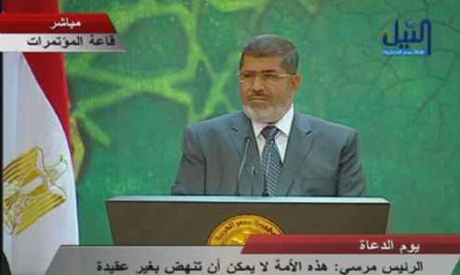
 Morsi during his speech for Eid al-Adha (Nile tv)

President Mohamed Morsi on Wednesday said Egypt would do its best to support Palestinians in their struggle against Israeli occupation "without declaring war against anyone."
Morsi spoke on national television to mark Muslim's four-day Al-Adha feast "We will never accept any assault or siege on the Palestinian people. Egypt provides Palestine with all its needs such as food and clothing," he said.
"The blood of Palestinians is our blood, their life is our life and their pains are our pains. However, supporting Palestine does not mean that we will declare war against anybody," he added in reference to Israel, which he stopped short of calling it by name, maintaining the same pattern he has followed in his speeches since his inauguration as Egypt president. His speech came on the same day that Egypt brokered a cease fire, after Israel killed four Palestinian militants in two days and the Palestinians fired about 80 projectiles into Israel.

Morsi also spoke up for the Palestinians in his speech to the General Assembly of the United Nations on 26 September. He described himself as Egypt's first democratically elected leader the country  underwent what he called a ‘great, peaceful revolution’. Morsi said in the UN General Assembly that the first issue for the world body should be certifying the rights of the Palestinian people.
‘‘The fruits of dignity and freedom must not remain far from the Palestinian people,’’ he said, adding that it was ‘‘shameful’’ that UN resolutions are not enforced. He decried Israel’s continued building of settlements on territory that the Palestinians claim for a future state in the West Bank.

Wednesday, October 24, 2012

King Abdullah: 'Ruling Jordan is a sacrifice'


  King Abdullah of Jordan his told his subjects on Tuessday that he or his family was never after the power, but that ruling Jordan was 'a sacrifice'.
 “Governing, for us Hashemites, was never at any point a gain that we sought, but rather a responsibility, a duty and a sacrifice that we have been carrying out in the service of this nation and in defence of its causes and interests — a cause to which we have offered many martyrs,” said the King.
“Governing was never for us about holding a monopoly over authority, nor about power and its tools, but about supporting state institutions run by Jordanians from all segments of society, according to the provisions of our Constitution.'
Abdullah said this on Tuesday in a speech for  more than 3,000 personalities in which he urged all political parties and forces to take part in the upcoming legislative elections of 23 January. Abdullah, who is not really the brightest of personalities, told his audience that 'the next Parliament will determine the formation of the new parliamentary government, and with it the future of political reforms and socio-economic policies'. To that he added more hollow niceties , to the tune of “If you want to change Jordan for the better, there is a chance, and that chance is the upcoming election, and there is a way, and that way is through the next Parliament.” 
All this was said amidst demonstrations that go on and off in Jordan since months, during which demands are heard for real reform and changes of the constitution towards real democracy. It's highly improbable that many people will have been impressed by his majesty's banalities. But that ruling Jordan in fact is a sacrifice may have been a revelation to many among them. 

Monday, October 22, 2012

Links for the past week

Some links for articles I would recommend: 

Must read for anyone who still thinks that Israel 'always wanted peace but never found a partner at the other side'. In Foreign Policy Stephen Walt shreds the myth of the peace loving Israel to pieces.    What's going on in Israel? 
 
Egyptian blogger Maikel Nabil Sanad in a courageous piece -  also in Foreign policy:
 'Yes, I'm a blasphemer'

Joshua Landis gives a remarkable advise on his blog 'Syria Comment'
The US  must Supply anti-Aircraft Missiles to the Syrian Opposition

Writer/lawyer Raja Shehadeh in The New York Times about a meeting about the ;Nakba' organised by the Israeli Zochrot movement: The Nakba, Then and Now 
   
'Yerachmiel Kahanovich described how he had dug a hole in the wall of the Dahmash Mosque in   the center of Lydda, where more than 150 Palestinians had taken shelter, and shot an anti-tank shell through it. Asked what had happened to the Palestinians, he said they were all crushed against the walls by the pressure from the blast.' 

Al Monitor translated this from the Lebanese paper As-Safir (18 October):
Iran’s Man in Damascus Says Tehran Supports UN's Cease-Fire Initiative

And also this:
Syria Turns to Iran for Electricity, Leaves Regional Power Grid

As'ad Abu-Khalil (also known als Angry Arab) provides some sobering background information about a man who was turned into a hero after he had been killed by a car bomb. 
Car bom in Beirut: Wissam al-Hassan

Kuwaiti's protest against changes in electoral law


p1b2 Al Sabah family, tribes affirm loyalty to Amir   Pitched battles in streets as protesters defy policeMore than 100 protesters and 11 police have been injured in Kuwait after tens of thousands took to the streets against changes to the electoral law. 'The number of wounded protesters in hospital has exceeded 100 after riot police attacked them,' director of the Kuwait Society for Human Rights Mohammad al-Humaidi said on Twitter on Sunday. 
The opposition called the demonstration to protest against a decision by Emir Sheikh Sabah al-Ahmad al-Sabah to amend the electoral law. The Kuwaiti cabinet on Saturday amended a controversial electoral law and set a December 1 date for snap polls, sparking angry opposition calls for demonstrations.The cabinet acted on orders from the emir who on Friday said the voting system must be amended immediately to deal with shortcomings in the law and to safeguard national unity against sectarian, tribal and factional tensions.
The electoral constituency law, issued in 2006 after opposition-led protests, divides the country into five electoral districts, each electing 10 MPs to the 50-member parliament. Under that legislation, each eligible voter was allowed to elect a maximum of four candidates. The government's amendment reduces this number to one, the cabinet statement said.

The decision came despite a ruling by the emirate's constitutional court last month that the legislation was in line with the constitution, turning down an appeal by the government.
 The opposition claims the change is aimed at electing a rubber-stamp parliament. It has decided to boycott polls called for December 1.'The people want to abolish the decree,' chanted the protesters marching in the street.
The demonstrators were due to march on the Seif Palace which houses offices for the emir, crown prince and prime minister, but were prevented by police.
p1c2 Al Sabah family, tribes affirm loyalty to Amir   Pitched battles in streets as protesters defy police
As the clashes took place, the emir (second from right in the picture) received members of the Al-Sabah ruling family, in power for more than 250 years, who reiterated their loyalty to him, TheKuwait Times reported.