A rocket from Gaza killed three Israeli people in an apartment in Kiryat Malachi on 15 November. A little child was wounded.
Palestinian armed groups in Gaza violated the laws of war during the
November 2012 fighting by launching hundreds of rockets toward
population centers in Israel,
Human Rights Watch said in a report released on Monday. Under international humanitarian law,
or the laws of war, civilians and civilian structures may not be
subject to deliberate attacks or attacks that do not discriminate
between civilians and military targets.
About 1,500 rockets were fired at Israel between November 14 and 21,
the Israel Defense Forces reported. At least 800 struck Israel,
including 60 that hit populated areas. The rocket attacks, including the first from Gaza to strike the Tel
Aviv and Jerusalem areas, killed three Israeli civilians, wounded at
least 38, several seriously, and destroyed civilian property.
Israel's Internal Security Agency (ISA)
said
that about half of the rockets fired into Israel were short range,
reaching up to 20 kilometers; slightly less than half were medium range,
reaching 20 to 60 kilometers, and less than 1 percent were long range
reaching over 60 kilometers.
The Israel Defense Forces
said that its “Iron Dome” anti-rocket defense system intercepted more than
400 rockets during the November fighting. Of the rockets that hit
Israel, the vast majority landed in open areas, causing no injuries or
damage.
In addition to the locally made Qassam rockets and Soviet-designed Grad
rockets long used by Palestinian armed groups, the Qassam Brigades
announced that it had launched a locally made larger rocket, called the
M75, as well as Iranian-produced Fajr 5 rockets. Officials from Hamas
and Islamic Jihad said that Iran had supplied Palestinian armed groups
with military support.
The
Guardian newspaper
quoted
an Iranian military official's statement to Iranian media that Iran had
not supplied rockets but had provided technical information to
Palestinian armed groups that enabled them to build their own Fajr 5
rockets. The Fajr 5 has a reported range of 75 kilometers, capable of
reaching the Tel Aviv metropolitan area from Gaza, with 90 kilograms of
explosives in its warhead.
Human Rights Watch research in Gaza found that armed groups repeatedly
fired rockets from densely populated areas, near homes, businesses, and a
hotel, unnecessarily placing civilians in the vicinity at grave risk
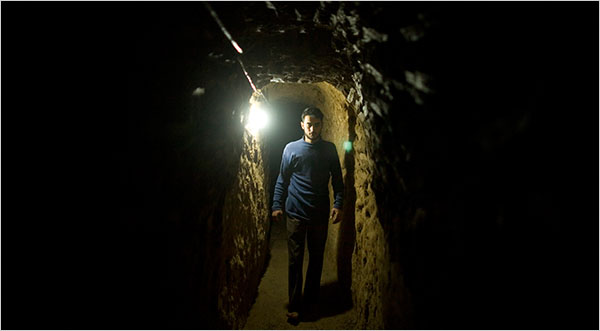
from Israeli counter-fire. Unlike during previous fighting, armed groups seem to have
fired many rockets from underground tunnels, opening a hatch to launch
the munition.
One rocket was launched on November 20 at around 1:30 p.m. just off
Wehda Street in Gaza City, about 100 meters from the Shawa and Housari
Building, where various Palestinian and international media have
offices. “I saw it [the rocket] go up and heard it, and then smoke was
in the office,” a witness said.
One man said he saw a rocket launched from the yard of a house near the
Deira Hotel in central Gaza City, though he could not recall the date.
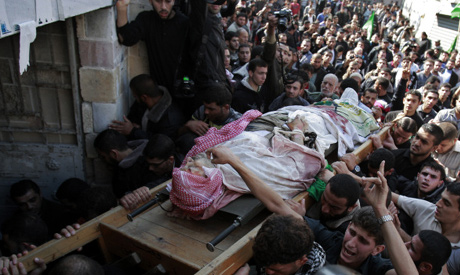
Some rockets launched by Palestinian armed groups fell short and struck
inside Gaza. On November 16, a rocket that appears to have been launched
from within Gaza hit a crowded street in the Gazan town of Jabalya,
killing a man, 23, and a boy, 4, and wounding five people.
International and Palestinian journalists traveling around Gaza during
the fighting told Human Rights Watch that they did not see any
Palestinian militants moving in the open, suggesting that Hamas has
developed a network of tunnels for personnel and perhaps rockets.


.jpg)