
Showing posts with label water. Show all posts

Thursday, June 13, 2013

Ethiopian parliament strips Egypt of its lion's share to water of the Nile


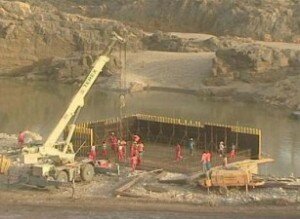
renaissance_dam_construction site 1_year_on


 (Reuters) - Ethiopia's parliament unanimously ratified on Thursday a treaty that strips Egypt of its right to the lion's share of the Nile river waters, raising the political temperature in a dispute between Cairo and Addis Ababa over the construction of a dam. The parliament's move follows days of irate exchanges between two of Africa's most populous nations over Ethiopia's new hydroelectric plant, which Egypt fears will reduce a water supply vital for its 84 million people.
Egyptian President Mohamed Mursi said on Monday he did not want "war" but would keep "all options open", prompting Ethiopia to say it was ready to defend its $4.7 billion Great Renaissance Dam near the border with Sudan.
Six Nile basin countries including Ethiopia have signed a deal effectively stripping Cairo of its veto, which is based in colonial-era treaties, over dam projects on the Nile, source of nearly all Egypt's water.
Ethiopia's late leader Meles Zenawi had delayed parliamentary ratification until Egypt elected a new government. "Most of the upstream countries have approved it through their parliaments. We delayed it as a gesture of goodwill to the people of Egypt until a formal elected government was in place," Ethiopian government spokesman Bereket Simon told Reuters. "We have a principled stance on the construction of dams. We are determined to see our projects brought to completion."


Egyptian Foreign Minister Mohamed Kamel Amr is expected to travel to Addis Ababa on Sunday for talks about the dam, though Ethiopia's foreign ministry has said there can be no question of suspending construction. The African Union has urged both sides to hold talks to resolve the row.
Under a 1929 pact, Egypt is entitled to 55.5 billion cubic metres a year of the Nile's flow of around 84 billion cubic metres. But, along with other upstream neighbours such as Kenya and Sudan, Ethiopia argues that this pact is outdated. Ethiopia has also dismissed the talk of military action as "psychological warfare".
Officials in Addis Ababa say a technical analysis compiled by experts from Ethiopia, Sudan and Egypt provides assurances to downstream nations that the dam being built by an Italian firm will not have a negative impact on the river's water levels.

Tuesday, June 4, 2013

Egypt extremely worried about start of work at Ethiopian dam in the Blue Nile

The Nile in Egypt


The Egyptian presidency on Monday published a summary of a report issued over the weekend by a tripartite commission – including Egyptian, Sudanese and Ethiopian representatives – about the potential impact on downstream states of Ethiopia's controversial Renaissance Dam project.  The committee, which also comprised international experts, was formed in May 2012 to study the impact of the dam on Sudan and Egypt, which are downstream of Ethiopia.
 Ethiopia announced last week that it will begin diverting the course of the Blue Nile, one of the Nile River’s two major tributaries, as part of the project. The plans for the Renaissance Dam have been a source of concern for the Egyptian and Sudanese governments since some time, since the Blue Nile is the main source of water for both countries. The project, if completed, could negatively impact the volume of Nile water that will reach Egypt. Egypt will need an additional 21 billion cubic metres of water per year by 2050, on top of its current 55 billion cubic metres quota, to meet the water needs of a projected population of 150 million people, according to Egypt's National Planning Institute.
Ethiopia asserted that the project will not have an adverse impact on either Sudan or Egypt, but according to the summary of the tripartite report, most studies conducted by Ethiopia have been insufficient or out of date.
The summary said that Ethiopia had failed to conduct  studies on the dam's potential environmental and social impact on downstream countries. Also, according to the report and contrary to what Ethiopia claimed, the Renaissance Dam will affect the ability of Egypt's High Dam to generate electricity, especially during the Nile's high and medium flood seasons. It also highlights negative environmental and social impacts, including a negative impact on Ethiopia's own ecosystem and on Egyptian agriculture. The summary goes on to describe Ethiopian reports on the dam's ostensible advantages for Egypt as undependable, since they were not based on extensive studies of the dam's operational conditions or the Nile's hydrological system.

Sunday, June 27, 2010

YNet describes how the Palestinians steal their own water

Isareli bulldozer destroys Palestinian irrigation canal near Hebron.

I really love this. In YNet a reportage about the theft of water by Palestinians. It happens on the West Bank. And what YNet seems to miss altogether is that the Palestinians actually are stealing their own water. This is what Amnesty International in 2009 wrote about the Palestinians in relation to the availability (or non availability) of water: they have accces to only 20% of what is available to the Israelis. On my Dutch blog I refered to it here).
This is what YNet wrote:

"This is lawlessness," Yigal Klein, chairman of the secretariat at the Pnei Hever settlement, told Ynet. "The Palestinians are connecting to the pipes with trucks or via an illegal system of pipes, and we don't have water in the morning. Children want to wash their faces before they go to school, and the faucets are empty. Even a cup of coffee becomes a rare commodity."
The phenomenon, according to Israel Water Authority, has already reached the proportions of a serious issue. "The pumping fro these illegal drillings come to a massive quantity of 10 million cubic meters of water a year," said a senior water official. "The Palestinians are connecting illegally to the supply lines of Mekorot and are causing a shortage in Hebron, Kiryat Arba, Yatta, and the surrounding villages." (For the whole article click here)

 Theft .. of their own water. (Picture YNet/courtesy of Mekorot wter company).