
Monday, December 20, 2010

New Human Rights Watch report: systematic discrimination in West Bank and East-Jerusalem

Cover of the Human Rights Watch report. The picture shows Bedouin children walking towards their homes outside the settlement of Ma'aleh Adumim. Israel almost never recognizes the right of Bedouin property.


Well. sometimes it is good to hear it from other sources. Human Rights Watch has issued a new report about Israels policies in the West Bank, partcularly area C and East Jerusalem. It stipulates that Israeli policies in the West Bank harshly discriminate against Palestinian residents, depriving them of basic necessities while providing lavish amenities for Jewish settlements, and that without any security reason or other justification  Human Rights Watch said.

"Palestinians face systematic discrimination merely because of their race, ethnicity, and national origin, depriving them of electricity, water, schools, and access to roads, while nearby Jewish settlers enjoy all of these state-provided benefits," said Carroll Bogert, deputy executive director for external relations at Human Rights Watch. "While Israeli settlements flourish, Palestinians under Israeli control live in a time warp - not just separate, not just unequal, but sometimes even pushed off their lands and out of their homes."
By making their communities virtually uninhabitable, Israel's discriminatory policies have frequently had the effect of forcing residents to leave their communities, Human Rights Watch said. According to a June 2009 survey of households in "Area C," the area covering 60 percent of the West Bank that is under exclusive Israeli control, and East Jerusalem, which Israel unilaterally annexed, some 31 percent of Palestinian residents had been displaced since 2000.

Human Rights Watch looked at both Area C and East Jerusalem and found that the two-tier system in effect in both areas provides generous financial benefits and infrastructure support to promote life in Jewish settlements, while deliberately withholding basic services, punishing growth, and imposing harsh conditions on Palestinian communities. Such different treatment on the basis of race, ethnicity, and national origin that is not narrowly tailored to legitimate goals violates the fundamental prohibition against discrimination under human rights law.

The whole report,  Separate and Unequal, 166 pages, can be found here.  

Wednesday, December 15, 2010

At least 39 killed by suicide attack in Southeast Iran, claimed by Jundallah


A suicide attack has killed at least 39 people and wounded more than 100 others near a mosque in the southeastern Iranian city of Chabahar as Shias marked the aproach the climax of Ashoura, the commemoration of the death Hussein, of the grandson of the prophet Mohammed.
Arabiyya tv reported that two suicide bombers were involved. One detonated himslef in front of the mosque, the other one attacked inside it.
According to Al-Arabiyya tv the attack has been claimd by an armed Sunni group, Jundallah, or Soldiers of God, which has waged earlier attacks to fight alleged discrimination against the area's Sunni minority in overwhelmingly Shia Iran. In July, two suicide bombers blew themselves up at a mosque in the same province, Sistan-Baluchestan, killing at least 28 people. Jundallah said that attack was revenge for the execution of its leader, Abdulmalik Rigi, who was hanged in June. The Iranian authorities captured him in February by diverting the plane on which he was traveling from Dubai to Kyrgyzstan. In May also Abdulmalik's younger brother Abdol Hamid was hanged.
Iranian officials claim Jundallah, which has operated from bases in Pakistan, receives support from Western powers, including the United States. Washington denies any links to the group, and in November the State Department added Jundallah to a U.S. list of foreign terrorist organizations.
The group has also targeted members of Iran's Revolutionary Guard, the country's most powerful military force. In its deadliest attack, a suicide bomber hit a meeting between Guard commanders and Shiite and Sunni tribal leaders in the border town of Pishin in October 2009, killing 42 people, including 15 Guard members.

Monday, December 13, 2010

At least 31 killed because of bad weather in Egypt

sandstorm kills 31
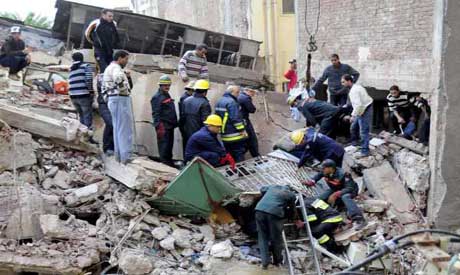
A six floor textile factory collapsed in Alexandria. (Reuters)
Rain and sandstorms that battered Egypt at the weekend killed at least 31 people. Officials said Monday, that the toll could rise as rescue workers were still sifting through two collapsed buildings.
The bodies of six workers were pulled out Monday of the debris of a six-storey textile factory that crumpled on Sunday  in Alexandria. Earlier three bodies had been found. One worker among 10 who had been wounded also died of his injuries. About a dozen workers are still missing.
In the Nile Delta city of Tanta, a child was killed and nine people hurt when a five-storey residential building came down on Sunday. One person is still trapped under the rubble.

Twenty people were killed and more than 40 injured in road accidents Sunday across Egypt blamed on poor visibility from heavy rains and sandstorms, officials said.
Meanwhile, a tug boat was trying to pull to safety on Monday an Italian cargo ship stranded off Egypt's northwestern coast with 21 crew on board and 38 containers of toxic paint and resins. Egypt's main ports in Alexandria and the Red Sea reopened on Monday a day after authorities closed them. Also traffic at the Suez Canal was restored after north-bound traffic had been limited.

Ahmadinejad fires foreign minister

Mahmoud Ahmadinejad, the Iranian president, has fired Manouchehr Mottaki, his foreign minister, the official IRNA news agency has reported. The announcement came on Monday, while Mottaki was in Senegal on a visit. No reasons were gven
Ahmadinejad appointed the head of Iran's Atomic Energy Organisation, Ali Akbar Salehi, a close ally to the president, as caretaker for the ministry, state television reported.
Sadegh Zibakalam, a professor in political science at the Tehran university, told Al Jazeera that there had been rumours of tensions between Ahmadinejad and Mottaki.
"The relationship between the ex-foreign minister and Ahmadinejad hasn't been going that well," he said. "When he was appointed, five years ago, there were a lot of rumours that Mottaki had been imposed on Ahmadinejad and he wasn't pleased to have him. Since then, on half a dozen occasions, there had been rumours that Ahmedinejad had either sacked Mottaki or asked him to resign."
Marwan Bishara, Al Jazeera's chief political analyst, said that there had been rumours of discord between the two men.

Americans shift back to indirect peace talks


Video of the speech of Hillary Clinton at the Saban Centre on Friday. She arrives at the more interesting points at about 10' into her talk.

The Americans go on as if  not much has changed. After the approach failed to get the Israelis and Palestinians at the table for direct talks, due to Israeli refusal to extend the building freeze in the settlements,  U.S. Secretary of State Hillary Clinton announced Friday that Washington would fall back on the indirect approach, whereby the U.S., will have talks with both parties seprartely from each other.  During those talks the United States would push to resolve core issues of the conflict, she said, including borders, security, the  future of Jerusalem, and the issue of the Palestinian refugees.
"Like many of you, I am frustrated that we have not gotten farther, faster," Ms Clinton said in a speech at the Saban Forum, a Middle East policy seminar sponsored by the Brookings Institution think tank.
Stressing that a negotiated solution remained the only way forward, she said the US would resume the role of broker, opening talks with both parties on vital issues. "We will push the parties to lay out their positions on the core issues without delay, in good faith, and with real specificity," she said.
Ms Clinton's speech was the first Middle East policy address after the US on Tuesday announced it had abandoned  its efforts to persuade Israel to halt construction of Jewish settlements in the West Bank. Ms Clinton had talks with Israeli and Palestinian envoys before her speech. Special U.S. Middle East envoy George Mitchell on Monday went  to the region for talks with Netanyahu and Palestinian President Mahmoud Abbas.

The Israeli Prime Minister Benjamin Netanyahu on Monday hailed the U.S. decision to drop efforts to achieve a building freeze in Jewish settlements. "I welcome this American decision. It is good for Israel. It is good for peace," he told an economic forum."To reach peace, we have to discuss the issues that are truly delaying peace ... I welcome the fact that we will now begin discussing these issues and try to narrow gaps," Netanyahu said.

Palestinian officials have voiced concern that Israel would try to undermine any indirect negotiations by avoiding discussion of future borders of a state they intend to establish in the West Bank and Gaza Strip. Netanyahu Netanyahu's speech was proof that their concern was not unfounded, as the prime minister cited issues such as his demand that Palestinians recognize Israel as a Jewish state, security arrangements and the future of Palestinian refugees.
One day earlier, on Sunday, Netanyahu had as well made it clear that he is against a division of Jerusalem. His office communicated that  that comments by the country's defence minister, Ehud Barak, in favour of dividing Jerusalem between Israelis and Arabs were not the policy of the Israeli government. They represent the long-held views of the defence minister but do not represent the views of the government as a whole," his spokesman said.
Addressing the Saban Center for Middle East policy in Washington on Friday, Barak, a former prime minister from the Israeli Labour Party, had said Jerusalem's Jewish neighbourhoods should remain part of Israel, but Arab sectors should come under the sovereignty of an independent Palestinian state.
The comments were in line with the "Clinton parameters" - proposals for the city's future outlined by Bill Clinton, the former US president, in 2000, after the failure of the Camp David peace summit, which would see Jerusalem as the capital of both Israel and a future Palestinian state.

Palestinian negotiators and analysts said Washington's failure to win a new settlement freeze was a sign of Israeli intransigence and US weakness, and that they held out little hope for the future of negotiations.
Speaking to Al-Hayat newspaper, Yasser Abed Rabbo, an aide to the Palestinian president, said it made no sense to resume so-called proximity talks, and suggested that the Palestinians were considering abandoning negotiations altogether in favor of a unilateral declaration of statehood.
"The old way did not achieve any results and we will not accept a return to it," he said.
"We want to know, will the US side return to the old approach [of proximity talks or direct negotiations], or will they recognize a Palestinian state on the 1967 borders with Jerusalem as its capital?"

The Elders, agroup of former statesmen and women, founded by Nelson Mandela and including people like Desmond Tutu, Jimmy Carter, Mary Robinson and Kofi Annan, gav a declaration unde the title: We need peace in the Middle East, not just process. According to the Elders what is needed is:

  1. Universal human rights and respect for international humanitarian law must apply equally to all.
  2. The occupation must end, and the aim of negotiations should be to define the boundaries of a future Palestinian state based on 1967 borders, including its capital in East Jerusalem. Such an accord could entail, if agreed, a one-to-one land swap to allow for minor adjustments. Initial negotiations should also aim at security arrangements in which both Israelis and Palestinians have confidence.
  3. The remaining final status issues can be addressed more effectively once there is an agreement on borders and security.
  4. Israeli settlements are illegal and all settlement activity must halt throughout the occupied Palestinian territory including in East Jerusalem.
  5. Israel must lift its illegal and inhumane blockade of Gaza and stop the demolition and seizure of Palestinian homes in East Jerusalem and the West Bank.
  6. Palestinian authorities in the West Bank and Gaza must end all human rights violations against political critics and rivals.
  7. Israel's right to exist must not be denied. Incitement and calls for the destruction of Israel must not be tolerated.
  8. The Arab Peace Initiative must serve as the basis for normalisation of relations between Israel and the Arab world.

Sunday, December 12, 2010

Egyptians protest outcome rigged parliamentary elections

Protest in Cairo (Photo AP)

Hundreds of Egyptian activists and members of opposition groups protested on Sunday against what they said were violations during a parliamentary vote that handed the ruling party a huge victory last month.
Opposition and independent monitors said the elections were fraught with ballot stuffing, voter intimidation and other abuses.
"Void, void, void," the protesters chanted, referring to the parliament vote, during the demonstration by several hundred people in downtown Cairo. And:'This is not a council, it is a cabaret."

Meanwhile president Hosni Mubarak neglected all signs that the voting had been massively rigged. In a speech before the NDP Parliament Bureau on Sunday he said that the the elections had been fair in spite of some irregularities. 'As chairman of the National Democratic Party (NDP) I was pleased with the majority secured by the party, but as  president of Egypt I would have preferred to see more representation by the opposition," he said.In his speech Mubarak acknowledged that irregularities took place, but said they only occurred in a few electoral districts and were promptly addressed by the Higher Committee for Elections.

The protesters on Sunday included members of opposition movements Kifaya (=Enough) and April 6, as well as Egypt's two biggest opposition groups in the outgoing parliament, the Muslim Brotherhood and the liberal Wafd party.
In a press conference held on Saturday at the headquarters of the National Democratic Front party in Mohandisin, the MPs that represented the Brotherhhood, the Wafd party, the pan-Arab would-be El-Karama party and some independents said they will "go international” with evidence of wide-scale vote rigging and election irregularities. The speakers also said they will start by going to local courts, including the constitutional court, to dissolve the parliament.
“We’ll resort to every legal and political means to dissolve the parliament,” former MP and El-Karama party founder Hamdeen Sabahi told Ahram Online, “That also includes calling on president Hosni Mubarak to do so.”
The Brotherhood boycotted the second round of the vote after winning no seats in the first stage, and refused to acknowledge the seat it won in the run-off.
Wafd also withdrew and refused to acknowledge the six seats it won after the second round. It called on successful candidates to choose between the party or parliament.
Egypt's ruling National Democratic Party secured about 80 percent of seats, the oppostion got only 15 seats and independents won 65 seat. Analysts say that many of the independent candidates in fact have links to the ruling party, so that the NDP victory is about 96 or 97%.

Thursday, December 9, 2010

Alexandria police makes victim for third time in a year

 
'De martelaar'  Mustafa Attia

Blogster Zeinobia has the facts. After Khaled Said  and  Ahmed Sha'aban
the police in Alexandria has tortured yet another victim to death, the third in less than a year. Police in the district Mina al-Basal arrested the taxi-driver and former owner of a small shop Mustaf Attia. Shortly after that Attia was dead. According to the police he just dropped dead in the street. Two witnesses of what may have happened have been arrested. Mustafa's family was asked to bury Mustafa, a father of three (the oldest 4 years old) quicly, without ceremony. Nobody was allowed to see his body, except a brother, who got only a partial view. 
Zeinoba adds that the police, and some papers, now describe Attia as someone who had committed several crimes. She, however, tells the story that he was indebted after his shop got broke and took a loan from a bank in order to start a life as a taxi driver. He was late in paying back the debt and was sued. Two days before his death he paid the loan off, but unfortunataley the Alexandria police was not informed. It seems that the attorney general in Alexandria, after the story broke, has asked for an autopsy. We'll see.

Wednesday, December 8, 2010

The real meaning of 'easing' the blockade of Gaza

Strawberries in Gaza. Thye Israeli military agreed to a limited amount of strawberries and flowers, cultivated with the help of Holland, to be exported to Europe. Israels supporters were delighted by this show of Israeli leniency.

Whoever interpreted the news that Israel let through a limited amount of strawberries and flowers for exportation to the European market  as a sign of lifting the pressure and improving the situation in Gaza, should read the recent bitter article that Kate Allen, director of Amnesty International in the UK, contributed to the Middle East Channel of Foreign Policy.


Referring to the fact that the Mark Regev, spokesman for the Israeli prime minister Netanyahu, constantly keeps repeating how much the blockade of Gaza has been ''eased'' since the summer, she writes:
 
As a recent report from 26 humanitarian and human rights organizations shows, six months of a less-oppressive blockade regime has made only a minimal difference to the lives of Gaza's 1.5 million inhabitants. Here are a few headline findings:
  • Imports into Gaza are still at 35 percent of pre-blockade levels
  • Israel has granted approval in 7 percent of projects submitted by the UN's Refugee and Works Agency (UNRWA) for constructing clinics and schools (though only a fraction of the number green-lighted has actually had materials sent through)
  • There is still no free movement of people in and out of Gaza (movement levels are 1 percent of those in the year 2000, for example)
  • In the past six months there have been almost no exports allowed out of Gaza (true, a Europe-bound consignment of strawberries and flowers was allowed out in late November, but this is a mere fraction of what is needed)
Or, to cite another telling figure: the U.N. has estimated that Gaza needs 670,000 truckloads of construction materials to rebuild its shattered roads and buildings; in the past half year Israel's "easing" has allowed in a grand total of 4,290. At this rate it will take another 78 years to get those materials in (fresh destruction from any future Israeli military assaults on Gaza would, of course, set even this hopelessly postponed date back still further).
Not surprisingly the figures tell the story far more accurately than the rhetorical device of referring to an "easing." If we're going to employ these concepts realistically, we'd actually be better talking about a noose that‘s been loosened very slightly, but better still would be to avoid misleading use of politicized metaphors and have recourse to the figures themselves.
That said, even when the data is cited by commentators there seems to be evidence of Israel's things-are-getting-better message subverting the truth.
So on the very day that NGOs were publishing their latest bleak (but factually-based) assessment of the continuing harm and deprivation caused by the blockade, Tony Blair's Quartet office was accentuating the positive with a highly selective run-through of import-export data).(....)
Israel's own response to detailed criticism has had a predictable quality: the selective provision of figures that ignore the pre-blockade situation to focus on the good news supposedly heralded by the "easing" story. Plus, when the blockade has been condemned, there's been the standard-issue criticism of NGO bias.

Allen points out that - at last - the EU's Foreign Minister Catherine Ashton has voiced critiscism of the 'unsatisfactory' nature of what the easing measures have achieved, and that it is high time that the internationale community takes action vis a vis the infringement of international and humanitarian laws that the blockade in fact is. Her article is worth reading in full.  .

Rift in Fatah, did Dahlan plan another coup?

Dahlan (Photo Al-Masry Al-Youm, Hossam Fadl)


 Muhammad Dahlan, former assistant Palestinian minister for the Interior, former Fatah police chief in Gaza and nowadays chief of the Palestinian presidential guard that protects president Mahmoud Abbas, is again in the news. In 2007 he was the main character in the dramatically failed attempt to seize the Gaza Strip from the hands of Hamas (with help from the US, see David Rose's story 'The Gaza Bombshell' in Vanity Fair)
This week he was spotted in Cairo where, on Monday, he had talks with Egyptian intelligence chief Omar Suleiman, after news had leaked out about a rift between him and Palestinian Authority (PA) President Mahmoud Abbas. Dahlan, who currently is also a member of the Central Committee of Fatah, told reporters, according to Al-Masry Al Youm, that his relationship with  president Abbas was one of "friendship'' and ''nothing but respect". He expressed "surprise" over what he called the "leaks referring to a problem between me and President Abbas." Such leaks, he added, "are only intended to sow confusion."

However, last months press reports suggested the existence of a serious disagreement between Dahlan and Abbas due to Dahlan's criticism of Abbas' policies regarding negotiations with Israel. Here is what The Palestinian Information Centre (close to Hamas) on 21 November reported (in Arabic): 

"A Palestinian leader close to Fatah has revealed new details of what has become known in the Fatah milieu as the "Dahlan case," the incessant accusations against him for being the architect of a comprehensive plan to control Fatah and succeed Mahmud Abbas as president.
Two weeks after the Palestinian Information Centre disclosed the content of the plan sent by Fatah Central Committee [CC] member Muhammad Dahlan to the US Administration, which contains security proposals to topple the Palestinian government in Gaza and to control the Gaza Strip, the source related to our correspondent the existence of a connection between the abovementioned security document and the developments within Fatah, after Dahlan and other Fatah leaders, including CC member Nasir al-Qudwah, appeared before a commission of inquiry set up by the PNA presidency and headed by Fatah leader Abu-Mahir Ghunaym. The source explained that the investigation of Dahlan and a number of Fatah leaders followed on the heels of Al-Qudwah's harsh criticism of Mahmud Abbas, which was published in The Wall Street Journal and was later confirmed to be instigated by Dahlan.
 Yet, the most serious thing that the sources disclosed goes beyond disagreements and verbal criticisms to practical action on the ground that Dahlan and a number of leaders supporting him are preparing. The source revealed that the US Administration received a letter from Muhammad Dahlan, Nasir al-Qudwah, Sultan Abu-al-Aynayn, and Tawfiq al-Tirawi stating that "Abbas is now unable to make peace but we are able to, and that he must be substituted by a personality that has the ability to achieve this." Moreover, and as proof of the seriousness of the offer, the letter suggests assigning the Interior Ministry in the Fayyad government to Dahlan and pledges to regain control of the Gaza Strip from Hamas according to the plan sent earlier. The source also noted that the US response has not arrived yet.  According to the source, the recent letter coincided with the rise in the pace of alignments within Fatah between a group supporting Dahlan and another comprising historic leader who oppose him, especially after the return of large numbers of Dahlan's supporters to Palestine after their exit from the Gaza Strip in the aftermath of the decisive military action that was carried out by Hamas." 
Source BBC Monitoring Service  (quoted by The Angry Arab News Service)

Tuesday, December 7, 2010

Egypt gets parliament with at least some opposition, after massive vote rigging and some horse trading

Protest by unhappy oppostion members

Official results of the 2010 parliamentary elections in Egypt are somewhat of a surprise after all: the ruling National Democratic Party (NDP) clinched almost 86.4 percent of the 508 seat People's Assembly, with 424 MPs . Some 65 went to independents, who for the most part are also NDP candidates albeit in disguise. The opposition won a meagre 16 seats, or around 3 percent, in contrast to their 23 percent representation in the outgoing parliament.
The liberal Wafd party won six seats. The left-wing Tagammu five (as opposed to only one in the outgoing parliament), the Muslim Brotherhood won only one seat (down from the 88 it won in 2005) and the Ghad (Tomorrow), Geel (generation), Adalah (social justice), and Salam (social peace) parties, won one seat each. The total number of  "opposition" in the new parliament is now 15.

Four seats are still up for grabs, following clashes in the constituencies. The Higher Election Committee has said another election round for those four seats - which constitute a little less than one percent of the parliament - will be scheduled at a later date.
Both the Muslim Brotherhood and Wafd had withdrawn from the elections two days after the 28 November vote last Sunday, citing “blatant” and “widespread” rigging in favour of the ruling party, and after both parties had alsmost no seats won in the first round.
It seems, however, that the NDP backtracked on the way it handled this first round and for the second round on Sunday made some last-minute backroom deals with opposition candidates to guarantee a few independent victories after all. According to observers the NDP in this way pushed some independent candidates to join parties that had no run-off candidates.
In the Aga district of Daqahliya Governorate, NDP candidate for the professionals seat Abdel Fattah Diab announced his withdrawal from the election in protest over alleged fraud aimed at facilitating a win for his leftist Tagammu Party competitor. The NDP pushed Mohamed al-Kharweeli, an independent candidate in the Mahalla Governorate, to join the Geel Party, according to a report published today by the Egyptian Association for the Development of Societal Participation.
Also one Muslim Brotherhood contender was forced to run in the second round in order to guarantee Brotherhood parliamentary representation, according to rights reports. In this way MB-affiliated parliamentary candidate in Al-Nozha district of Cairo, Magdy Ashour, won the group’s sole parliamentary seat this year. It is as yet  unclear whether he will choose to relinquish the seat or not. “It’s totally up to [Ashour],” Saad El-Katatni, head of the 2005 MB parliamentary bloc, told Daily News Egypt. “We are not pressuring him to withdraw. He can choose to do whatever he sees fit. But if Magdy Ashour decides to [accept the MP position], he will be considered an independent candidate who does not represent the Brotherhood.”
Also the Wafd announced, in line with the party's decision last Wednesday to pull out of the elections, that it will suspend candidates who participated in the election runoffs on Sunday. “The Wafd is not going to have any parliamentary representation,” party Secretary General, Mounir Fakhry AbdelNour. 
After the first round Safir Nour and Mosaad El-Meligy emerged as the only victorious Wafd candidates. ats. A week later, during the runoff round, the party surprisingly won four additional seats which went to Atef El-Ashmouny, Tareq Sebaq, Mohamed El-Malki in Cairo and Magda Neweshi in Ismailia  
Initially the party expected it would win more than 20 seats, but members were shocked when only two seats were secured in the first round and in a reaction to what they argued was "widespread rigging", the party decided to pull out of the elections.
At the other hand, the leftist Tagammu, which decided to stay in the elections, won one in the first round and four seats in the second one. It is not expected that the party is going to renounce these seats, but te position of party secretary general Rifaat Said has been considerably weakened after the decision not to withdraw, which was critisized by large factions  in the party. 

Who bit tourists at Sharm el-Sheikh? Sharks with Israeli GPS-devices or just sharks?

 A Sharm El Sheikh marine biologist slammed the conspiracy theory circulating around the country that last week's shark attacks off the South Sinai resort of Sharm El-Sheikh were part of an Israeli conspiracy, but the South Sinai governor supports it.
Mahmoud Hanafy, a professor of marine biology at the Suez Canal University, told Ahram Online that it is "sad," that Egyptian national TV helped perpetuate the theory that the shark attacks, which resulted in one death and four serious injuries this week, may have been controlled by Israel.
One of the rare sharks that were caught and killed. Apparently the wrong ones.  

Speaking on the public TV program "Egypt Today" yesterday, a specialist introduced as "Captain Mustafa Ismail, a famous diver in Sharm El Sheikh," said that the sharks involved in the attack are ocean sharks and do not live in Egypt's waters. When asked by the anchor how the shark entered Sharm El Sheikh waters, he burst out, "no, it's who let them in?" Urged to elaborate, Ismail said that he recently got a call from an Israeli diver in Eilat telling him that they captured a small shark with a GPS planted in its back, implying that the sharks were monitored to attack in Egypt's waters only.  "Why would these sharks travel 4000 km and not have any accidents until they entered Sinai waters?" asked Ismail.
Earlier today, General Abdel-Fadeel Shosha, the governor of South Sinai, backed Ismail's theory. In a phone call to the TV program, he said that it is possible that Israeli intelligence, Mossad, is behind the incidents and that they are doing it to undermine the Egyptian tourism industry. He added that Egypt needs time to investigate the theory.
Marine biologist Hanafy refuted the allegations, saying that the Oceanic White Tip, blamed for the attacks, does indeed exist in Egypt's waters. He also added that the existence of a GPS inside the shark does not mean there is a conspiracy at play, adding that these "tracking devices" are often used by marine biologists to study sea life. ''It is sad that they made a person whose only knowledge of sharks comes from the movie Jaws go on national TV to propagate this mumbo-jumbo,." he said.
This morning, a team of Egyptian and foreign divers and photographers started surveying the popular diving spots of Sharm El-Sheikh, the Ras Mohamed Protectorate, and Tiran. According to General Shosha, the surveillance will be conducted for 72 hours in diving areas and 24 hours in swimming and snorkeling areas.
A 70-year-old German woman was killed on Sunday, just days after three Russians and a Ukrainian were injured.  Egypt's environment ministry caught and killed two sharks - an Oceanic White Tip and a Mako.But divers and conservationists who compared the pictures with one taken shortly before a previous attack, said it was not the same shark
Shark experts and local observers have offered a number of possible explanations for the attacks. Some say overfishing in the Red Sea may have driven sharks closer to shore. Others said the sharks could have been drawn to the area after a ship carrying Australian sheep and cattle for sacrifice during last month's Muslim festival of Eid al-Adha dumped the carcasses of animals which had died during the voyage.

Monday, December 6, 2010

GOD helps to uproot the Bedouin from the Negev

By Neve Gordon
Despite the fact that it was the seventh demolition since last July, this time the the destruction of the Bedouin village of El-Araqib in the Iraeli Negev  was different. The difference is not because the homeless residents have to deal this time with the harsh desert winter; nor in the fact that the bulldozers began razing the homes just minutes before the forty children left for school, thus engraving another violent scene in their memory. Rather, the demolition was different because this time Christian evangelists from the United States and England were involved.


I know this for a fact because right next to the demolished homes, the Jewish National Fund put up a big sign that reads: “GOD-TV FOREST, A Generous donation by God-TV made 1,000,000 tree saplings available to be planted in the land of Israel and also provided for the creation of water projects throughout the Negev.” GOD-TV justifies this contribution by citing the book of Isaiah: “I will turn the desert into pools of water and the parched ground into springs.”
The JewishNational Fund's objective, however, is not altruistic, but rather to plant a pine or eucalyptus forest on the desert land so that the Bedouins cannot return to their ancestral homes. The practice of planting forests in an attempt to Judaize more territory is by no means new. Right after Israel’s establishment in 1948, the JNF planted millions of trees to cover up the remains of Palestinian villages that had been destroyed during or after the war. The objective was to help ensure that the 750,000 Palestinian residents who either fled or were expelled during the war would never return to their villages and to suppress the fact that they had been the rightful owners of the land before the State of Israel was created. Scores of Palestinian villages disappeared from the landscape in this way, and the grounds were converted into picnic parks, thus helping engender a national amnesia regarding thePalestinian Naqba
For several years, I thought this practice had been discontinued, but thanks to the JNF’s new bedfellows and the generous donation of  Rory and Wendy Alec, who established the international evangelical television channel GOD-TV, within the next few months a million saplings will be planted on land belonging to uprooted Bedouins.
God-TV can afford such lavish gifts, since it boasts a viewership of nearly half a billion people, with 20 million in the United States and 14 million in Britain. The television channel regularly features evangelical leaders such as Joyce Meyer, Creflo Dollar, Benny Hinn, Kenneth Copeland and John Hagee, at least some of whom espouse Christian Dispensationalism and believe that all Jews must convert to Christianity before the Second Coming.
The viewers are asked to open their wallets in order to “sow a seed for God.” In this case, the donations seem to have actually been allocated toward sowing seeds, but these seeds are ones of hate and strife. They are antithetical to Isaiah’s prophecy about the people beating their swords into plowshares, and their spears into pruning hooks. Indeed, if Isaiah were alive today, he would probably be among the first to lie in front of the bulldozers in an effort to stop the destruction of the Bedouin homes.