Tuesday, April 19, 2016

Brawl in New Cairo: policeman shoots three, one of them died

Cairo
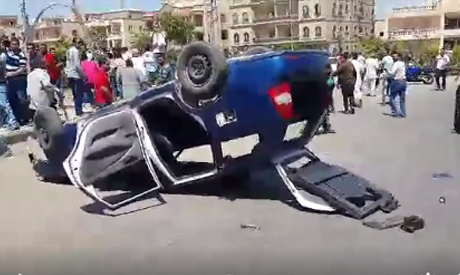
Photo on social media of an overturned police car following the shooting of three people by a policeman, killing one and injuring two others.(Ahram Online).
A low-ranking Egyptian policeman shot three people in Egypt's New Cairo on Tuesday following a quarrel, Al-Ahram Arabic news website reported, killing one man and injuring two others.
Pictures and videos circulating on social media, apparently taken from the scene in the Rehab neighbourhood, showed an overturned police van with shattered windows.
Pictures of the corpse of the unidentified man killed were also circulated by social media users.

The interior ministry was not available for comment on the incident.
In February, a low-ranking policeman killed a driver in the working-class Cairo district of El-Darb El-Ahmar, following a dispute over a fare. In April a court sentenced the policeman to life in prison, one of the harshest sentences issued to policemen convicted of similar violent crimes. The sentence can still be appealed.

World Bank: Palestine loses $ 285 million a year due to agreement with Israel

The Palestinian Authority is losing up to $285 million a year under its current economic arrangements with Israel, the World Bank said on Monday.
According to Ma’an News Agency, the global financial institution announced the finding a day before it presents its full report to the Ad Hoc Liaison committee, which decides on development assistance to the Palestinian territories, in Brussels. It found that the current revenue sharing arrangements as outlined by the Paris Protocol — through which Israel collects VAT, import taxes and other revenues on behalf of the PA — “have not been systematically implemented.”
The World Bank estimated that “tax leakages on bilateral trade with Israel and undervaluation of Palestinian imports from third countries” amounted to up to $285 million in revenues lost annually by the PA. It added that the amount could be higher, as it was unable to make estimates for Area C — the 61 percent of the occupied West Bank under full Israeli control — “due to data constraints.”

Sunday, April 17, 2016

Crisis continues in Baghdad

Moqtada al-Sadr during hiss ''sit in''. (Reuters)

Hundreds rallied in central Baghdad on Sunday in support of powerful Shi'ite Muslim cleric Moqtada al-Sadr who has threatened to call mass protests if the prime minister fails to name a new cabinet to fight corruption by Tuesday. People in Tahrir Square on Sunday said many more would join them if Prime Minister Haider al-Abadi did not select a government mainly made up of technical experts to tackle what they see as widespread graft and mismanagement.
"Yes, yes to Iraq; no, no to corruption," they chanted, carrying Iraqi flags.


Prime Minister Haider al-Abadi's presented on 31 March a list of new ministers in keeping with a deadline set by the legislature earlier in the week, which was underscored by a ''sit in'' in the Green Zone by Moqtada al-Sadr personally. The list was made up of independent professionals who he hoped could free their ministries from the grip of dominant political groups that have built their influence and wealth on a system of patronage put in place since the overthrow of Saddam Hussein in 2003.

Tuesday, April 12, 2016

Egyptians protest transfer of two islands to Saudiyya

Egypt's announcement during a five-day visit by King Salman that it would transfer two Red Sea islands to its Saudi ally has outraged Egyptians, who took to social media to criticize the move, which now faces a legal challenge.The Egyptian government said in a statement on Saturday that the two countries had signed maritime demarcation accords that put the islands of Tiran and Sanafir in Saudi waters, a process it said had taken six years.
Earlier, on Friday, after a meeting with Egyptian presidnt Abdel fattah al-Sisi, King Salman announced that a bridge connecting Egypt and Saudi Arabia would be built across the Red Sea. No details were given. Also Saudi Arabia is expected to sign a $20 billion deal to finance Egypt's oil needs for the next five years and a $1.5 billion deal to develop its Sinai region, two Egyptian government sources told Reuters.
 Saudi and Egyptian officials said about the the islands thatb they belong to the kingdom and were only under Egyptian control because Saudi Arabia's founder, Abdulaziz Al Saud, asked Egypt in 1950 to protect them.

Saturday, April 9, 2016

Italy recalls ambassador from Cairo, deepening row over murder of student

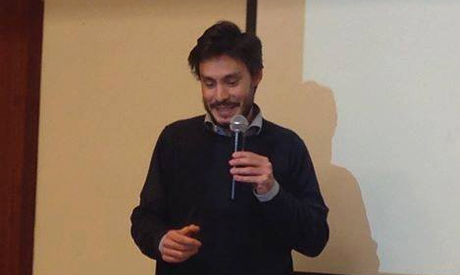
Guilio Regeni
Giulio Regeni. 

Italy recalled its ambassador to Egypt for consultations on Friday after Egyptian investigators in Rome failed to provide evidence needed to solve the mystery of the murder of an Italian student in Cairo. Ambassador Maurizio Massari was called to the capital for "an urgent evaluation" of what steps to take to "ascertain the truth about the barbaric murder of Giulio Regeni", the Foreign Ministry said in a statement.
Egyptian authorities met with Rome prosecutors on Thursday and Friday, handing over some, but not all, of the evidence Italy had requested. The prosecutors said in a statement Egyptian investigators had still not handed over such evidence as details from Cairo cell towers that had connected to Regeni's mobile phone. Regeni, 28, vanished from the streets of Cairo on Jan. 25. His body was discovered in a ditch on the outskirts of the Egyptian capital on Feb. 3, showing signs of extensive torture. Regeni's mother said last week that her son's body had been so disfigured that she had only been able to recognize him by the tip of his nose. Human rights groups have said the torture indicates he was killed by Egyptian security forces, an allegation Cairo has repeatedly denied.

Tuesday, April 5, 2016

Sons of Mubarak and other M-Eastern figures mentioned in ''Panama papers''

Alaa Mubarak and his brother Gamal.

Alaa Mubarak, the son of former President Hosni Mubarak, is among the global political figures whose financial dealings were exposed in the “Panama Papers,” a document leak said to be the largest in the history of journalism.
More than 11 million documents were leaked from Panamanian law firm Mossack Fonseca, which sells offshore companies to customers around the globe. The leaked documents show how the firm helped clients dodge taxes, launder money and evade sanctions. German newspaper Süddeutsche Zeitung, which originally received the documents, shared them with a team of journalists from around the world in cooperation with the International Consortium of Investigative Journalists (ICIJ).

Saturday, March 12, 2016

Israel kills 10-year and six year old in Gaza

A ten-year-old Palestinian was killed and his sister seriously injured in an Israeli airstrike launched early Saturday in the northern Gaza Strip after rockets were fired from the besieged enclave.
Spokesman for the Gaza Ministry of Health Ashraf al-Qidra confirmed the death of Yasin Suleiman Abu Khusah,10, and told Ma’an his six-year-old sister Israa had sustained serious head injuries during the strike. Israa later died.
A Ma’an reporter based in Gaza said the children were in their house at the time of the strike, located in northwestern Beit Lahiya, adding that the family was still living in their home that was partially destroyed during the most recent Israeli offensive on the strip in 2014. Israa was transferred to Shifa Medical Center in Gaza City from Indonesian Hospital in Beit Lahiya due to critical injuries, al-Qidra said.
The Israeli army said the Israeli air force targeted four Hamas sites in the northern Gaza Strip after four rockets were fired from the strip Friday evening.

Wednesday, March 9, 2016

Wednesday: three young Palestinians killed in two attacks, Israel wants to complete Wall in Jerusalem

 The car in which two Palestinians were shot. (Ma'an)

Israeli forces shot dead a 16-year-old Palestinian boy after he allegedly attempted to carry out a stabbing attack at a military checkpoint outside the blockaded village of al-Zawiya in Salfit district on Wednesday morning.
 The incident in al-Zawiya occurred shortly after the Israeli police shot dead two Palestinians outside Jerusalem's Old City after they opened fire in the area -- continuing a string of deadly encounters that shook Israel and the occupied Palestinian territories a day earlier.
Israeli police spokesperson Micky Rosenfeld said the two Palestinians initially opened fire on an Israeli bus in the settlement of Ramot in occupied East Jerusalem, before fleeing the scene without causing any injuries.The shooting sparked a massive manhunt across Jerusalem, with Israeli police later spotting the car outside the Old City's New Gate. Rosenfeld said that a gun battle erupted between Israeli police and the two Palestinians, with both gunmen shot dead. They were later identified as Abdul-Malak Saleh Abu Kharoub,19, and Muhammad Jamal al-Kalouti, 21. A Palestinian bystander was also shot in the head in the crossfire.

Tuesday, March 8, 2016

Tuesday: Four Palestinians, one US tourist dead, 12 wounded after four Palestinian attacks

Ambulances and police vehicles arrive at the scene of a shooting attack on Salah a-Din street in Jerusalem on Tuesday, March 8, 2016 (Magen David Adom)
Ambulances after the shooting in Jerusalem.

Four Palestinians were shot dead after they allegedly carried out separate attacks in Israel and occupied East Jerusalem, killing one tourist from the U.S. and wounding at least 12 others, on Tuesday morning, afternoon and evening.
In the first deadly encounter, shortly before 5 p.m., Israeli police spokesperson Luba al-Samri said a Palestinian man was shot dead after he allegedly stabbed and wounded an Israeli man near Petah Tikva, around seven miles east of Tel Aviv.Al-Samri said that an "Arab terrorist" stabbed a Jewish Israeli in his mid-30s "in the upper part of his body," leaving him with light to moderate injuries.Israeli police forces arrived on the scene and shot dead the Palestinian, she said, adding that Israeli forces closed the area for investigation.
Minutes later, another Palestinian was shot dead after allegedly firing gunshots at Israeli police forces near Salah al-Din Street in occupied East Jerusalem, injuring two Israeli officers.Israeli police spokesperson Micky Rosenfeld said two Israeli policemen were wounded when a Palestinian shot them with an automatic weapon.

Israeli Arab parliamentarians again under fire after they criticize GCC decision to label Hezbollah ''terrorist organization''

Israel Katz
Israeli members of parliament (the Knesset) renewed their cries that Arab representatives have to be removed after the parties Balad and Hadash, who are part of the Joint Arab List,  Monday criticized the decision of the Gulf Cooperation Council to label Hezbollah a terrorist organization. 
"Hezbollah fights against Israeli attacks on Lebanon, and this decision only serves the interests of Israel and the US," a Balad spokesperson said. 
The GCC officially decided to label Hezbollah as a terrorist organization last Wednesday. Balad officials explained that they view the decision by the interior ministers of the GCC as dangerous because they are fueling the Sunni-Shia conflict, and adding fuel to the fire of this bloody conflict. Furthermore, the Balad officials claimed, the decision serves to widen the sectarian divisions in Lebanon, Syria, and the wider Arab world.
They also said that "the party doesn't believe that it is correct to tag Hezbollah - an organization which represents a large part of the Lebanese nation - as a terrorist organization, despite criticism over its participation in the fighting in Syria."

Sunday, March 6, 2016

Sudanese leader Hassan al-Turabi 1932-2016

Turabi in 2012 (Reuters)
Prominent Sudanese politician Hassan al-Turabi, a veteran Islamist and leader of the opposition Popular Congress Party (PCP), has died at the age of 84, medical sources said on Saturday.
Turabi, one of the country's most influential political figures, formed the PCP in 1999 to challenge long-serving President Omar al-Bashir and his ruling National Congress Party, with which Turabi had previously been aligned.
He was rushed to hospital earlier on Saturday after suffering a heart attack, the sources said.
Turabi was elected speaker of parliament in 1996 and was close to Bashir before a bitter power struggle and split in 1999.

Saturday, March 5, 2016

The media keep saying that the West isn't involved in Syria. This is not true


By Ian Sinclair, Open democracy


“The sinister fact about literary censorship in England is that it is largely voluntary”, George Orwell noted in his censored preface to his 1945 book Animal Farm. “Unpopular ideas can be silenced, and inconvenient facts kept dark, without the need for any official ban”. Orwell went onto explain that “at any given moment there is an orthodoxy, a body of ideas which it is assumed that all right-thinking people will accept without question. It is not exactly forbidden to say this, that or the other, but it is ‘not done’ to say it”.
The corporate media’s ‘coverage’ of Syria adds a twist to Orwell’s dictum – inconvenient reports and facts do occasionally appear in respected newspapers and on popular news programmes but they are invariably ignored, decontextualised or not followed up on. Rather than informing the historical record, public opinion and government policy these snippets of essential information are effectively thrown down the memory hole.
Instead the public is fed a steady diet of simplistic, Western-friendly propaganda, a key strand of which is that the US has, as Channel 4 News’s Paul Mason blindly asserted in January 2016, “stood aloof from the Syrian conflict”. This deeply ingrained ignorance was taken to comical lengths when Mason’s Channel 4 News colleague Cathy Newman interviewed the former senior US State Department official Anne-Marie Slaughter, with both women agreeing the US had not armed the insurgency in Syria.
In the real world the US has been helping to arm the insurgency since 2012, with US officials telling the Washington Post in last year that the CIA’s $1bn programme had trained and equipped 10,000 rebel fighters. “From the moment the CIA operation was started, Saudi money supported it”, notes the New York Times. According to the former American Ambassador to Syria, the US "has looked the other way" while fighters it has backed have "coordinated in military operations" with the Al-Nusra Front, Al-Qaeda’s official affiliate in Syria. The UK, of course, has obediently followed its master into the gates of hell, with the former UK Ambassador to Syria recently explaining the UK has made things worse by fuelling the conflict in Syria.