Sunday, February 16, 2014

Egyptian textile workers on strike for seventh day

Mahalla strikers score victory
Workers of the Misr Spinning and Weaving Company in Mahalla el-Kubra, north of Cairo, on strike in 2007.


(Aswat Masriya) Thousands of workers from Egypt’s largest textile company continued their strike on Sunday, for the seventh day in a row, demanding better pay conditions and that an elected committee be formed to manage their affairs.
Textile production plays a significant role in Egypt’s economy, coming at 26.4% of the country’s GDP in 2007 – 2008, according to official statistics.
A number of workers gathered in front of the company’s headquarters on Saturday, chanting against the CEO and the chairman of the holding company whom they want removed.

Saturday, February 15, 2014

Lebanon finally got a new government


 File - Prime Minister designate Tammam Salam speaks during a press conference at the Presidential Palace in Baabda, Thursday, April 11, 2013. (The Daily Star/Dalati Nohra)


Tamam Salam (Photo Daily Star). 

Lebanon announced a new government on Saturday, breaking a 10-month political deadlock during which spillover violence from neighboring Syria worsened internal instability.
A caretaker government has run the country since former Prime Minister Najib Mikati resigned in March as parties aligned with the Shi'ite Hezbollah movement and a Sunni-led rival bloc pursued a power struggle exacerbated by their support for opposing sides in Syria's almost three-year-old civil war.
"A government in the national interest was formed in a spirit of inclusivity," new Prime Minister Tammam Salam declared on live television.
He said he hoped the new government would allow Lebanon to hold presidential elections before President Michel Suleiman's mandate expires in May and finally conduct parliamentary polls that were postponed last year due to the political impasse.
The March 8 and March 14 coalitions have each been allotted eight seats in the government with the remaining ministerial posts divided among Salam, President Michel Sleiman and Progressive Socialist Party leader MP Walid Jumblatt.

No results from Syria peace talks, Brahimi apologizes to Syrian people

U.N. Envoy Hopes for Syria  Peace Conference within Weeks
Brahimi

International mediator Lakhdar Brahimi apologized to the Syrian people on Saturday for the lack of progress at peace talks in Geneva after their second round ended with little more than an agreement to meet again,  Reuters reports The head of the International Committee of the Red Cross (ICRC) also stressed the meager results so far, saying the evacuation from the city of Homs did not herald any wider improvement in humanitarian access to Syria's civil war zones, where the United Nations says it cannot reach up to 3 million people in need.
"I am very very sorry and I apologize to the Syrian people that their hopes which were very very high here, that something will happen here," Brahimi told journalists after the talks.

Wednesday, February 12, 2014

HRW: Sudanese and Egyptian security officers collude in abuse of migrants

Egyptian and Sudanese security officers have colluded with traffickers accused of holding Eritrean migrants for ransom and torturing them, Human Rights Watch said Tuesday.
Victims accused the traffickers of raping both women and men, administering electric shocks and burning genitalia and other body parts with hot irons, boiling water and molten plastic, the New York-based rights group said. Migrants said they had been abused for weeks or even months, and several said they had witnessed captives die under torture.
The loosely governed desert region stretching from eastern Sudan up through Egypt to the Sinai Peninsula is a major trafficking route for African migrants seeking jobs. Thousands of Eritreans flee each year, with many heading for Israel.

Tuesday, February 11, 2014

Egyptian textile workers in Mahalla on strike

Textile workers
Mahalla workers on strike. The photo is from a previous strike. (Reuters)

Workers at Egypt's biggest public textile company, Weaving and Textile Company in Mahalla, went on strike on Monday as the government delayed the payment of the last installment of the yearly bonus. The workers are also demanding the implementation of a minimum wage of LE 1,200 as well as the dismissal of Fouad Abdel-Alim, the head of the Holding Company for Weaving and Spinning, which oversees all public sector textile firms.
More than 10,000 workers of the morning shift started the strike; 2,000 workers of the evening shift joined them. "We have been told that the bonus installment would be paid in two weeks, but there is no official statement," Kamal Al-Fayoumi, a worker who has become a well-known figure after playing a key role in strikes staged before Mubarak’s ouster, told Ahram Online.
Abdel-Alim told Ahram Online that a ministerial economic group will grant the workers the delayed installment and that an official decision would be announced soon. Al-Fayoumi said that the administration told them that the minimum wage would be applied to the company's workers once the National Council for Wage made a final decision. "We will make a final decision whether to go on striking or to end it Tuesday morning when more workers will be present," he said.

Saturday, February 8, 2014

Turkey deports journalist over tweets

Interior Ministry document shows Zeynalov deported over critical tweets
Mahir Zeynalov and wife. (Photo Today's Zaman)

A document released by the Interior Ministry on Tuesday proves that the decision to deport Mahir Zeynalov, a Today's Zaman journalist and blogger, was made over tweets Zeynalov posted. This contradicts another document issued by the ministry on Friday which says the journalist was ordered to leave as the result of the expiration of his residence permit.

The Interior Ministry document Today's Zaman obtained was dated Feb. 4 and states that the Prime Ministry's Coordination Center (BİMER) demanded the deportation or exclusion of Azerbaijani national Mahir Zeynalov for his “statements that are contrary to fact” and “against the state and government.”
The Interior Ministry found it appropriate to deport Zeynalov over his tweets, sent from the @MahirZeynalov_ account and targeting high-level state officials, the document states. Zeynalov was also included in the category of ‘'Foreign nationals whose entry into our country [Turkey] has been barred.”

Two Iran executed two peaceful Ahwazi activists

hashem-shabani-hadi-rashedi-300x236 
Hadi Rashedi (l) and the poet Hashem Shabani.

According to sources Iran Human Rights (IHR) has been in contact with the two Ahwazi Arab activists Hadi Rashedi and   Hashem Shabani have been executed. Iranian intelligence ministry offcials have informed the families of the prisoners that the executions were carried out on 25 January. However, Ahwazi activists believe that Hadi Rashedi and Hashem Shabani were executed immediately after their transfer from the Karoun prison of Ahwaz.
Hashem Shabani (32) and Hadi Rashedi (38) were sentenced to death for Moharebeh (“enmity against God”), Mufsid-fil-Arz (“corruption on earth”) and spreading propaganda against the system in July 2012 alongside three other political prisoners. All are founding members of Al-Hiwar, a cultural institute that promoted Arabic education, literature and cultural activities among deprived Ahwazi Arab youth.
Insisting on his innocence and demanding a retrial before an impartial court, Shabani has retracted the “confession” made following torture and has repeatedly repudiated violence.
In one of his letters from prison, made available to use through his family, Shaabani who was known as a poet, says he could not have remained silent against ‘hideous crimes against Ahvazis perpetrated by the Iranian authorities, particularly arbitrary and unjust executions.’ He adds “I have tried to defend the legitimate right that every people in this world should have which is the right to live freely with full civil rights. With all these miseries and tragedies, I have never used a weapon to fight these atrocious crimes except the pen.’”

Friday, February 7, 2014

HRW: Abuse of women is common in Iraq's justice system


Iraqi authorities are detaining thousands of Iraqi women illegally and subjecting many to torture and ill-treatment, including the threat of sexual abuse, according to a report by Human Rights Watch. Convictions arefrequently based upon coerced confessions, and trial proceedings fall far short of international standards. Many women were detained for months or even years without charge before seeing a judge.
The 105-page report, “‘No One Is Safe’: Abuses of Women in Iraq’s Criminal Justice System,”documents abuses of women in detention based on interviews with women and girls, medical service providers in the prisons, and is also based upon court documents and extensive information received in meetings with Iraqi authorities including Justice, Interior, Defense, and Human Rights ministry officials, and two deputy prime ministers.
Many of the 27 women who spoke with Human Rights Watch described being beaten, kicked, slapped, hung upside-down and beaten on their feet (falaqa), given electric shocks, and raped or threatened with sexual assault by security forces during their interrogation. They said security forces questioned them about their male relatives’ activities rather than crimes in which they themselves were implicated. Security forces forced them to sign statements, many with fingerprints, which they were not allowed to read and that they later repudiated in court, they said.

Thursday, February 6, 2014

Largest Dutch pensionfund ABP decides not to divest from Israeli banks

Bank Leumi branch | Oranit Settlement | May 2011 | Photographed by Who Profits
Branch office of Bank Leumi in the settlement Oranit. Bank Leumi has similar offices in settlements around Jerusalem and on the Golan and its daughter (for nearly 90%),  Leumi Mortgage Bank, which provides mortgages for houses in the settlements has a branch in the settlement Nofei Zufim  

The largest pension fund of the Netherlands, ABP (short for Algemeen Burgerlijk Pensioenfonds), announced Wednesday that it does not intend to divest from its investments in Israeli banks. In a press statement it said that it had concluded that they had not done anything contrary to international law or regulations.
ABP has investments in Israel's two largest banks, Bank Hapoalim and Bank Leumi, and Bank Mizrahi-Tefahot. The pension fund's announcement came several weeks after the second largest Dutch pension fund, PGGM, said it was divesting its holdings in Israel's five largest banks.

ABP's statement reads:

Israel destroyed 27 homes in Jordan Valley in January, Red Cross stops providing tents


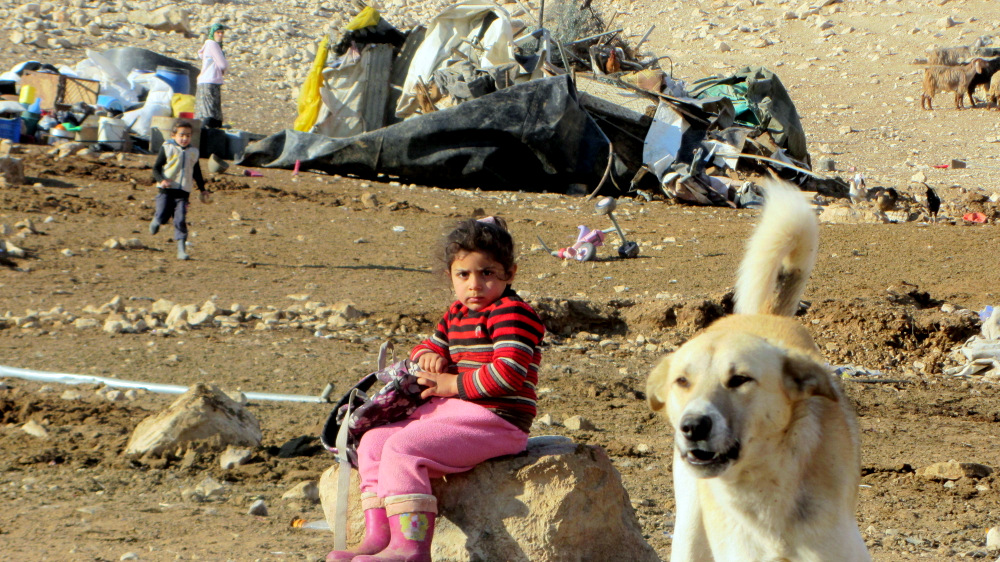
On 8 January 2014 Israeli forces destroyed the Bedouin community of  Khirbet ‘Ein Karzaliyah in the north of the Jordan Valley (Photo B'tselem)

Israeli forces destroyed 27 homes in the occupied Jordan Valley in January, according to Israeli rights group B'Tselem, leaving 147 people homeless. Nearly half of those displaced were children and 65 people lived in communities that had been demolished more than once by Israel, B'Tselem said.
On Wednesday, the International Committee of the Red Cross said it would stop providing tents to Palestinians whose homes had been demolished in the Jordan Valley because Israel would confiscate them.
Last week, the UN humanitarian coordinator for the Palestinian territories criticized Israel's demolition of Palestinian homes in the Jordan Valley.

Monday, February 3, 2014

More barrel bombs kill dozens in Aleppo after Geneva talks failed

Syrian forces kill 83 in barrel bomb attacks in Aleppo
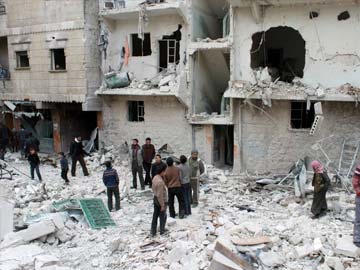
People inspect a building that has been destroyed by a barrel bomb on 2 February 2014. (AFP)

Syrian military helicopters dropped more improvised "barrel bombs" on the northern city of Aleppo on Sunday, a monitoring group said, bringing the death toll to at least 83 people in the latest episode of a campaign that many consider a war crime. Most of the victims killed since Friday have been civilians from the city's eastern districts, including women and children, according to the British-based Syrian Observatory for Human Rights, which has a broad network of sources across Syria.
The '' barrel bombs'' fell after a week-long first round of Syrian peace talks ended on Friday with no progress and the government delegation unable to say whether it will return for the next round in about a week. U.N. mediator Lakhdar Brahimi said the opposition delegation would be back on February 10, but President Bashar al-Assad's delegates had told him they would have to check with Damascus before agreeing to return.

Saturday, February 1, 2014

Aid agencies evacuate hundreds of people from Yarmouk camp in Damascus

Sick and elderly people are evacuated from the Yamouk camp. (Photo Wall Street Journal).

Aid agencies in Syria have evacuated hundreds of people from the rebel-held Damascus suburb of Yarmouk, a government-aligned Palestinian group said on Saturday, in a rare moment of coordination between the government and rebel forces.
Granting relief groups access to an estimated 250,000 people trapped by fighting across Syria was one of the goals of the peace talks held last week in Switzerland, which recessed on Friday with no substantial results.
Despite lengthy discussions, the sides could not agree on passage for an aid convoy to reach 2,500 people trapped in the old city of Homs, Syria's third-largest city, with no access to food or medicine.