Wednesday, October 30, 2013

Satirist Bassem Youssef: 'Egypt's liberals are as intolerant as the Islamists'

bassem-youssef-27032013
Bassem Youssef
Bassem Youssef, the Egyptian hart surgeon turned television presenter and satirist, said on Tuesday, in the weekly column he writes for the paper Al-Shorouk, that Egypt’s liberals are as intolerant as their Islamist opponents, and as unwilling to accept criticism of themselves or the country's interim-authorities. “Those who defend liberalism and secularism say they are opposed to religious fanaticism and endorse freedom of opinion. However, when it suits them, they use Quranic verses and Hadiths to justify attacks against their enemies, using the same accusations as religious movements,” Youssef wrote.

Sunday, October 27, 2013

Few Saudi women brave enough to defy the ban on driving, at least 16 fines

 
At least 16 Saudi women have received fines for taking the wheel on a day set by activists to defy the kingdom's traditional ban on female driving, police and reports said Sunday. Only few women braved official threats of punishment and drove on Saturday in response to an online campaign headlined "Women's driving is a choice."
"Police stopped six women driving in Riyadh, and fined them 300 riyals ($80) each," said the capital's police deputy spokesman, Colonel Fawaz al-Miman. Each of the women, along with her male guardian – who could be a father, husband, brother, uncle, or grandson – had to "sign a pledge to respect the kingdom's laws," Miman told AFP.
In Jeddah, police also fined two women for driving, according to the Red Sea city's police spokesman, Nawaf al-Bouq. Saudi newspapers, meanwhile, reported that six women were stopped by police in Eastern Province, and at least two others were stopped in other parts of the kingdom. A dozen Saudi women posted videos on the Twitter account of the campaign, @oct26driving, showing themselves driving.

Toll of seven days of fighting in Lebanese city of Tripoli rises to 16

Map showing locations of Bab al-Tabbana and Jabal Muhsin in Tripoli
The toll of seven days of fighting between supporters and opponents of Syrian President Bashar Assad in the northern Lebanese city of Tripoli rose on Sunday to at least 16 dead and over 80 wounded. Sniper fire over the weekend claimed the lives of five people. The dead hailed from Jabal Mohsen and Bab al-Tabbaneh, the two rival neighborhoods that have fought one another with increasing frequency since the uprising in neighboring Syria began.
The clashes in the city subsided overnight but sniper activity picked up in the morning on Syria Street, Al-Barranieyh and al-Baqqar neighborhoods and Jabal Mohsen.Gunfire also accompanied funeral processions for the victims of the recent violence.
The Army deployed heavily in the city in the morning hours as Refaat Eid, the head of the Jabal Mohsen-based Arab Democratic Party, urged his fighters to withdraw completely.
Army checkpoints were established along Syria Street, the line that divides the warring Jabal Mohsen and Bab al-Tabbaneh neighborhoods, where the bulk of the fighting takes place.
The streets of Tripoli remained empty Sunday and shops in the city were closed for business.
The latest round of clashes between the predominantly Sunni neighborhood of Bab al-Tabbaneh, which supports the uprising in Syria, and the mostly Alawite Jabal Mohsen, which backs the Damascus regime, broke out Monday after the appearance of Assad in a television interview in which he said the time is not ripe for a peace conference to try to resolve the 31-month conflict and also said he was ready to run for re-election in 2014. .

Saturday, October 26, 2013

Iran hangs 17 rebels accused of 'enmity against God'

The Iranian authorities on Saturday hanged 16 "rebels" following overnight clashes in which 14 border guards were killed on the frontier with Pakistan. "Sixteen rebels linked to groups hostile to the regime were hanged this morning in the prison of Zahedan in response to the death of border guards in Saravan," Mohammad Marzieh, the attorney general of Sistan-Baluchestan province, was quoted as saying by Fars news agency.
"We warned the rebel groups that any attack targeting civilians or members of the security forces would not go unanswered," he added.
The official IRNA news agency, quoting what it called an informed source, said the clashes in which the border guards were killed occurred in a mountainous region used by both drug traffickers and armed rebels.
Deputy Interior Minister Ali Abdollahi said that the guards had been killed during the ambush set by Iranians who were "members of hostile groups". He added that "three soldiers have been taken hostage and taken to the other side of the border in Pakistan".According to several news websites run by the Iranian authorities 16 prisoners convicted of Moharebeh (enmity against God) and "terrorism". According to "Afkarnews" another state run news website, the prisoners were members of "Jeish Al-Adl". They are beleived to belong to be Sunni Muslims of Baluchi ethnicity. None of the prisoners were identified by name.
There are also unofficial reports regarding execution of the Kurdish political prisoner "Habibollah Golparipour".

Tunisian ruling party and opposition start talks to solve political crisis

Tunisia
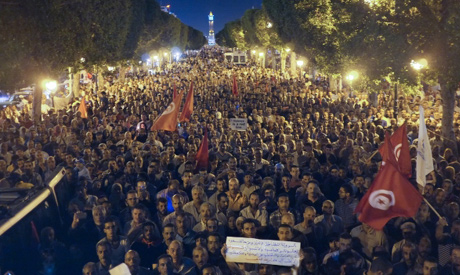
Demonstration in Tunis on 24 October after the murder of seven Tunisian policemen by islamists. (AP)

Negotiations between the Tunisian governing coalition, the opposition, and civil society mediators aiming to solve the political crisis that has crippled Tunisia the past three months began Friday. The negotiations aim at organziing new elections, the formation of a new government consistying of technocrats, and a finished constitution.
Durting their first meeting the representatives agreed on the formation of three committees, each of which will address a key aspect of the roadmap plan,according to Moncef Cheikhrouhou, an NCA member in the Democratic Alliance party. One will handle preparations for elections, another finishing the draft constitution, and a third the formation of a new government.
The talks sarted after Prime Minister Ali Laarayedh of the ruling Ennahda party pledged to resign within the three-week deadline defined in a political roadmap advanced by major civil society groups.
The talks are intended to resolve Tunisia’s political deadlock, which began when opposition politician Mohamed Brahmi was assassinated on July 25. After his death, roughly 60 opposition National Constituent Assembly (NCA) members withdrew from the assembly-halting it’s work. The NCA is set to resume its work, according to press attache Mofdi Mssadi, with withdrawn members returning on Saturday.

Wednesday, October 23, 2013

Amnesty and HRW: US drone attacks are unlawful and kill many innocent civilians

<p>The remnants of a US drone strike on August 29, 2012 in Khashamir, Yemen. The strike killed three alleged members of Al-Qaeda in the Arabian Peninsula, a policeman, and a cleric who preached against the armed group.</p>
The remnants of a US drone strike on August 29, 2012 in Khashamir, Yemen. The strike killed three alleged members of Al-Qaeda in the Arabian Peninsula, a policeman, and a cleric who preached against the armed group.(Reuters)

The two human rights organizations Amnesty International and Human Rights Watch both have issued reports about America's war with drones at tha same day. The reports were on Tuesday at a joint press conference. Amnesty International reviewed all 45 known drone strikes that took place in North Waziristan in northwestern Pakistan between January 2012 and August 2013. The region that has seen more strikes than any other part of the country. Human Right Watch's  report is about the American strikes in Yemen. Both reports concluded, not unexpectedly, that the strikes, apart from alleged activists or terrorists,  killed many innocent civilians.
Amnesty did detailed field research into nine strikes and documented killings, which raise serious questions about violations of international law. In October 2012, 68-year-old grandmother Mamana Bibi was killed in a double strike, apparently by a Hellfire missile, as she picked vegetables in the family’s fields while surrounded by a handful of her grandchildren. In July 2012, 18 laborers, including a 14-year-old boy, were killed in multiple strikes on a impoverished village close to the border with Afghanistan as they were about to enjoy an evening meal at the end of a long day of work. Amnesty International also documented cases of so-called “rescuer attacks” in which those who ran to the aid of the victims of an initial drone strike were themselves targeted in a rapid follow-on attack. While there may have been a presumption that the rescuers were members of the group being targeted, it is difficult to see how such distinctions could be made in the immediate and chaotic aftermath of a missile strike.

Human Rights Watch investigated six strikes which killed 82 people, at least 57 of them civilians. HRW interviewed during six weeks in Yemen in 2012-2013, more than 90 people about the strikes including witnesses, relatives of those killed, lawyers, human rights defenders, and government officials. Human Rights Watch reviewed evidence including ordnance and videos from attack sites. Security concerns prevented visits to four of the attack areas.

Saturday, October 19, 2013

Tunesian security forces kill 10 islamists

Tunisian security forces have killed 10 Islamist militants near the border with Algeria during a three-day operation against gunmen who attacked police patrols in the remote northern region, the government said on Saturday.
Prime Minister Ali Larayedh said the militants belonged to Ansar al-Sharia, the most radical Islamist group to emerge in the North African country since the 2011 uprising ousted its autocratic leader and sparked revolts across the region.
Two police officers died in clashes with a group of gunmen on Thursday and security forces killed a total of 10 militants in raids after that near the northeastern city of northeastern city of Goubellat.

Saudi Arabia rejects seat on Security Council

Saudi Arabia slammed the UN Security Council for “double standards” yesterday as it turned down its election to the 15-member panel as a rotating member. Citing a lack of progress on Palestinian statehood, regional arms control, and the Syrian conflict, the foreign ministry said that it would not join “until the council is reformed and enabled, effectively and practically, to carry out its duties and responsibilities in maintaining international peace and security”.
“The Kingdom of Saudi Arabia believes that the manner, the mechanisms of action and double standards existing in the Security Council prevent it from performing its duties and assuming its responsibilities towards preserving international peace”, the statement said.
Saudi Arabia has repeatedly expressed frustration with the Security Council in recent months over its inability to bring a halt to the civil war in Syria and what Riyadh argues is its overly narrow focus on eliminating the country’s chemical weapons.
Saudi Arabia’s rejection of the Security Council seat is thought to be the first time a nation has ever turned down the position. This was the kingdom’s first election to the council and countries often spend months or years campaigning for one of the 10 rotating two-year seats on the council. The 15-member council also includes the five permanent members with veto power — the US, Russia, China, Britain and France. The non-permanent Security Council seats offer countries access to top international diplomats as well as local prestige, since they are allotted on a regional basis.
The Saudi ambassador to the UN had initially welcomed the vote, calling it “a reflection of a long-standing [Saudi] policy in support of moderation and in support of resolving disputes in peaceful means”. “We look forward to working with the rest of the international community to help our Syrian brothers achieve their objectives,” Abdullah Al Mouallimi said after the vote on Thursday.

Wednesday, October 16, 2013

Half a million deaths in Iraq between 2003 and 2011 related to war

Nearly half a million people have died from war-related causes in Iraq since the US-led invasion in 2003, according to an academic study published in the United States on Tuesday.
That toll is far higher than the nearly 115,000 violent civilian deaths reported by the British-based group Iraq Body Count, which bases its tally on media reports, hospital and morgue records, and official and non-governmental accounts.
The latest estimate by university researchers in the United States, Canada and Baghdad in cooperation with the Iraqi Ministry of Health covers not only violent deaths but other avoidable deaths linked to the invasion, insurgencies and subsequent social breakdown.
It also differs from some previous counts by spanning a longer period of time and by using randomized surveys of households across Iraq to project a nationwide death toll from 2003 to mid 2011.
Violence caused most of the deaths, but about a third were indirectly linked to the war, and these deaths have been left out of previous counts, said lead author Amy Hagopian, a public health researcher at the University of Washington.
Those included situations when a pregnant woman encountered difficult labor but could not leave the house due to fighting, or when a person drank contaminated water, or when a patient could not get treated at a hospital because staff was overwhelmed with war casualties.
"These are all indirect deaths, and they are significant," Hagopian told AFP.
The aim of the study was to provide a truer picture of the suffering caused by war, and hopefully to make governments think twice about the harm that would come from an invasion, she said.
"I think it is important that people understand the consequences of launching wars on public health, on how people live. This country is forever changed."
The research team from the University of Washington, Johns Hopkins University, Simon Fraser University and Mustansiriya University conducted the work on a volunteer basis using pooled internal resources instead of seeking outside funds.
Their tally was compiled by asking adults living in 2,000 randomly selected households in 100 geographic clusters across Iraq if family members had died, when and why.
Researchers used the survey data, which was completed by 1,960 of those chosen, to calculate the death rate before the war and after. When multiplied by the whole population, they returned a number that represented "excess deaths."
Researchers estimated there were 405,000 excess Iraqi deaths attributable to the war through mid-2011.
They also attempted to account for deaths missed because families had fled the country, and estimated 55,805 total deaths, bringing the total to nearly 461,000.
About 70 percent of Iraq deaths from 2003-2011 were violent in nature, with most caused by gunshots, followed by car bombs and other explosions, said the study.
Coalition forces were blamed for 35 percent of violent deaths; militias were blamed for 32 percent. The rest were either unknown (21 percent), criminals (11 percent) or Iraqi forces (one percent).
Heart conditions were the most common cause of non-violent death from 2003-2011 – indicating a key role of stress in war-related deaths – followed by chronic illness and cancer.
In a perspective article accompanying the PLoS Medicine study, Salman Rawaf, director of the World Health Organization Collaborating Center at Imperial College London, said the latest research would likely be called into question, as have other estimates before it, with most "perceived as being politically motivated, deliberately either over-reporting or suppressing the number of deaths."
"This estimate carries substantial uncertainty, and undoubtedly the methodology and findings of this latest study will be controversial and debated," he wrote.
However, the attempt to quantify the catastrophe created by war is "valuable" in the context of understanding the health consequences of war, he said.
"Living in Iraq today is no longer about how many have died, but how future deaths should be prevented."
(AFP)

Monday, October 14, 2013

Eid al-Adha said

This evening marks the beginning of Eidh al-Adha. I wish my muslim readers a very happy eid.
Indian muslims pray at the Jama majdid in New Delhi on Eid al Adha 2012.

'The real force behind the Egyptian ''revolution of the state'''


In March 2011 protesters stormed the headquarters of the dreaded State Security Service (Amn al-dawla) in Cairo. Here activists in the archives room that contained files on individual Egyptians. Right now the Amn al-Dawla is back in business again. (Photo Hossam al-Hamalawy).  

Reuters press agency published a remarkable story about 'how the Egyptian police and forces at the ministry of the Interior colluded with the army in order to depose the Muslim Brotherhood president Mohammed Morsi:
 Weeks after Mubarak was overthrown, the Interior Ministry called a meeting at the police academy in Cairo. The gathering, headed by the interior minister and senior security officials, was the first in a series that discussed how to handle the Brotherhood, according to two policemen who attended some of the gatherings. Thousands of mid- and lower-ranking officers were angry and said they could not serve under a president they regarded as a terrorist. Senior officers tried to calm them, arguing that the men needed to wait for the right moment to move against Mursi. "We tried to reassure them but the message did not get through," said a senior police official. "They just fumed silently." The senior state security officer told Reuters there were no explicit orders to disobey Mursi but that a large number of officers decided they would not be "tools" for the Brotherhood.
The story in its entirety gives examples about how the security services were actively involved in getting rid of Morsi. It is to be found here.

Egyptian prosecutor orders arrest of 14 people for 'practising homosexuality'

Mada Masr:
An Egyptian prosecutor has ordered the detention of 14 people for four days pending investigation for “practicing homosexuality,” state-owned Al-Ahram daily reported Sunday.The detainees were arrested at a medical center in Marg, a neighborhood in north-east Cairo. The prosecutor also ordered the closure of the center.
Security forces raided the center after being informed that its patrons, whose ages range between 18 and 57, are involved in “indecent acts.”Narcotics and sexual stimulants were found in the center and confiscated, Al-Ahram said.
Although homosexuality is not officially a criminal offense in Egypt, crackdowns on LGBT people have been carried out under the pretext of various moral laws such as "violating the teachings of religion" and “moral depravity.”
On May 11 2001, 52 men were arrested on a boat on the Nile, the Queen Boat, in a crackdown on the gay community, causing an international outcry.