بصمات أصابع
-
حبيبتي
رُغم أننا في نفس القارب
نهاياتُ القصصِ أخذتْ تختلف
أسبقُكِ ربما
أو نُواصلُ معا
طرقٌ يتحسّسُ الجسدُ فيه
المزيدَ من الجسد
قصدتُ الأرميني العجوز في م...
Légendes et barricades
-
On peut vivre sans connaître Marius Jacob, mais franchement, on vit moins
bien. Cet homme-là fut étonnant. Tenant de la théorie anarchiste de la
« repris...
Will US global hegemony last for another century?
-
My weekly article for Al-Akhbar: "Will US global hegemony last for anther
century"?
(A critical review of Michael Beckley's new book from Cornell Universi...
Iran: Bibi Plays Trump Like a Fiddle
-
The midterm elections have shown that Trump has no sense of being a
traditional politician. He doesn’t go
The post Iran: Bibi Plays Trump Like a Fiddle a...
This blogname was derived from a satiric Arabic novel by the Palestinian Israeli Emile Habiby. In the ''The Secret Life of Saeed The Pessoptimist'' he uses absurdism as a weapon against the (ir)realities of daily life in Palestine/Israel. I consider it to be an example for how events in Israel/Palestine best can be approached.
The subtitle is from a book by Dutch author Renate Rubinstein. In a way that is also still my motto.
My real name is Martin (Maarten Jan) Hijmans. I've been covering the ME since 1977 and have been a correspondent in Cairo. In 2018, I concluded the study 'Arabic language and culture' at the University of Amsterdam.
I started 'Abu Pessoptimist' in January 2009 out of anger about the onslaught of that month in Gaza. The other blog, The Pessoptimist, is meant to be a sister version in English. (En voor de Nederlandstaligen: ik wilde in november 2009 een tweede blog in het Engels beginnen en ontdekte te laat dat als je één account hebt, een profiel dan meteen ook voor allebei de blogs geldt. Vandaar dat het nu ineens in het Engels is... So sorry.)
After Brazil's decision to recognize a Palestinian state within the 1967 borders, the President of Argentina, Cristina Fernandez de Kirchner, confirmed on Sunday, that she would also recognize an independent Palestine with the same parameters.
Kirchner made the announcemeent in a phone call to Palestinian President Mahmoud Abbas in which she added that her recognition was not just a political gesture, but a moral stand.
Brazil announced its official recognition of a Palestinian state on December 3, responding to a request sent by Abbas on November 24, through a letter from the Brazilian President Luiz Inácio Lula da Silva to Abbas. Isarel has said it deplored the deciiosns of both countries. More than 100 countries have already recognized an independent Palestine within its '67 borders, including all Arab countries, most African nations and part of the new Asian economic powers, such as China and India.
Update: Uruguay announced soon afterward that it would recognize a Palestinian state next year. “Uruguay will surely follow the same path as Argentina in 2011,” Deputy Foreign Minister Roberto Conde told AFP.
Sharek partcipated yearly in summer camps for youth in Gaza with UNRWA, like here in the summer of this year. These camps were attacked by unknown thugs and destroyed.
GAZA CITY (Ma'an) -- Palestinian police detained at least 13 young people who were protesting Hamas authorities' closure of the Sharek Youth Forum, a large independent NGO in Gaza Sunday.
Police spokesman Ayman Al-Batniji said 13 young men were taken into custody for holding a demonstration without a permit from the Ministry of Interior. He said the male detainees would be freed by sundown without being charged with a crime, while an unspecified number of female demonstrators had already been released.
The Gaza government shut down Sharek last Tuesday citing an ongoing criminal investigation into the group's activities and members. Sharek officials say the shutdown is a nakedly political attempt to crack down a liberal-minded institution.
One of the protesters, Ebaa Rezeq, told Ma'an that between 30 and 60 youths arrived outside the organization's offices around noon on Sunday holding signs. She said plainclothes government officers were waiting for the demonstrators, and ordered the group to speak with officials in the attorney general's office before holding the demonstration.
As the demonstrators walked from Sharek's office toward the attorney general's office, Rezeq said, police in jeeps arrived, ordering the group to disperse, then arresting several people.
"They were shouting at us 'we will beat you up and arrest you if you don't go home,'" she said. She said police also "hit and attacked" one female demonstrator.
After being dispersed by the police, Rezeq said the remaining protesters gathered outside the French Cultural Center, where again police arrived, arresting several more youths.
Rezeq estimated the total number of people arrested at more than 20, while another observer at the protest put the number at between 15 and 20.
Rezeq added that the demonstration was not backed by any political party and was intended only as an expression of solidarity with the Sharek Youth Forum. "We are the kind of people who believe that these kind of actions are wrong, including closing Sharek," she said.
'Democracy' agenda
The Sharek organization, which focuses on empowerment and capacity building among Palestinian youth in the West Bank and Gaza, has denounced the closure of its Gaza branch as an assault on an independent organization. Sharek co-founder Sufian Mshasha told the Ramallah-based website Palestine Monitor that the closure was "prompted by our agenda of democracy, social development, and our insistence on holding activities for both genders."
The organization said its Gaza manager, Muheib Shaath has been summoned 15 times for interrogation by Hamas-allied police. Mshasha said the vast majority of the questioning focused on mixed-gender activities.
A summer camp run by Sharek in partnership with the United Nations Relief and Works Agency (UNRWA) was attacked in May.
Mshasha also said: "Our director is an observant Muslim, our IT technician wears a burqa. Almost all the women wear traditional Islamic dress and all our volunteers are from Gaza."
In a statement on its website, Sharek also disputed the legal basis for the closure, citing the Palestinian Charitable Societies and Nongovernmental Organizations Law of 2000, which says the closure of an organization must be based on a court ruling.
President Peres receives the report from the hands of IDI-director Carmon.
The Israel Democracy Institute yearly takes a poll among the Israeli public in which it measures the democratic character of Israel and its institutions according to international standards. A few days ago, on 5 November the results of the 2010 survey were published and made public during a conference in Tel Aviv.
A did hot have time to pay attention to it earlier. But some of the findings are nevertheless interesting enough, if not outright alarming. For that reason I devote as yet a few lines to the report. Particularly the attitude towards the Arab minority is what deserves attention. Here it goes:
' - Of the Jewish public, 86% believe that critical decisions for the state should be taken by a Jewish majority.
- Almost two thirds (62%) of the Jewish sample feel that as long as Israel is in a state of conflict with the Palestinians, the views of Arab citizens of Israel on foreign affairs and security issues should not be taken into account.
- A total of 53% maintain that the state is entitled to encourage Arabs to emigrate from Israel.
- Roughly two thirds (67%) of Jewish Israelis feel that first-degree relatives of Arabs should not be allowed entry into Israel under the rubric of family unification.
- As for equality in the allocation of resources, a majority of respondents (55%) think that greater resources should be allocated to Jewish communities than to Arab ones, a minority (42%) disagrees. Nevertheless 51% of the general public say they support full equality of rights between Jews and Arabs.'
The rest of the report is probably less alarming, athough some of other the findings are remarkable as well:
's for the democratic character of the state: there is broad support for the assertion that Israel must remain a democratic state, but the Israeli public tends to characterize the country’s democracy as weak and ineffective. The preferred solution is a more centralized government. The bulk of the survey’s respondents (60%) ascribe advantages to an authoritarian government and a strong leadership, which, as they see it, solve problems efficiently.'
The institute adds the remark that 'since the Democracy Index was first published in 2003, significant gaps have been observed between the opinions of long-time Israelis and those of immigrants from the Former Soviet Union (hereafter: FSU immigrants). It seems, ' it says, 'that the latter are among the less liberal Israeli groups with regard to such issues as majority-minority relations and gender equality.'
As far as the concept of Israel as a Jewish and democratic state is concerned:
'Among the Israeli public as a whole, the highest percentage—43%—consider both parts of this definition (“Jewish” and “democratic”) to be equally important; 31% classify the Jewish component as more important; and only 20% ascribe greater importance to the democratic component. Among Arab citizens of Israel, the democratic element takes precedence (38%).'
Remarkable is also the lack of trust of the general public in the state institutions:
'Only slightly more than half the general Israeli public—54%—state that they trust the Supreme Court fully or to some extent, as opposed to 44% who state openly that they do not trust it. Only 41% of the respondents express full or partial trust in the police.'
Iran says it has delivered its first domestically produced raw uranium, or yellowcake, to a plant that can make it ready for enrichment. That has been announced by Iran's nuclear chief Ali Akbar Salehi (picture) in a statement on tv, one day before talks between Iran and world powers over its nuclear programme.
"The West had counted on the possibility of us being in trouble over raw material but today we had the first batch of yellowcake from Gachin mine sent to Isfahan (conversion) facility," Mr Salehi said on state television.
Iran was believed to be running out of stock of yellowcake, which it imported from Sout Africa in the 1970 -ties.
The claim comes ahead of talks in Geneva on Monday between Iran and the five permanent members of the UN Security Council - the US, Russia, China, France and Britain - and Germany.
US Secretary of State Hillary Clinton has urged Iran to enter the talks in good faith and with "a much more sober assessment of what isolation means", given successive rounds of UN sanctions.
The sanctions have been levelled at Iran's failure to comply with UN Security Council resolutions ordering it to stop uranium enrichment.
The Security Council has said that until Iran's peaceful intentions can be fully established, it should stop enrichment and other nuclear activities. Iran says that as a signatory of the Nuclear Non-Proliferation Treaty, it has the right to enrich uranium for fuel for civil nuclear purposes.
Enriched uranium can be used for fuel in reactors. If enriched to a higher degree it can be made into nuclear bombs.
Brazil has recognized a Palestinian state within the borders of 1967, including East-Jeruzalem. Brazilian President Luiz Inacio Lula da Silva announced the decision Friday in a letter addressed to Palestinian leader Mahmud Abbas and published on the website of Brazil's foreign ministry. The Brazilian Foreign Ministry said the recognition is in response to a request made by Palestinian President Mahmoud Abbas last month to President Luiz Inacio Lula da Silva.
Lula said in his letter to Abbas that he hopes that the recognition will help lead the states of Israel and Palestine to "coexist peacefully and in security." The international community backs Palestinian demands for a state in most of the Gaza Strip, the West Bank and east Jerusalem, all territories occupied by Israel in the 1967 Six Day War. But the United States and most Western governments have held back from recognizing a Palestinian state, saying it should be brought about through a negotiated peace agreement with Israel.
Brazil's recognition could play a role when the PA would announce the birth of a state unilaterally. But the move was sharply criticized by members of the US Congres. Representative Ileana Ros-Lehtinen, the top Republican on the House Foreign Affairs Committee.called it "regrettable'' and said the decision ''will only serve to undermine peace and security in the Middle East." Ros-Lehtinen, set to chair the panel come January, said "responsible nations" would wait to take such a step until Palestinians return to direct talks with Israel and recognize its "right to exist as a Jewish state."
Brazil's decision also drew fire from Democratic Representative Eliot Engel, who said it "is severely misguided and represents a last gasp by a Lula-led foreign policy which was already substantially off track."
Engel tied the move to Lula's "coddling" of Iranian President Mahmoud Ahmadinejad and warned that Brazil "wants to establish itself as a voice in the world, but is making the wrong choices as it tries to do so."
"One can only hope that the new leadership coming into Brazil will change course and understand that this is not the way to gain favor as an emerging power or to become a permanent member of the United Nations Security Council."
Lula will be stepping down in four weeks' time and handing power over to Dilma Roussef, his protegee and former cabinet chief.
The Muslim Brotherhood and the secular Wafd-party withdrew on Wednesday from Egypt's election after the ruling National Democratic Party got almost all seats that were decided in a first round, which was marred by fraud and violence. A third party, the leftist Tagammu, is expected to follow suit, which will reduce the second round of the elections , next Sunday, to an exclusive NDP-circus.
The Muslim Brotherhood, which was the main opposition party in the outgoing parliament with 88 seats (20 % of the total) will boycott the second stage of parliamentary voting, a Brotherhood source said on Wednesday. Mohamed Badie, the movement's leader, is expected to confirm that the party is formally quitting the vote, which as many believe was massively fixed by President Hosni Mubarak's National Democratic Party (NDP) using thugs, ballot box stuffing and other tricks.
The NDP got captured nearly all seats in parliament in the first round of the disputed elections, according to official results. The National Democratic Party won 209 of 221 seats in Sunday's polls, but the Muslim Brotherhood, the country's largest opposition group, failed to win a single seat.
The Egyptian parliamnet has a total of 508 seats.The Muslim Brotherhood is outlawed in Egypt under a ban on religious parties and fields candidates as independents Analysts said the government wants to push the Brotherhood to the margins of formal politics before next year's presidential race.
Egypt's electoral commission dismissed the Brotherhood's claim that the vote was "rigged and invalid". "While the commission regrets that certain irregularities took place, it is satisfied with the fact that these irregularities did not impact on the transparency of the first round of the election."
The White House and the US state department have criticised the way the poll was conducted. "We are disappointed by reports in the pre-election period of disruption of campaign activities of opposition candidates and arrests of their supporters, as well as denial of access to the media for some opposition voices," Philip Crowley, the state department spokesman, said on Monday.
"We are also dismayed by reports of election-day interference and intimidation by security forces."
The Egyptian foreign ministry spokesman on Wednesday dismissed the criticism from the US as "unacceptable interference in Egypt's internal affairs".
Amnesty International said there had been eight election-related deaths and scores of injuries, mostly during clashes between rival parties.
An Iranian nuclear scientist has been killed on Monday and another wounded in two separate attacks in Tehran. Both men were targeted by men on motorbikes who attached bombs to the windows of their cars as they drove to work.
Both worked at the nuclear engineering department of Shahid Beheshti University in Tehran. The killed scientist, was named Majid Shahriari. His wife was injured. The scientist injured in the second attack was named as Fereydoon Abbasi. His wife was also wounded. According to the conservative news website Mashregh News, Dr Abbasi is "one of the few specialists who can separate isotopes" - a process that is crucial in the manufacture of uranium fuel for nuclear power stations and is also required for the creation of uranium-based nuclear weapons. Abbasi has also been a member of the Revolutionary Guards since the 1979 revolution, the website said.
Cartoon from Haaretz. The caption says: Meanwhile in Tehran.
At a news conference, President Ahmadinejad accused Western powers and Israel of being behind the murder. "One can undoubtedly see the hands of Israel and Western governments in the assassination which unfortunately took place," he said, without specifying which Western governments. He said the assassination would not stop Iran from pursuing its nuclear programmes.
Earlier, state television reported a similar claim by Iran's Interior Minister, Mostafa Mohammad Najjar, who accused US and Israeli intelligence services of killing the scientist."Mossad and the CIA are the enemies of Iranians and always seek to hurt this nation. They particularly want to stop our scientific progress," he said. The head of Iran's Atomic Energy Organisation, Ali Akbar Salehi, who went to visit the surviving scientist in hospital, said he had a message for the country's enemies: "Do not play with fire".
Early results of Egypt's Sunday parliamentary elections on Monday showed a landslide victory for the ruling National Democratic Party (NDP) and only 9 seats for the (liberal) Wafd, 7 for the Muslim Brotherhood, 1 for the lftist Tagammu and 1 for the Social Justice Party. This was in line with the predictions by experts, that the opposition would only win a handful of seats in the Egypt’s 508-seat parliament. The elections were characterized by widespread vote rigging, representatives of parties that in many places were barred from entering the polling stations, and violence. Definite results are not expected before Tuesday evening.
The Moslem Brotherhood, which held 20 percent of the seats in the outgoing legislature (88 seats) was aiming to win 30 percent of the seats in the upcoming chamber, despite having been subjected to a fierce government crackdown on candidates and their supporters since the group officially announced its participation in the 2010 PA elections. It seems, however, that the MB, whose candidates run as independnets, will win much less than that.
“Violence and thuggery are the most striking features of this year’s elections,” said Tarek Zaghloul, spokesperson for the Egyptian Coalition for Monitoring Elections. At midday, Hussein Salama Zeri, a 30-year-old campaigner for an NDP candidate in North Sinai was shot in the head during clashes with supporters of a rival NDP candidate. Earlier in the day, another death was reported in the low-income Matariya district in northern Cairo. The son of Sayyed Abu Amr, an independent candidate for the Matariya/Ain Shams workers’ seat, was stabbed last night while hanging up leaflets in support of his father’s campaign. He later succumbed to his injuries.
Human rights groups reported Sunday the deaths of eight people during the People's Assembly (PA) elections, as well as 45 clashes and 180 total arrests by security forces. The government lateron conced the death of five people. According to the Nadim Center for the Rehabilitation of Victims of Violence, the eight deaths occurred in Omraneya (Giza), Al-Raml (Alexandria), Farkous, Wadi Notroun, Menouf, and Al-Arish over stabbings and health emergencies.Clashes were reported in Suez, Hamoul, Beni Suef, Sohag, Abdeen, and involved the use of knives between thugs and candidates’ supporters, while Qena saw gun shootouts occur between supporters of rival candidates. In Al-Raml in Alexandria independent, Moslem Brotherhood affiliated candidate Subhi Saleh was nearly strangled by a mob of supporter of the NDP-candidate Abdelsalam Al-Mahgoub, Human Right Watch reported. HRW also reported that scores of supporters of opposition candidates were wounded in fights with government supporters. The violence was less severe, however, than the elections of 2005, when there were 14 deaths on election day.
Port Said witnessed 100 arrests, the largest number out of all of Egypt's constituencies. An overwhelming majority of those detained were allegedly supporters of Muslim Brotherhood-affiliated independent candidate Akram Al-Shaer.
Voting officially kicked off on Sunday at 7 AM with nearly 5000 candidates competing over 508 parliamentary seats in 254 electoral districts. In a number of Cairo districts, polling stations opened at least 45 minutes late, while many others were closed periodically during the day for unknown reasons. The polling station at Dokki’s Hoda Shaarawy School, in particular, was forcibly closed.
Official voter turnout figures will be made available on Tuesday, but election monitors suggest that only 10 percent of Egypt’s 41 million registered voters actually cast ballots today. “We estimate that the national voter turnout rate won’t exceed 10 percent at most,” said Fawzy.
In 2005, 25 percent of registered Egyptian voters participated in parliamentary elections. Al-Masry Al-Youm reporters in Cairo, Qena, Alexandria, Gharbiya and Northern Sinai confirmed that voter turnout had been “modest.”
Moharam’s polling station was only one of several voting spots to be closed to voters during the day and surrounded by thugs.A similar scenario occurred at Al-Haram district, where Muslim Brotherhood campaigners alleged that NDP-backed thugs had been brought to a local polling station to prevent opposition voters from casting ballots.
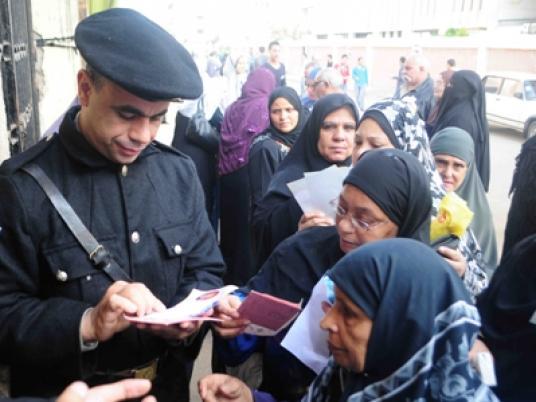
Speaking from behind her niqab, brotherhood campaigner Hanan Mohamed said that female thugs had briefly prevented women from entering the polling station. “When we began yelling, and the press began to arrive, they allowed us entry,” said Mohamed.
“But when we went in, we found wooden boxes instead of transparent glass ones,” she added. “We could hardly slide our ballots in because the boxes were already full to bursting.” Zaghloul, for his part, claimed that vote rigging had been reported nationwide. “Ballot stuffing is happening in all provinces,” he said.
The state-run High Elections Commission invalided a number of “compromised” ballot boxes in the Beheira governorate after they had been destroyed by candidate supporters who attacked at least three polling stations in the Nile Delta. In a separate incident, ballots were stolen from seven polling stations in the Kom al-Baraka district in the same governorate. Police arrested 43 of the alleged perpetrators.
Al-Jazeera English made the following compilation:
The elections for the Egyptian parliament are in progres this Sunday. How they proceed is described in this tweet by human rights activist Ramy Raoof and others:
few hours after opening poll stations in #EgyElections: at least 150 cases of Arrest/Detention, 2 dead and at least 6 sites blocked. #Egypt
falsification of voting cards in poll station number 27 in Domiat governorate
Egypt election: Sobhi Salah, a Muslim Brotherhood candidate just survived an assassination attempt.
Moreover The Daily News Egypt reported that the Administrative Court, two days ago, cancelled the elections in 24 districts after its orders to reinstate opposition and independent candidates were ignored by officials. These include 12 districts in the Nile Delta governorates, 10 districts in Alexandria, and two in Upper Egypt.
Whoever wants to read background about the situation in the weeks leading to election day, click here for a detailed report by Human Rights Watch. It can be summed up as follows: 1200 followers of Muslim Brotherhood arrested, as well as een number of followers of Mohammed ElBaradei's movement for Change, two popular tv-shows closed, elctions rallies disturbed by security forces and additoional arrests, opposition candidates candidates barred, insufficient supervision by judges or other impartial parties on vote rigging (which will undoubtedly occur massively, as was the case with former elections.
Riots accompanied the elction in Alexandria.
As the results for sure will be without big suprises, the turnout is not expected to exceed 10%. An update will follow later.
One Coptic protesters died and scores more were wounded in clashes on Wednesday between police and Copts over a decision to stop construction of a church in Giza. Approximately 2000 Copts attempted to break into the Giza Governorate headquarters, while others attacked police and security vehicles, according to security officials.
Security repulsed the attempted infiltration, the officials said, adding that police have arrested 100 protesters and dispatched thousands of forces to Omraneyya and Talbeyya in southern Giza to prevent the spread of unrest.
Thousands of Copts organized a protest on Tuesday in rejection of the Giza Governorate decision to stop construction of the church. Officials said the building did not possess the appropriate permit. They said that building authorization was approved for a service center, not a church.
Protests resumed on Wednesday with demonstrators hurling stones and bottles at security personnel, after they had marched towards the offices of the governorate in Omraneyya. Security used tear gas and also live ammunition to disperse the Coptic protesters.
Update 26/11: The 19-year old Makarios Gad Shaker was shot in the chest during this last demonstration and was pronounced dead on arrival in hospital. Al Ahram reports on Friday that also a second protester died in hospital. Police kept 156 people in custody, pending investigations into several charges, including the attempted murder of the assistant head of Giza security. Other charges against the defendants are assault of central security force troops, criminal damage of a central security forces vehicle, theft of a central security forces vehicle battery, illegal assembly, causing a disturbance, use of illegal weapons, failure to carry personal identity documents, throwing stones at police cars and pedestrians, deliberate destruction of buildings for a terrorist objective, blocking traffic, possession and use of explosives and disturbing public security.
When some 30 lawyers went to the South Giza public prosecution office on Wednesday night they were surrounded by central security force troops and prevented from representing defendants arrested during the demonstrations.Head of the South Giza public prosecution office is reported to have told a delegation of five lawyers who were able to enter the building that he had received instructions not to allow them to attend interrogations.Lawyers presented a complaint about the incident to the attorney general on Thursday. (End of update)
The Coptic protests started already 11 November, after police sealed of the area where the church of St Mary was being built in Talbeyya district of Giza. Copts claim that about a million Coptsare living in this area without even one church. Protests like this one are rare from Egypt's Christians. But church building and restoration has been a controversial issue since both require approval from a governor. A government report published last year stated that Egypt has 2000 churches, compared with more than 93,000 mosques. Copts constitute roughly ten percent of Egypt's total population of 79 million.
Earlier this month, on 16 November there was also an incident between Muslims and Copts in the village Al-Nawahid in Qena province, some 465 kilometers south of Cairo. After a christian young man was seen on a cemetery in an encounter with a muslim girl, angry muslims burned down about ten houses belonging to christians, before the police intervened. The young man and the girl had to be taken into protective custody.
A car bomb struck a religious procession in an area of north Yemen where Shiite rebels have been active, killing 15 people on Wednesday, a rebel spokesman told AFP. "Fifteen people were killed and 30 others wounded in the car bombing that targeted a Shiite procession in Al Jawf province," rebel spokesman Mohammad Abdulsalam told AFP by telephone.
Abdulsalam said the attack targeted Shiites who were preparing to mark Al Ghadeer, the day on which Shiites commemorate the annointment of Ali, one of the key figures of their faith.
The anniversary has long been a source of contention between the Sunni and Shiite branches of the faith.
The rebel spokesman did not rule out that the attack could have been a suicide bombing.
Iran temporarily halted most of its uranium enrichment work earlier this month, the UN nuclear watchdog IAEA said in a report, an unusual move which Western diplomats said they believed was linked to technical problems.The confidential report, obtained by Reuters, did not say why or for how long Iran stopped feeding material into all centrifuge machines used to refine uranium to a low level.
It also said Iran's uranium stockpile had continued to grow and that the International Atomic Energy Agency (IAEA) remained concerned about possible activity in Iran to develop a nuclear payload for a missile.
Security experts have said the release of the Stuxnet computer virus could have been a state-backed attack, possibly by Israel or another enemy of Iran, aimed at sabotaging the Islamic Republic's nuclear enrichment programme.
"Was the Stuxnet worm responsible for these disruptions or were they caused by some other event or problem?" said the Washington-based Institute for Science and International Security in an analysis.
Any delay in Iran's enrichment campaign could buy more time for efforts to find a diplomatic solution to its stand-off with six world powers -- the United States, China, Russia, France, Germany and Britain -- over the nature of Tehran's nuclear work.
Iran has tentatively agreed to meet a representative of the six powers early next month, for the first time in over a year, but analysts do not expect any breakthroughs soon in the long-running dispute.
Iran's envoy to the IAEA, Ali Asghar Soltanieh, denied that his country's nuclear programme was experiencing problems.
"There is no problem at all and the enrichment is continued without any interruption," he told Reuters Television. "If a couple of machines are up and down, it is absolutely normal in any industry."
Despite the temporary halt in enrichment, Iran's total output of low-enriched uranium (LEU) has reached 3.18 tonnes since early 2007, the IAEA report said, suggesting Iran had maintained steady production in recent months.Experts say that amount could be enough for at least two bombs if refined to a much higher level.