Thursday, August 8, 2013

Israel in a show of its peaceful intentions, is building 1096 new houses in the settlements

tel-tzion.jpg
Kochav Yaakov: 38 new houses retroactively approved.

The higher planning committee of Israel's Civil Administration (the misleading name for the military administration of the occupied West Bank) met yesterday (7-8-13) to discuss the promotion of 1096 housing units, divided into 21 plans inside 11 settlements, the NGO Peace Now  reports. The newspaper Haaretz tells us that that planning was temporarily frozen due to the efforts of the US Secretary of State Kerry to get Israel and the Palestinians at the table again. But apparently, now that Kerry succeeded, it is again business as usual.

Peace Now reports that the plans also include 'the legalization of an outpost'(i.e. a settlement that even under Israeli law was illegal).  The outpost in question is Nahlei Tal, established in 2012) ( and first reported by Peace Now ). The plan for Nahlei Tal includes 225 housing units. Currently there are merely a half dozen illegal mobile homes. This is a massive expansion of this illegal outpost, de-facto creating yet another new settlement. (The Israeli government did something similar in April 2012 concerning the illegal outposts Bruchin, Sansana and Rechalim).
Peace Now calls the location of the 1096 plans 'alarming', as only one of the settlements that is on the list to receive additional units is inside the separation barrier (which means that it falls in the terms for 'a land swap' during talks with the Palestinians). Seven others are east of the barrier and three are within the planned route of the barrier.
The settlement of Shiloh gets 95 new residential units on a site in a southern neighborhood that now holds chicken coops. The settlement Talmon gets 304 new houses in northern neighborhood of Zayit Raanan, some of which are retroactively approved. There are about 30 buildings in that neighborhood at present, only 10 of them legally constructed. In Kokhav Yaakov a plan for 38 residential units was retroactively approved, and on Kibbutz Gilgal in the Jordan Valley another 78 units have been added to the 156 already in place. In Almog, which is near the Dead Sea, 31 units were approved, and in Alon Shvut in Gush Etzion a plan for 60 units was advanced.  Several of these plans were intended to be discussed last month, at the previous meeting of the HPC, (17-7-13). However, press coverage of these plans and the HPC's agenda for the meeting, pushed the HPC to remove these plans from the agenda. The plans formerly removed but, promoted yesterday are for 234 units in Gilgal, 38 in Kochav Yaakov, 31 in Almog and 17 in Shilo.
 Of the 1096 housing units, 949 were discussed for depositing and 147 for validation.   

EID SAID

(Photo PalToday)

Wednesday, August 7, 2013

Egyptian troops ''apprehended 227 people in Sinai and closed 102 Gaza-tunnels''

The Egyptian security forces in the Sinai have in the period 5 July to 4 August apprehended 227 individuals, army spokesman Ahmed Ali has reported in a statement on his Facebook page. Hundred three of these, from across Sinai, were held and are are currently being interrogated; from 124 others 60 were killed in clashes and 64 were injured.
Sinai suffered security problems since Hosni Mubarak's regime was toppled in January 2011. The situation escalated with the ouster of  the islamist president Mohamed Morsi on 3 July. Militants attacked police and security forces on a daily basis in response to Morsi's overthrow.
Spokesman Ahmed Ali also announced that 102 tunnels between Egypt and the Gaza Strip have been destroyed. According to the statement, the tunnels were used as 'an entry point by terrorists', as well as for smuggling weapons, drugs and cars, among others things. Also 40 petroleum tanks containing 2.7 million litres of gas and diesel, intended to be smuggled into Gaza, have been destroyed. according to Ali.  The armed forces destroyed four houses as well. that reportedly sheltered terrorists. Some 38 cars have been seized by authorities. The UN warned in late July in a statement that the crackdown on the tunnels, which were also used to bring in basic necessities, is worsening "the already difficult economic and humanitarian conditions in Gaza''.
On Wednesday a Mubarak-era parliamentarian was murdered by unknown assailants in Sinai. Abdel Hamid Silmi, 58, was killed by bullets fired from a moving car as he left a mosque early Wednesday after dawn prayers. Members of Silmi's prominent Fawakhreya tribe gathered at Al-Arish General Hospital, where Silmi was moved following the shooting.

Tunisia: thousands demonstrate, Constituent Assemblee suspended

Protest in Tunis, 6 AugustTens of thousands of people poured onto the streets of the Tunisian capital to demand the resignation of the government as the political crisis in Tunisia deepened. The country has been wracked by political unrest since the July 25 murder of opposition lawmaker Mohamed Brahmi and Tuesday's protests marked the biggest anti-government demonstration since the assassination. A police official estimated that 40,000 people crowded the streets of Tunis to call for the government led by the moderate Islamic movement Ennahda to step down. Opposition leaders put the figure at 100,000-200,000.
 Brahmi's murder, as well as that of another opposition politician, Chokri Belaid, have been blamed on radical Islamists, with the Ennahda-led cabinet criticised for not doing enough to prevent them. The demonstration attracted a mixed bag of opposition parties, ranging from extreme left to centre-right, and was timed to mark six months since Belaid was gunned down outside his home. Protesters carried pictures of both Belaid and Brahmi and shouted slogans such as "The people want the regime to fall" and "The government will end today". The march passed off peacefully.
Also on Tuesday, the National Constituent Assembly (ANC) -- a body elected in 2011 to forge consensus on drafting a new constitution -- was suspended. Assembly speaker Mustapha Ben Jaafar said the ANC's work would be halted until the government and opposition opened negotiations to break the deadlock "in the service of Tunisia". Brahmi's killing had already prompted several opposition members to boycott the ANC and its suspension was a key demand of the protesters on the street. The stalemate showed no sign of ending, however, with the opposition refusing to hold talks with the government until it steps down and Ennahda ruling out any dialogue conditional on its ouster.  Since the ANC was elected in October 2011, political leaders have failed to find a consensus on a new constitution following a revolution that ousted longtime president Zine el Abidine Ben Ali. The suspension of the assembly's work throws into question Prime Minister Ali Larayedh's target of the ANC adopting a new constitution and electoral law by October 23 ahead of a December 17 election. Larayedh has refused to quit, offering instead to broaden the coalition.

Ennahda chief Rached Ghannouchi, quoted in La Presse newspaper on Tuesday, said the government will not step down under pressure from the street, while Larayedh charged that demonstrators were hampering efforts by security forces to root out gunmen linked to Al-Qaeda. "There are excessive demands at protests for the dissolution of the elected government," Ghannouchi told La Presse. "In democratic regimes, protests don't change governments. It's under dictatorial regimes that a demonstration is able to topple a regime."
Earlier Tuesday, before its work was suspended, the ANC had gathered to discuss the "terrorist crisis" as security forces pressed on with a vast operation to hunt down militants holed up in the rugged Mount Chaambi region near the Algerian border. Speaking to the assembly, Larayedh had harsh words for the demonstrators, saying their activities meant security forces "are obliged to be in the streets when they should be participating in the battle against terrorism". Defence Minister Rachid Sabbagh told the ANC that the armies of Tunisia and Algeria would "reinforce their cooperation, particularly to arrest the Chaambi terrorists.".

Tuesday, August 6, 2013

Ahmed Maher warns about the present political climate in Egypt

 Ahmed Maher, one of the founders of the Egyptian 6 April Movement wrote an OpEd in the Washington Post:
 
Our support for the transitional road map to new elections was predicated on the military’s pledge that it would not interfere in Egypt’s political life. The expanding role of the military in the political process that we are nonetheless witnessing is disconcerting.
The escalation in hateful rhetoric in the media against the Muslim Brotherhood and liberals also concerns me a great deal. Rhetoric that encourages the extermination of a whole political faction or calls for imprisonment of its members, regardless of their views, is wholly unacceptable. We refused to treat members of Mubarak’s regime this way after they were ousted from power. How can we support such treatment of the Brotherhood now?
 
No one can defend the mistakes committed by Morsi or the Brotherhood. But is it not my right to question, with great concern, the deaths of more than 100 Morsi supporters, many of them by bullets to the head and chest?
Despite my support for the June 30 revolutionary wave, and despite the fact that it was a people’s movement before it was a military intervention, I now see much to fear. I fear the insurrection against the principles of the Jan. 25 revolution, the continued trampling of human rights and the expansion of restrictive measures in the name of the war on terror — lest any opponent of the authorities be branded a terrorist.

Monday, August 5, 2013

Tunisia: mass demonstrations and military action against 'terrorists'

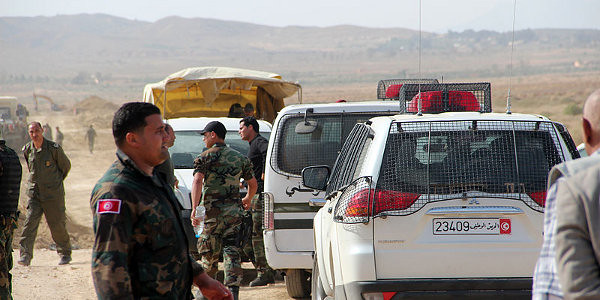
Tunisian security forces operating near Chaambi Mountain, June 2012. Image courtesy Maghrebia via Wikimedia Commons
Tunisian troops in action near the Chaambi mountains.

Tunisia is facing a what may be the deepest crisis since the toppling of former president Ben Ali, two years ago.The opposition has accused the ruling party Ennahda, which is the main party in the leading coalition,  of being linked to or tolerating Islamist militant attacks.Demonstrations swept Tunisia after the assassination of Mohamed Brahmi, a member of the Arab nationalist Popular Front party, on July 25, a killing that followed the assassination of party leader Chokri Belaid in February.Ennahda has denied the accusations. Tens of thousands of Tunisians came out in a show of force for the ruling Ennahda party on Saturday. "No to coups, yes to elections!" they shouted, in one of the biggest demonstrations since the 2011 revolt.The opposition pledged to rally even more supporters in its own demonstrations. It held rallies on Sunday and it is planning a mass protest on Wednesday to mark the six-month anniversary of Belaid's assassination.
Prime Minister Ali Larayedh told journalists on Sunday a man suspected of ties to the Belaid assassination was captured by security forces. He called on militants being hunted by security forces to turn themselves in. There is no future in terrorism," he said, speaking outside the Interior Ministry, where he had been meeting officials.
Reuters reported that two soldiers were killed in a blast near the Algerian border on Sunday. This happened after the Tunisian army started early on Friday air and artillery strikes in the Mount Chaambi area, where on Monday eight soldiers had been killed in an ambush. The bombing will continue until all fighters are driven from the area, Ministry of Defense spokesperson Tawfik Rahmouni said in an interview Friday with the radio station Mosaique FM. He said that the military was assisted in its operations by Algerian intelligence. State Tataouin radio and other local media reported on Sunday that Tunisian forces had killed 10 militants in Chaambi and arrested three others. I
Also on Friday morning, the Anti-Terrorism Unit, a specialized division of the Tunisian police, arrested twelve “religious extremists” inside the Ettawba mosque in Kasserine, according to Mosaique FM.
In the capital Tunis, Interior Ministry official Lotfi Hidouri said police raided a house where militants were hiding weapons in the Kabaria district. "The police killed a terrorist and arrested five others," he said. Witnesses said police also arrested several hardline Salafists suspected of ties to militant groups in the town of Sbitla, north of the capital. One witness said dozens of Salafists then gathered at the police headquarters in Sbitla to protest against the arrests and that the police fired in the air to disperse them.

Israeli cabinet puts some 20 settlements on list of communities that will receive extra benefits

 A picture taken on April 24, 2012 shows the Jewish outpost of Bruchin, near the West Bank city of Nablus
 The recently 'legalized' settlement of Bruchin near Nablus was one of the places that is to receive exta benefits.  

The Israeli cabinet on Sunday approved a new map of national priority areas, which includes an additional 20 West Bank settlements and communities inhabited by former Gaza settlers.The list of national priority areas features hundreds of towns and villages that are entitled to government benefits in housing, infrastructure, education, culture and security. The list was last updated in 2009 to include dozens new West Bank settlements.
Fifteen out of 20 communities to receive national priority status are strongholds of Habayit Hayehudi, one of the coalition partners and the party of minister of Economy aftali Bennett. Conversely, two orthodox  communities have been removed from the list. The Israeli government denies, however, that the decision is politically motivated, it claims that the reason for including settlements on the list has to do with security.
Four ministers abstained in Sunday's vote, including Justice Minister Tzipi Livni and Environmental Protection Minister Amir Peretz of the Tenuah party. They blamed the government for promoting a partisan agenda at the expense of a national one."It is unacceptable that [northern Negev towns] Kiryat Gat and Kiryat Malachi are not on the list due to so-called proximity to the center, despite their difficult socioeconomic state, and at the same time include remote settlements, that were until recently illegal outposts, under the guise of 'security needs,'" Peretz said.
Some of the newly prioritized communities are outside the large settlement blocs, like Eshkolot and Negohot in the southern Hebron Hills. Other settlements on the list include Rehelim, Sansana and Bruchin, which were considered illegal outposts until several months ago, but were legalized by the cabinet before the last elections. Other settlements on the list are the West Bank settlements of Nofim, Geva Binyamin, Ma’aleh Michmash and Elon Moreh.
Several communities populated by former Gaza Strip settlers, who were evacuated from their communities in 2005, were also added to the list. These are Be’er Ganim, Bnei Dekalim, Ganei Tal, Netzer Hazani and Nitzan.

Saturday, August 3, 2013

Moroccans protest against royal pardon for convicted pedophile

(Update: Morocco's king on Sunday revoked his pardon of a Spanish pedophile, after hundreds rioted in front of parliament on Friday to protest the decision. A statement from the palace carried by the state news agency on Sunday said the king revoked the pardon, taking into consideration the gravity of the crimes committed. The pedophile, Daniel Vino Galvan, was later arrested in Spain. A spokesman for Spain's Interior ministry said he was arrested by police in Murcia in south-eastern Spain on Monday.  Galvan, who once worked at the University of Murcia, will be taken to Madrid where he will be brought before Spain's top criminal court, the National Audience, which will decide his fate, the spokesman added. The news came as King Mohamed VI of Morocco announced that the country’s director of prisons has been sacked after an inquiry blamed his department for Galvan’s release).


Riot police broke up a protest by hundreds of Moroccan demonstrators late on Friday against a royal pardon for a Spanish pedophile serving a 30-year sentence for raping and filming children as young as 4.
In running clashes with the demonstrators, baton-wielding police prevented them from gathering in front of the Moroccan parliament in the centre of the capital Rabat, injuring several people including journalists.
The convicted pedophile is among 48 jailed Spaniards who were pardoned by King Mohamed VI on Tuesday at the request of Spain's King Juan Carlos, who visited Morocco last month.The demonstration followed an online campaign by outraged activists. Protests were also reported in several other cities in Morocco. Protesters demanded that the royal pardon be revoked and the Spaniard be brought back to jail. The government said the man had been expelled to Spain.
Hamid Krayri, a lawyer for families of the victims, named the pedophile as Daniel Vino Galvan and said he had been convicted 18 months ago by criminal courts in Kenitra, near Rabat, of raping and filming children aged between 4 and 15. "He is a retired Spaniard who owns two flats here in Kenitra," Krayri, who is a member of Morocco's Human Rights Association, told Reuters. He said he had filed a complaint against Galvan three years ago when activists showed him discs containing footage of the Spaniard and his victims.
The royal palace made no immediate comment, but the Justice Ministry said in a statement on Friday that the pardon had been issued based on Morocco's national interests under the friendly relations between the two countries."That person is banned in Morocco's territory, he cannot return," Justice Minister Mustapha Ramid told Reuters on Thursday.

Friday, August 2, 2013

Bahraini parliament 'legalizes human rights violations'

The Bahraini parliament


The Bahrain Center for Human Rights is concerned about what it calls actions of the he Bahraini authorities’ ''to legalize human rights violations and the crackdown on activists and protesters in anticipation of “Bahrain Tamarod” on August 14th.
On Sunday 28 July, 2013, the National Assembly held a special session during which 22 recommendations were agreed upon which  restrict freedoms of expression and assembly.  They were issued in just 20 minutes of the ending of the session, which gave the impression that they had been previously prepared. Hamad bin Isa Al-Khalifa as head of the ruling family, readily accepted all recommendations and called for them to be promptly implemented (read more here http://bahrainrights.org/en/node/6263).
(See below for the complete list of 22 recommendations).
In less than 72 hours since the recommendations were made, on 2 July,  two royal decrees were issued to amend laws on the Protection of Society against Acts of Terror and Charity Fundraising regulations. The amendments on laws of protection from terror acts have provisioned harsher punishment of up to 15 years’ imprisonment, the death penalty or life, or revocation of citizenship according to the Terrorism Law.

During the extraordinary session held here today in line with Royal Order 33 for this year issued by His Majesty King Hamad bin Isa Al Khalifa on July 25, members of the National Assembly agreed on the following recommendations:
1. Issuance of Decree Laws during parliament's summer recess in order to toughen penalties in the terrorism law and, if necessary, to implement such recommendations, in order to face any event requiring expediting the adoption of measures that brook no delay, and need swift actions to protect national security and stability, in line with Article 38 of the Kingdom’s Constitution.
2. Revoking the citizenship of those who carry out terrorist crimes and their instigators.
3. Inflicting tough penalties on those who incite all forms of violence and terrorism.
4. Inflicting severe punishment on all kinds and forms of violence and terror crimes.
5. Drying up all sources of terrorist financing.

6. Banning sit-ins, rallies and gatherings in the capital Manama.
 7. Taking all necessary measures, including the declaration of the State of National Safety, to impose civic security and peace whenever law is violated, the security of the citizens is compromised and private and public property is under threat.
 8. Taking legal actions against some political associations which incite and support acts of violence and terrorism.
 9. Amending Law 58 of 2006 with respect to protection of the community of against terrorist acts so as to inflict punishment on those who instigate and support terrorism.  
10. Granting the security bodies all required and appropriate powers to protect society from terror incidents and prevent spreading them.
11. Requesting Ambassadors to Bahrain not to interfere in the kingdom’s domestic affairs, in line with International Law and regulations.
12. Toughening penalties on those who involve children and exploit them in acts of terrorism and vandalism of private or public facilities.
13. Total commitment to applying all punitive laws related to combating violence and terrorism. 
14. Adherence to a balanced moderate discourse in order to preserve the social fabric of the Bahraini society.
15. Direct relevant state bodies to activate the necessary legal action against those who use social networks in an illegal way, and toughening penalties against those who use those networks to disseminate false information to foreign sides which plot against the country’s security and stability.  
16. Basic liberties, particularly freedom of opinion, should be affected so as to strike a balance between law enforcement and human rights protection.
17. Examination of the educational policies of the kingdom and review and change educational curricular in a way that protects society from violence and terrorist actions and improves the behavior of students.
18. Using the media to shed light on the dangers of terrorism and its negative impacts on national stability and economy.  
19. Backing the loyal efforts of HM the King to encourage national dialogue and push it forward, as serious national dialogue is the best means to resolve all issues and maintain national cohesion.
20. Those involved in terrorist acts shall not be covered by Royal pardon on crimes.
 
21. Devising an integrated national security strategy in order to be able to face all developments and supporting the efforts of those in charge of it and ensuring their protection.
22. Launching programmes to rehabilitate youths who were exploited in various crimes.

Morsi supporters defiant after government warning that protest camps will be removed

 http://madamasr.com/sites/default/files/VNH_06%20copie.jpg
Supporters of the deposed Egyptian president Mohammed Morsi remain defiant in spite of a warning by the government that it is ready to take action to finish off their protest camps in Cairo. The government took this decion on Wednesday and the Interior Ministery promised protesters on Thursday a safe exit if they leave the Cairo and Giza sit-ins “quickly.”
 In a statement, the ministry urged them "to rethink their positions and listen to the country's best interests. They must leave quickly and clear the sit-ins." The ministry said it was “committed to providing a safe exit and full protection for all who listen to the call and leave the sit-in for the sake of the country's stability."
However the Muslim Brotherhood's Freedom and Justice Party, and the Anti-Coup Pro-democracy Alliance – led by the Brotherhood – responded to the interior ministry's warning in a declaration that
'' they do not recognize the coup government or its decisions or negotiations.'' The alliance said that the demonstrations '' will continue in spite of threats'' and ''will not give up its right to protest peacefully.'' .The statement added that "the Alliance affirms that the Egyptian people will remain steadfast in their revolution against the coup, which has brought back the police state in its worst incarnations."
Confrontations between Morsi's supporters and the police near their sit-in at the Rabaa Al-Adawiya sit-in in Nasr City led to over 80 deaths and hundreds of injuries on Saturday. Earlier Morsi's supporters suffered at least 50 dead at the headquarters of the Republican Guard, when the military personnel  opened fire at them after claiming they were attacked.
Millions of Egyptians took to the streets on 26 July after army chief Abdel-Fattah El-Sisi – the leader behind the 3 July military intervention – called the Egyptians to come to the streets and protest against "violence and terrorism", by which he meant the resistance by the Morsi supporters.

At least 40 people killed in Syria city of Homs by explosion of ammunition depot


At least 40 people were killed in an ammunitions depot blast Thursday in a government-held area of Homs in central Syria apparently triggered by rebel rocket fire, a monitoring group said.
The Syrian Observatory for Human Rights, which earlier reported 22 killed, warned that the death toll could rise further as many of the 100 people wounded were in serious condition.
The rocket fire followed the government's capture on Monday of the Khaldiyeh district of the flashpoint city that had been in the hands of mainly Sunni rebels for the past two years.
The ammunitions depot blew up in the pro-regime Wadi al-Zahab district "after rocket fire, most probably by rebels," said the London-based Observatory, which relies on a network of activists and medics for its information.
It said the depot was operated by pro-regime militias.
Rockets also crashed into Akruma and Al-Nozha, all districts in southern Homs inhabited mainly by members of President's Bashar al-Assad's Alawite community.

Thursday, August 1, 2013

In Iraq 989 killed in July, deadliest month since five years

 
 Remains of a car that exploded in Sadr City (Baghdad) on 29 July.

AFP reports:
  Violence in Iraq killed 989 people in July, government figures released on Wednesday showed, making it the deadliest month since April 2008.
The dead comprised 778 civilians, 88 police, 55 soldiers and 68 insurgents, according to the figures compiled by the health, interior and defence ministries.
Violence also wounded 1,567 people in July -- 1,356 civilians, 122 police and 89 soldiers.
The figures make July the deadliest month since 2008, when Iraq was emerging from a bloody sectarian conflict.
In April of that year, 1,428 people were killed, according to official figures -- 966 civilians, 69 police, 38 soldiers and 355 insurgents.
The killing continued on Wednesday, taking the lives of 15 people, including five Sahwa anti-Al-Qaeda fighters, officials said. Gunmen killed three Sahwa militiamen and wounded a fourth in the northern province of Kirkuk. Two more were shot dead near Baquba, also north of the capital.
The Sahwa, who sided with US forces against insurgents from late 2006, helping to turn the tide of the war. They are regarded as traitors by Sunni militants and are frequently targeted in attacks.
Two people were killed by gunmen in the same area where the Sahwa fighters were attacked northeast of Baquba, while two bombings in Kirkuk province wounded five soldiers and a policeman.