Saturday, October 9, 2010

Raid on Free Gaza Flotilla: family of victims bring case before ICC in The Hague

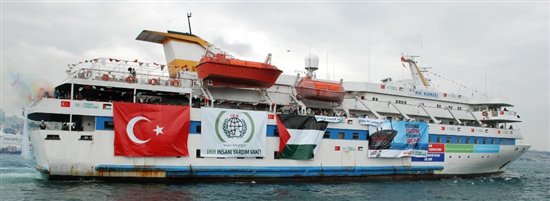
The International Criminal Court is being urged to prosecute members of the Israeli defence force for the raid on the Gaza-bound aid ship Mavi Marmara.The British newspaper The Guardian learned that lawyers acting for Turkish citizens injured or killed when Israel intercepted the flotilla on 31 May have written to Luis Moreno Ocampo, the court's prosecutor, claiming there is an "overwhelming" case for prosecution.

The request is a significant step towards a criminal investigation by the court, which experts say has jurisdiction to prosecute those involved in the raid despite Israel not recognising its jurisdiction.

"The attack on the flotilla occurred in international waters, which directly violated many parts of international law as well as international public and criminal law," said Ramazan Ariturk, a partner at Elmadag Law Office, the Turkish legal body that is representing the Turkish victims and the human rights group IHH. "The crimes committed by Israeli Defence Forces should be prosecuted and the International Criminal Court is the sole authority which is able to do that."

Last month a UN report into the incident, in which nine Turkish activists were killed, accused Israel of violating international law. According to the report Israel "betrayed an unacceptable level of brutality" during the raid. Also it stated that the attack on the flotilla "constituted grave violations of human rights law and international humanitarian law". Israel called the report "biased and distorted".
It has created its own state-appointed inquiry, headed by retired supreme court justice Jacob Turkel. A
government spokesman pointed out that also an investigation is underway under the auspices of the UN secretary general. He called further investigations redundant and unnecessary, and said the might contribute to further alienation between otherwise friendly countries, " according to The Guardian.

Neither Israel nor the Palestinian territories are parties to the Rome statute, which established the international criminal court. An investigation of incidents involving the two countries is possible only after a reference from the UN security council. But the Turkish victims' lawyers say the involvement of Turkey with the Mavi Marmara and the fact it was sailing under the flag of the Comoros Islands give the court with jurisdiction. Both countries are members of the ICC.

Friday, October 8, 2010

Soldier who abused female Palestinian prisoner identified

This video circulated a few days ago on the internet, after it had been shown by Al-Jazeera. It's yet another example of how some Israeli soldiers apparently abuse Palestinians after they have been arrested. (Remember Eden Abergil, the female soldier who surfaced earlier with similar pictures?). This one shows  a soldier who performs a kind of belly dance around a frightened female prisoner, who is handcuffed and blkindfolded and is leaning against a wall.


 It did not post it at first, considering that there are probably examples of abuse which are far worse, and also because of lack of time and space. But now, there is reason to do it as yet. Thanks to my twitter friend Dena Shunra we now know wo this soldier is. Dena found his Facebook page, from where I post a picture here.
The name of the soldier is Avi Jakobov. According to his Facebook page he is working in the liquor sector and right now he seems to be in Berlin, where he takes part in the 'Oktoberfest' as a bartender. (This information comes from the Tikun Olam blog of Richard Silverstein, who also got his first information from Dena). Is anybody familiar with his exact wherabouts? And could someone try to get him arrested for war crimes, maybe?

Two more things should be mentiond. First the reaction of the Israeli army after Yakobov's video had been surfaced. Did theystart an inquiry? In order to punish him? No, wrong. The army spokesman issued  the following statement:
The video clip, which has aroused many reactions in the wider world, brought the IDF to the conclusion that it must explain better to soldiers the dangers of uploading video and images embroiled in controversy.
Which tells us that apparently the Israeli army is more concerned with its image than with the moral standards of its employees.
Another fact: Also Yakobov's victim has been identified. The French press agency AFP found her. It is Ihsan Dababseh (35) from a village near Hebron, who was arrested and aftrwards convicted to 22 months for her membership of the Islamic Jihad. AFP quoted her as follows:

“I saw the video on Al-Jazeera. I did not sleep last night so I felt humiliated and frustrated “, said Ihsan Dababseh, after the international television retransmission of these images broadcast from YouTube Monday by an Israeli channel.
“The sound of laughter of the soldiers and the music echoed in my ears,” said the young woman from the village of Nuba, near Hebron in the south of the occupied West Bank.
She said he contacted the Prisoners’ Club, a Palestinian NGO, and is considering legal action against the Israeli army.


Thanks to Dena Shunra I'm able to provide some additional information. It is taken from the Hebrew on the blog of Yossi Hurvitz ( http://www.hahem.co.il/friendsofgeorge/?p=193 ) who did some additional research. Dena was kind enough to translate it:

The incident occurred in December 2007, at the Etzion Division base, behind the base warroom. A short while thereafter Yakobov & the other soldier placed a military cap on Dababseh's head, at which point the Deputy Division Commander, lieutenant colonel Guy Osheri, arrived on the location and shouted at the soldiers.

When a large Israeli paper contacted Israel's military spokesman about this, the spokesman claimed that Yakobov had been tried and sentenced to 21 days in military prison. Soldiers on the spot testify that this is untrue: they were called in for an investigative conversation, educational conversations were later held on the base. Yakobov was grounded, as far as can be determined without a military procedure. One of the soldiers involved said that his impression was that Osheri was under the impression that such a procedure would give his unit a bad image. This is a well-known issue in the IDF. Yakobov was not imprisoned. It will be noted that Yakobov was apparently imprisoned later, due to another incident, of being drunk on the job. It could be that that is what the unit told the military spokesman had been Yakobov's punishment. The military spokesman has only limited ability to verify exact details of an incident that occurred nearly three years
ago, since most of the soldiers involved have already been discharged,and record-keeping is notoriously inaccurate in Israel's army.

Some reports on the Internet say that Yakobov is in German. In fact, he is in Israel, and sounded quite stunned over the phone. He said he had just woken up and refused to answer questions.

Yakobov's name was not published, although his friends identified him on facebeook and informed him that he had become a celebrity. The security authorities have the toxic policy of hiding the identify of soldiers who committed war crimes.


Interesting is that Yossi tells us that Yakobov is in Israel. Initially it was reported that Yakobov was in Germany, but Yossi phoned him and found him at home. Yossi reminds his readers of Issaschar Shadmi who was found guilty as one of the perpetrators of the massacre of Kfar Qassem in 1956 (48 dead, 23 women and children among them) and was sentenced to a ridiculous low fine (less than an Israeli Lira). Yossi suggests that we (people in Israel and bloggers) start an effort to publish the names of people who thus abused Palestinians in order to have them punished. As yet Yossi Gurvitz has only published this in Hebrew, but he might come with a follow up on his English blog, here which is anyhow worthwhile to read).

Israeli army again kills two 'wanted' Palestinians

Two leaders of Hamas' military wing, the Al-Qassam Brigades, were killed overnight Friday in Hebron during an Israeli army raid in the Jabal Johar village, witnesses told Ma'an. The two killed were identified as Nashat Al-Karmi and Maamoun Al-Natsha.
Witnesses told Ma'an earlier they believed one of the killed was an important factional leader from the village's Abu Sneineh neighborhood and that he may have been 'wanted' by Israel.
Witnesses further said Israeli troops raided the area and confiscated cameras from journalists at the scene.
 Haaretz quotes Channel 10 News, which reported that Israeli forces arrived at the house in which the two wanted men were staying in Hebron with the intention to arrest them as part of a comprehensive operation in the West Bank city. According to the army version of what happend 'the militants opened fire at the Israeli soldiers and were subsequently killed in the exchange of fire'. The pokesman of the army confirmed that Israeli soldiers were not injured and that 'the two militants were wanted for their involvement in several attacks against Israelis'.

Israel always pretends that it kills wanted Palestinians after an exchange of fire. But the killing is strongly reminiscent of the way in which on 17 September the 38 year old Iyad Shelbaya, also a leader of Hamas,  was murdered in his sleeping room in a house in the refugee camp of Tulkarem. (I wrote about that here, in Dutch). Is it too far fetched to suspect that these killings are still a revenge for the murder of four settlers near Hebron at the end of August ? (here, also in Dutch).
 
Ma'an further reports that Israeli forces imposed a curfew on the southern West Bank district. Locals said that the troops surrounded three homes belonging to Radwan Ar-Rajabi, Saadi Barwan and Ayoub Gheith, demolishing the fence surrounding the houses. Israeli bulldozers were also seen demolishing a three-story home in search of a 'wanted' Palestinians in hiding. Lateron it appeared, according to the Jerusalem Post, that one of the two wanted men, Maamoun al-Natsha, about whom was reproted earloer that he was killed in gunfire, had been in the house. His body was later retrieved from under the debris. The Forces also detained Ayoub Ismael Ar-Rajabi, 28, and Mus'ab Al-Atrash, witnesses said.

Thursday, October 7, 2010

Obama tries to bribe Netanyahu, Netanyahu tries to bribe Lieberman, the stakes rise, the standards go down

 
A few days ago, on 30 September, I wrote on this blog that Obama was trying to bribe Israeli prime minister Netanyahu into prolonging the building freeze in the settlements with an additional 60 days in the hope of saving the 'peace talks' with th Palestinians. The news came from David Makovsky, director of the Washington Institute for Near East Policy (WINEP), a offshoot of th Jewish lobby AIPAC. Apparently it was leaked to him by someone in te White House entourage in order to heighten the pressure on an as yet reluctant Netanyahu by making public what a tasty offer the Israeli prime ministers was turning down. I quote (this time from Jonathan Cook on Electronic Intifada for a change):

According to Makovsky, in return for the sixty-day settlement moratorium, the US promised to veto any UN Security Council proposal on the Israeli-Palestinian conflict over the next year, and committed to not seek any further extensions of the freeze. The future of the settlements would be addressed only in a final agreement.
The White House would also allow Israel to keep a military presence in the West Bank's Jordan Valley, even after the creation of a Palestinian state; continue controlling the borders of the Palestinian territories to prevent smuggling; provide Israel with enhanced weapons systems, security guarantees and increase its billions of dollars in annual aid; and create a regional security pact against Iran.
The offer is set to raise alarm with the Palestinians and understandably so  After all what does it reveal about America's so called 'impartiality' if the US is offering Israel to continue its control of the borders of a future Palestinian state and to maintain its military presence in the Jordan Valley? And that without even having consulted with the Paletsinians themselves?
But not only the Palestinians ought to be worried. The American promises have an impact that goes way beyond Israel/Palestine. What about creating a security pact in the region argainst Iran? Isn't that going to be in line with the Israeli policy of continuously beating the drums of war? And what about vetoing, one year long,  any initiative in the Security Council on the Palestinian-Israeli conflict? Does that include initiatives to demand follow ups to the Goldstone Report on the Gaza war, or further inquiries into the Mavi Marmara affair? And does that include vetoes as well in case Israel undertakes action against Lebanon or Syria? 

It appears that the offer was cooked in a cooperation with Netanyahu's lawyer and negotiator Yitzhak Molcho and the Israeli minister of Defense (and rival of Netanyahu) Ehud Barak, who for the purpose stayed in Washington for the most part of last week. But the real auctor intellectualis of this extraordinary offer was Dennis Ross, a long standing Middle East council under the administrations of Bill Clinton, and Bush (and now Obama). It carries the signature of this man, who - with no less than desastrous results - participated in almost all peace efforts since the beginning of the Oslo years. But before elaborating more on that, and on the huge dangers that come with his sudden re-emergence on the Israeli-Palestinian stage, it's time to pay attention to something else.
Today the curtains rose on a  new Act of  the Opera Bouffe that has taken the place of  regular  Israeli politics, when it became known that Netanyahu gave his blessing to a change to the law on Israeli citizenship. A proposal to change the law in such a way that applicants for citizenship (and that concerns only non-Jews) have to swear their loyalty to the 'Jewish and democratic state' Israel has been passed by the Knesset in first reading. And the green light of the prime minister clears the way for a definite vote in the Knesset, where the law is sure to be adopted as it has the support of the rightist majority.
Netanyahu's coming out in favour of the new law seems to be his share in the attempts to get all parties in line and in favour of an extension of the 'freeze'. More specifically he seems to try and win in this way the support of Lieberman's Yisrael Beiteinu party, the party where the proposal to change the law originated. So that in fact what becomes from Obama's proposal, is a kind of chain-bribery: Obama bribes Bibi, who in turn bribes Vicki Lieberman.
The Israeli Arabs, however, are not at all amused. In  this way Israel's ethnocentric, or outright racist character is underlined once more. It is in general inconceivable that Palestinian or Arab candidates for the citizenship would pledge an oath of allegiance to the Jewishnes of their new country of choice, thereby  categorizing themselves as second class citizens, while it also implicitly denies the Right of Return of the refugies of 1948.
But also the Labour party is less than happy with the change, which apparently came as a surprise for them as well. Labour leader Ehud Barak hastily tabled an alternative in which the newcomers should swear their loyalty 'to the State of Israel as a Jewish and democratic state, in the spirit of the declaration of independence' and will be 'committed to honoring the laws of the state'.


Where and how this Act will end we don't know yet. But deplorable as this new demonstration of how the democracy in Israel is decaying may be, the news that Dennis Ross is back at his old battl ground, the Israeli-Palestinian conflict, is no less frightening. This is what the New York Times wrote abvout him as quoted by Laura Rozen on 6 October:

Dennis Ross, a longtime Middle East expert, has emerged as a crucial, behind-the-scenes conduit between the White House and the Israeli government, working closely with Prime Minister Binyamin Netanyahu's private attorney - and also Defense Minister Ehud Barak - to discreetly smooth out differences and disputes between the two governments.

Ross's role, described by officials and other sources close to the process, is highly sensitive because it might be seen as undercutting the mission of George J. Mitchell, President Obama's special envoy for Middle East peace. Virtually no one interviewed would agree to be quoted by name because of such concerns.

Mitchell also deals directly with the lawyer, Yitzak Molho. But it was Ross - a senior director for Middle East policy on the White House staff - who primarily worked with Molho and Barak on a package of incentives that the Obama administration is offering Netanyahu to extend a settlement moratorium by 60 days to keep nascent peace talks with the Palestinians on track.

The White House referred questions to the State Department. "Dennis Ross' important role in this effort is actually well known and greatly appreciated," State Department spokesman P. J. Crowley said in a statement. "Working with George Mitchell and at the direction of [Secretary of State Hillary Rodham Clinton], he is encouraging the parties to continue negotiations towards an agreement that leads to a two-state solution." ...

Israeli officials have long preferred to bypass the State Department and peace envoys, and deal directly with a senior official in the White House. ....Ross knows both Molho and Barak well from his central role in the Clinton administration as Middle East peace negotiator. ... Ross originally joined the Obama administration as a senior adviser to Clinton on Iran policy. But within months - and especially after a difficult conversation with Saudi King Abdullah during a trip to Riyadh in June 2009 - Obama decided he needed Ross's expertise on the Middle East inside the White House.

Ross back, I should come back on that and maybe tell more. But for now I prefer to take a few lines from what 'old hand' Jerome Slater (he is an emeritus prof at New York State University) on 1 October wrote on his blog :

The latest is the incredible administration proposal that practically begs Netanyahu to make the most meaningless gestures to the Palestinians, in return for yet more unconditional U.S. support of Israel--as described in some detail in a story by Barak Ravid in this morning's Haaretz.
What can Obama be thinking?  I fear I am being reluctantly drawn to the conclusion that he is simply incompetent, unable to prevent himself from being made a fool of by the likes of Dennis Ross--who is said to have drafted the letter--and Benjamin Netanyahu.
Speaking of Ross, anyone who has been following US policies in the Israeli-Palestinian should that the man is a catastrophe, not just "Israel's lawyer," in Aaron Miller’s famous characterization, but a crazed narcissist.  That is what explains why, after Netanyahu apparently rejected even Obama's abject surrender, "Ross was very insulted by Netanyahu's conduct and considered it 'treason.'" (Ravid). 
Unless you happened to remember Ross's memoirs about the Clinton administration (The Missing Peace), that might seem quite puzzling:  "treason" to who?  Well, not such a great mystery.  During the Camp David negotiations, Ross tell us that he told the Palestinian delegation: “You know that I understand your problems, your needs, and your aspirations very well. You know that often I explain them better than any of you do” (p. 755).
At the same time, Ross sometimes seemed to regard the Israelis as spokesmen for him, who needed rebuking when they strayed from the correct path: after telling the Palestinians that he was “quite certain” that the Israelis would not accept anything less than a 7% annexation of the West Bank, he learned that the Israelis were considering 5%: “I was furious. What was the point of my conveying a tough posture on issues of supposed principle to the Israeli side if they were simply going to undercut me?” (pp. 748-49).
So now we know: Treason to Dennis Ross.   And this is who Obama entrusts his Israeli-Palestinian policies?
(Pictures: Obama and Netanyahu, Ross, Ross and Ehud Barak)

Settlers near Nablus torch land, harvest Palestinian olives and cut down trees

Residents of Huwwara village south of Nablus said Thursday that settlers set dozens of dunums of farm lands on fire, destroying crops. PA official responsible for settlement-observation in the northern West Bank Ghassan Doughlas said the fires were in the At-Tira area of Huwwara village, and had destroyed some crops.
On Wednesday Israeli settlers damaged 16 olives trees belonging to residents in the Nablus region on Wednesday after harvesting the olives and depriving several families of their income source. Rashed Mazar, Yanun village chief, told Ma'an that residents saw settlers from the Gideonim outpost in the Itamar settlement leave nearby agricultural lands in a jeep, towing a wagon filled with olive leaves behind it.
He added that settlers living on the illegal outpost began bulldozing land to make way for a road leading to their homes. He said the road would eat up several dunums of farm land, and make accessing the lands left difficult, since the land would basically be appropriated by the settlers and the outpost would be entrenched.
North of Yanun, PA official Ghassan Doughlas said settlers from the Yitzhar settlement uprooted nearly 50 trees in the Anukara area of the Huwwara village south of Nablus, owned by Najeh Issa Muhammad Odeh.

Wednesday, October 6, 2010

Chewing qat, a slow way of committing suicide

The widespread habit of chewing ‘qat’, a mild drug, is to blame for the growing number of mouth cancers in Yemen, according to local NGO National Foundation to Support Cancer Patients. The Foundation said the heavy use of pesticides by farmers to grow the crop, cultivated in Yemen for over 500 years, was to blame for the proliferation of cancer cases.
According to Nadeem Mohammed Saeed, head of the state-funded National Oncology Centre (NOC) in the capital Sanaa, about 30 percent of the cancer patients he sees have mouth and gum cancers - which some studies link to `qat’ as well as the heavy use of a chewing tobacco known as ‘shamma’. “This is really a frightening figure and represents one of the world’s highest rates for mouth and gum cancer,” Saeed said.

Millions chew `qat’ in Yemen, mostly men, some estimate that 90% of them take part in the daily sessions. At the end of the workday, usually from about 3 or 4 pm, tight little bundles of  branches with the narcotic leafs are bought fresh, and sessions of talking and chewing begin, which can last hours. It's during qat sessions that politics are shapen and business deals are done. An estimated 70 percent of households have at least one person that uses `qat’, which represents a huge and lucrative business for growers. Cultivating the shrub takes up more than 50 percent of arid Yemen’s arable land and consumes 65 percent of its precious groundwater, according Adel al-Shujaa, head of the Combating `Qat’ Damage Association, a local NGO.
The crop is not a hard-currency earner. It is officially banned in neighbouring Saudi Arabia, and with Yemen’s `qat’ consumption the highest in the region, production is mostly for local use.

  The 56-bed NOC, the only specialist oncology hospital in Yemen, is unable to cope with the growing number of people diagnosed with cancer. "We don't have enough beds to accommodate hundreds of cancer patients coming from all across the nation,” said Jamal al-Azab, a doctor at the centre. NOC has a waiting list of 300 patients, and "too many patients stop frequenting the centre after they fail to find unoccupied beds," he added.
"The centre's monthly funding is enough for the treatment of 200 cases, but we receive some 400-450 cases per month," said Saeed. Saeed’s deputy, Munif Ahmad Saleh, noted that the World Health Organization recommends there should be one oncology centre for one million people, "but in Yemen we have only one centre for 23 million people".

Tuesday, October 5, 2010

Egyptian paper Al-Dustour sacks editor amidst signs of growing repression of the press

The independent Egyptian daily Al Dustour has fired its chief editor, an outspoken government critic. It happened amidst what journalists are calling a state crackdown on the media ahead of parliamentary elections.The dismissal of Ibrahim Eissa (picture), which was announced in the paper on Tuesday, comes less than two months before parliamentary elections.
Eissa had long been a vocal critic of the government. Last month he was pulled from a popular talk show he hosted on a private satellite TV station. The Journalists' Union condemned  it  as "an organized attack on media freedoms."
Before his firing from the newspaper, Eissa warned of a government campaign against any criticism in the media, especially in light of approaching elections."The Egyptian regime cannot give up cheating in elections, so the only solution for the authorities is to stop any talk about rigging, rather than stopping the rigging itself," Eissa wrote in an editorial in Al-Dustour on Sunday. "So the result is the silencing of satellite channels ... and then the turn of the newspapers will come."
Al-Dustour reported on its website early Tuesday that the paper's mogul publisher El Sayed Badawi fired Eissa on Monday. Eissa later told the Qatar-based Al-Jazeera TV that he was told by the publishers they were firing him because they are under government pressure over his writings. "They want us to shut our mouths and be silent," he said.
Journalists at the paper issued a statement saying that they rejected Eissa's dismissal. "Without Ibrahim Eissa the paper will be tasteless, colorless and odorless," said the statement posted on the paper's website.

El-Badawi, a businessman who heads the opposition Al-Wafd Party, bought Al-Dustour in August shortly after he was elected to the party post. At the time, there was speculation he would fire Eissa in a move that would bring him and Al-Wafd closer to the government.
Al-Dustour has been sharply critical of the government and often breaks political, social and religious taboos in commentaries on Egyptian society. In 1999 it was shut down by the censors for seven years. In 2008, Eissa was sentenced to two months in prison on charges of insulting Mubarak after he reported about the president's health, but Mubarak later pardoned him.
The first sign of the latest media crackdown came in early September, when private and opposition newspapers were ordered to pull reports of a street poster campaign supporting the powerful intelligence chief Omar Suleiman for president. Journalists and editors were barred from writing about the story in subsequent issues and the posters were removed.
The question of who will succeed Egypt's ruler of almost 30 years has gained added urgency since Mubarak traveled to Germany earlier this year for surgery to remove his gallbladder and a benign growth in the small intestine.

Another program, the 12-year-old "Cairo Today" was also shut down Monday. Like Eissa's talk show, it was broadcast on a private satellite TV network. Information Minister Anas el-Fiqqi told The Associated Press the closure of Orbit TV's "Cairo Today" had no political dimension and was only because the network had not paid its bills, though officials from the station have disputed that.

The trial of Ameer Makhoul enters a new phase

On 6 May  Ameer Makhoul, director of the foundation Ittijad, was arrested by the Israeli security service Shin Bet. He wads arrested together with the medical doctor and herbal healer Omar Saed. Both were acused of contacts with a Palestinian living in Lebanon and spying. Dr Said eas released in September. The case against Makhoul is still pending. The following gives background and is taken from the blog Free Ameer Makhoul, which is written by dr Hatim Kanaaneh.
The campaign to free Ameer Makhoul, a Palestinian citizen of Israel and political and human rights activist falsely accused of espionage, has achieved significant advances. Makhoul’s attorneys challenged the legality of the circumstances of his arrest and undermined the prosecution’s core allegations against him on September 16th in the Haifa District Court. State Prosecutors admitted that no evidence of espionage had been found in any of the computers and cellular phones seized from Makhoul’s home and office. Nor was any evidence of espionage found, they admitted, in the transcripts of thirty thousand wiretapped telephone conversations.

Makhoul’s lawyers further secured a ruling from the Nazareth District Court, September 14th, upholding Makhoul’s right to direct and confidential access to counsel. Makhoul’s right to counsel as a citizen of Israel had been routinely violated by prison authorities, who had been officially and conspicuously wire-tapping his conversations, conducted across glass barriers via telephone, with his lawyers.

Sixteen members of Israel Security Agency commonly known in English as the Shin Bet abducted Mr. Makhoul from his home at 3:00 am on May 6th, 2010. They searched his home and office, seizing personal items belonging to Makhoul and his family, as well as office equipment, documents and databases. Makhoul was detained incommunicado. A sweeping “gag order” was placed on the case forbidding publication by Israeli media of any information relating to the interrogation and the arrest. For twelve days he was subjected to torturous interrogation techniques including excessively prolonged sleep deprivation—a technique Makhoul’s interrogators have openly stated they used. When Makhoul complained of being in excruciating pain, the Shin Bet interrogators cuffed his legs to a chair with shortened legs and threatened that he would be permanently crippled from the interrogation.

Three weeks after his detention, Makhoul was charged with espionage, assistance to the enemy in a time of war, contact with a foreign agent, and other trumped up security charges. When he finally appeared in open court, Makhoul categorically denied the relevance of all charges against him.

On June 14th, State Prosecutors announced their possessing of 'Secret Evidence' against Makhoul. That evidence, they stated, would not be disclosed to his legal defense team for security reasons. Meanwhile, Makhoul’s repeated requests for a medical exam and blood test by an independent doctor from the Association of Physicians for Human Rights were continually postponed. Makhoul was unable to discuss these matters with his lawyers without having his conversations wiretapped.

The Committee for the Defense of Ameer Makhoul was established in a public meeting held at the headquarters of the Galilee Society for Health Research and Services in Shafa Amr on September 8th. Participating in the meeting were 47 representatives of grassroots networks and professional associations, as well as concerned Jewish and Arab public figures. At this meeting, the Committee and those it represents assumed collective responsibility for the defense of Ameer Makhoul. It took such a step for the following reasons.

Ameer Makhoul was not arrested as an individual. He was not arrested due to any serious contention that he conducted illegal activities--let alone espionage. Makhoul was arrested to send a message to Palestinian citizens of Israel. That message was formulated by extreme right wing parties in the current Israeli government. They are targeting Makhoul because he is a legal, legitimate, and effective voice of a politically disadvantaged group –Israel’s Palestinian Arab citizens.

Makhoul has been a voice of this disadvantaged group of Israeli citizens in numerous public meetings around the world. He is internationally recognized as a human rights defender and as a member of international coalitions and networks of international and regional organizations. In his capacities as Chairman of the Public Committee for the Protection of Political Freedoms in Israel and as General Director of Ittijah --a network of Arab NGOs in Israel with consultative status in the United Nations Economic and Social Council —Makhoul regularly encounters and talks to citizens of foreign countries—including Arab countries. Simply talking to another Arab does not constitute espionage in the legal framework of Israel or any other country. But contacting an Arab colleague seems to be the core of the espionage charges against Makhoul.

In 2009, the Shin Bet promised Ameer Makhoul that they would “tailor a file for this disappearance and prolonged separation from his family” if he would not tone down his political and human rights activism. They were incensed by his legal, outspoken statements against Israel’s 2009 invasion of Gaza and his repeated reference to Israel’s use of phosphorus bombs against civilian populations in Gaza --including a majority of children. Spurious charges of espionage, the use of illegal interrogation techniques, and fabricated claims of evidence that evaporate in the open air seem to fulfill that threat to disappear Makhoul. Amnesty International has called his arrest and continued detention “pure harassment designed to hinder his human rights work.”

The Committee for the Defense of Ameer Makhoul faces two urgent tasks. But first, we want to note what has already been achieved—despite all of the obstacles. A gag order against discussion of Makhoul’s case crumbled – thanks to appeals by the defense, community protest and solidarity and Israeli and foreign bloggers who ignored the order and opened the way to public pressure. The legal team has won important victories. Illegal practices of prison authorities that violated citizens’ right to counsel have been waylaid.

The obstacle presented by state prosecutors’ invocation of “secret evidence” to silence activists remains to be challenged and ultimately undermined. The incrimination of talking to foreigners must be challenged as well. Already, it has become a tiny bit harder, we hope, for Israel to lock up intellectuals and activists under vague charges of “contact with a foreign agent” in the global village of the internet era.

Now, we have urgent and specific tasks at hand. The Committee for the Defense of Ameer Makhoul is working to mobilize legal and medical international observers for the trial of Ameer Makhoul and to raise funds to cover lawyer fees and related expenses for Makhoul’s defense. We have launched local publicity and fundraising campaigns to achieve those goals. We need your help to make our efforts even more effective.

We reach out to the friends of Ameer and supporters of his work on behalf of Palestinian citizens of Israel and human rights victims everywhere. At this critical moment, we ask for your direct involvement in the campaign for his freedom. Ameer’s trial is scheduled to proceed Tuesday October 5th. The time is now for you to get involved.

All interested individuals and groups are invited to contact the Chairman of the Committee for the Defense of Ameer Makhoul: Dr. Hatim Kanaaneh, Phone- 972-(0)522-414 126. email:kanaaneh@hotmail.com,
Checks can be made out to The Committee for Defense of Ameer Makhoul

Account details for direct bank transfers are as follows:

Bank: Arab Israel Bank- ltd.
Bank no.: 34.
Branch no.: 001 Haifa.
Beneficiary Name: The Committee for Defense of Ameer Makhoul- Haifa.
Account Humber IBAN= IL 890340010000000818780 (8187/80)
Swift Code: Lumiilittlv- 794 Branch

Online Donations through Pay pal can be made at:
https://www.paypal.com/cgi-bin/webscr?cmd=_s-xclick&hosted_button_id=SDH7XCZQ4XLG4

Four Bedouin houses destroyed in the Negev

Israeli forces demolished four houses belonging to Bedouin families in southern Israel on Monday, locals said.
Forces demolished the homes of Atef Al-Athamen, who plans to marry soon, and Nayed Abu Ghuneima, a father of six, as well as two others in Khashim Zena village in the Negev region, local residents said.
A statement from the Arab League follow-up committee said Israeli authorities claimed the homes did not have licenses, despite that the Bedouin villages in the area pre-date the establishment of the State of Israel. An Israeli police spokesman did not immediately return a call seeking comment. 
Israeli forces in the past weeks demolished no less than five consecutive times the Bedouin village of Al-Araqib (picture) in the Negev, each time after the inhabitants had rebuilt (some of) it with the help of Israeli peace activitsts,  also claiming that it has been built without a permit. 

Israel deports Nobel laureate Mairead Maguire


Israel on Monday has deported Nobel peace prize laureate Mairead Corrigan Maguire after she lost an appeal in the Israeli Supreme Court. Corrigan Maguire won the Nobel peace prize along with Betty Williams in 1976 for their efforts to end sectarian violence in their native Northern Ireland. Maguire, who was banned from Israel for 10 years after trying to breach its naval blockade of the Hamas-run Gaza Strip in June with the ship Rachel Corrie, was detained and ordered deported last Tuesday after flying into Tel Aviv's Ben-Gurion airport.
She appealed the order in the Supreme Court, arguing that she had been deluded in signing a paper that she would not return to Israel in ten years without knowing what she was signing. However, according to a transcript of the hearing, the Court voiced incredulity at her argument that she had been unaware of the ban. "I hope the court will allow me to stay in Israel with my Israeli and Palestinian friends," Maguire told reporters before the court turned her down Monday. "There will be peace in this country, I believe it, but only when Israel ends apartheid and the ethnic cleansing of the Palestinian people," she said, using terminology Israel has long challenged.

Saturday, October 2, 2010

Iraq: chances for Al-Maliki to remain prime minister increase after Al-Sadr drops objections


The BBC today reminds us that Iraqi politicians broke the world record of the time taken to form a coalition government, which up till now was in the hands of my fellow Dutch (in 1977 it took er 208 days a liberal-confessional coalition was only formed, after the formation of a second cabinet Den Uyl -Van Agt after long and fruitless negotiations failed to materialize).
Yet, on the same day that the record was broken, an important hurdle was taken in Baghdad which till  now precluded the formation of a new Iraqi government.


On Friday, the main Shia coalition said it had only now decided to nominate the incumbent Prime Minister, Nuri al-Maliki (top picture), for a second term of office, after the radical Shia cleric Moqtada al-Sadr gave up his longstanding objections. However, this is still not the end to the problems, because the National Iraqi Alliance - a merger of Mr Maliki's State of Law coalition and the Iraqi National Alliance is short of a parliamentary majority.
The reason that Muqtada al-Sadr (picture under) gave up his objections against al-Maliki's candidacy which he had held all the time since March are said to be due to strong pressure of Iran, which country  had favoured Al-Maliki  all the way, because in this way the Shia majority would remain in power and does not have to give ay to the Iraqiyya  bloc of Iyad al-Allawi (91 seats), who has the backing of the main Sunni formations (and till now also of the USA). 

However, Al Maliki needs more support. In order  to get the green light in parliament he needs 163 votes. So far he probably has 153. The 89 of his own State of Law (SOL), and the 70 of the INA minus 6 votes of the Fadila faction in this bloc, which still refuses to back Al-Maliki, (INA consists of  ISCI of Ammar al-Hakim (10 members), the Badr movement of the cleric Moqtada Sadr (40), Fadila (6) and independents (4).


It is thought that Al-Maliki and SOL wil now try to get the support of the Kurdish Alliance which has 43 seats. It it not a foregone conclusion, however, that he will get this easily. Analysts predict that tough negotiations are still ahead. .

Friday, October 1, 2010

The killing of little Muhammed al-Durra, ten years after


Al Jazeera English made a moving portrait of the family Al-Durra in the Bureij camp in Gaza. The family became world famous ten years ago when the 11-year old son Mohammed got killed while his father in vain tried to protect him. The dramatic event  was shot by a Palestinian camaraman of French tv and after it had been broadcasted went all over the world. The dying Mohammed al-Durra and his father Jamal became icons as it were of the Second Intifada. So much so, that Israel started to invest lots of time and energy in a hasbara campaign in which it 'proved' that Mohammed in fact was shot not by Israelis but by Palestinians, or even  that he did not die at all. (Here is an example of the stories and tapes). Also the French reporter Charles Enderlin (himself Jewish) was sued in court for libel, and stangely enough lost the case because he was not able to prove that the bullets that killed the boy. were really Israeli ones.
But ten years later Al-Jazeera paints a portrait of a family for which the death of Mohammed is still very much a fact of their life, and of a father who never doubted for a second where the bullets came from.