Showing posts with label Jordan. Show all posts

Saturday, March 4, 2017

Jordan hangs 15 people, 10 of them ''terrorists''

Troops closed the entrances to Irbid during a firefight with the ''Ibid terror cell'' in March 2016.

Jordan hanged 15 death row prisoners at dawn on Saturday, in a further break with a moratorium on executions it had observed between 2006 and 2014. Ten were convicted of "terror" offences, including attacks on tourists, a writer, and security forces. Five others were convicted of crimes including rape, Mahmud al-Momani, Jordanian information minister told the official Petra news agency. The group of 10 were part of the so-called "Irbid terror cell", which was responsible for several attacks.
In 2005, King Abdullah II said Jordan aimed to become the first Middle Eastern country to stop carrying out executions, in line with most European countries. Courts continued to hand down death sentences, but they were not carried out. But public opinion blamed a rise in crime on the policy and in December 2014 Jordan hanged 11 men convicted of murder, drawing criticism from human rights groups. Opinion hardened after the murder by the Islamic State of Iraq and the Levant (ISIL, also known as ISIS) group of captured Jordanian pilot Maaz al-Kassasbeh whose plane had crashed in a rebel-held region of Syria in December 2014. Grisly footage posted in February the following year of him being burned alive in a cage outraged the public.

Monday, December 22, 2014

Jordan revives death penalty, executes 11 citizens

Jordan executed 11 citizens on Sunday, ending an eight-year moratorium on capital punishment, judicial sources said.
The hanged men were among 120 Jordanians convicted of capital crimes in the last 10 years, according to the sources.
Jordan halted executions in 2006, but a recent rise in violent crime has resulted in calls to reimpose capital punishment.
The kingdom has in the past been sensitive to international concerns on human rights and civil liberties because it relies greatly on Western aid.
Jordan amended its penal code in 2006 in response to concerns expressed by the U.N. Human Rights Council over the number of offences punishable by death.
"With these executions, Jordan loses its standing as a rare progressive voice on the death penalty in the region,” said Sarah Leah Whitson, Middle East director at the U.S.-based Human Rights Watch. “Reviving this inherently cruel form of punishment is another way Jordan is backsliding on human rights.”
Most of those executed in Jordan in recent decades have been common criminals, while al Qaeda-inspired Islamist detainees handed death sentences in terrorism-related security trials usually saw their convictions commuted to life imprisonment.

Wednesday, February 26, 2014

Jordanian MPs voted for the expulsion of the Israeli ambassador


A majority of Jordanian MPs voted on Wednesday to seek the expulsion of Israel's ambassador to the kingdom after the Knesset debated Israeli sovereignty over Jerusalem's Al-Aqsa mosque compound.
Prominent lower house deputy Khalil Attieh told AFP that 86 out of 150 members of parliament voted to seek the expulsion of Israeli envoy Daniel Nevo.
The vote, which is not legally binding, came a day after 47 MPs, including Attieh, signed a motion demanding that a 1994 peace treaty with Israel be annulled.
"All deputies who attended a meeting today to discuss Israel's debate on sovereignty over Al-Aqsa voted to kick out the Israeli envoy and recall the Jordanian ambassador in Israel (Walid Obeidat)," Attieh said.
"This was in protest at the Knesset (Israeli parliament) debate. It is up to the government to act on the vote. If it does not, we will consider a no-confidence motion."

Monday, January 21, 2013

Jordanian elections, boycotted by Islamists, will produce a powerless parliament

 
Parliament building in Amman. 

Jordanians go the polls on Wednesday to elect a new parliament that was supposed to bring real reform. But a boycott by the powerful Muslim Brotherhood and other opposition groups such as the National Reform Front of former premier and intelligence chief Ahmad Obeidat cast a shadow over the process. Tribal leaders, pro-regime figures and independent businessmen are expected to sweep the election.
The Islamist boycott is in protest at constituency boundaries that they call unfair, and at the failure to move towards a constitutional monarchy with an elected premier rather than one named by the king.
"We do not seek the overthrow of the regime. We want to reform the regime. Our boycott was the right decision because a parliament or government that is imposed on people is illegitimate. A comprehensive national dialogue is the solution,"  Zaki Bani Rsheid, deputy leader of the Brotherhood, told AFP.
The Brotherhood boycotted the polls in 2010 also, for a similar reason: in protest at constituency boundaries which they say over-represent loyalist rural areas at the expense of urban areas where the Islamists are strong.
"We hoped to see elections under a national accord  that would produce powerful MPs and put reform on the right track. But that is not the case," analyst Oraib Rintawi, who runs the Al-Quds Centre for Political Studies, told AFP. "The coming election will add to problems instead of solving them.I think the turnout will be low. The opposition will keep expressing themselves in the street, escalating without violence. And I think their first protest after the elections will demand the dissolution of parliament, which brings us back to square one," Rintawi said.
Political analyst Labib Kamhawi said the election will be "disappointing." "The Islamists are boycotting the polls because they are not in their interest, others are boycotting them because the entire process is undemocratic. The result will be disappointing to the people because they feel there is no will for genuine reform."

Wednesday, November 14, 2012

Protests across Jordan after anouncement of high price rises of fuel and cooking gas

Jordan's prime minister announced price hikes for gas and other fuel Tuesday, setting off demonstrations and calls for general strikes. Protesters blamed Jordan's problems on King Abdullah II.
Abdullah Ensour's announcement on state TV cited a need to offset $5 billion in state losses from a rising fuel bill.
The news sparked protests in the capital, Amman, and at least 12 other cities across Jordan.
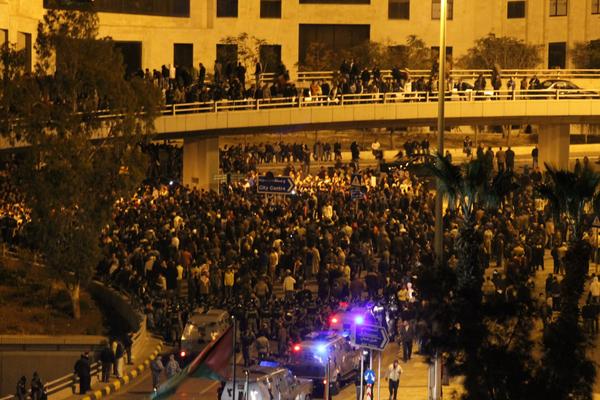
"Revolution, revolution, it is a popular revolution," chanted about 2,000 protesters in an impromptu demonstration at a main Amman square, housing the Interior Ministry and other vital government departments. Also the slogan 'As-shaab yureed 'usqut al nizam - the people want the downfall of the regime - was heard, a very popular slogan during the demonstrations in Cairo that led to the fall of Hosni Mubarak. For wednesday a general strike is foreseen in which schools, universities and taxi drivers are to take part.    

Embedded image permalink
Blocking roads in Irbid. 

Ensour said a type of fuel used in public transport will rise in price by 14 percent, while kerosene oil used for household heating goes up by 28 percent.Cooking gas will jump 54 percent, he said. Many low-income Jordanians use the gas for heating.

Embedded image permalinkRoundabout in front of the ministry of the Interior in Amman.

In Mazar, dozens of protesters burned down the main court building after stealing documents. Further south in Maan, a hotbed for Jordanian Muslim militants, 500 protesters blocked the streets, burning tires and throwing stones at riot police, who were firing tear gas.The protests also spread to Jordan's north. In Sareeh, on the edge of the northern city of Irbid close to the Syrian border, angry protesters burned down a gas station, said witness Mohammed Amoura.

Wednesday, October 24, 2012

King Abdullah: 'Ruling Jordan is a sacrifice'


  King Abdullah of Jordan his told his subjects on Tuessday that he or his family was never after the power, but that ruling Jordan was 'a sacrifice'.
 “Governing, for us Hashemites, was never at any point a gain that we sought, but rather a responsibility, a duty and a sacrifice that we have been carrying out in the service of this nation and in defence of its causes and interests — a cause to which we have offered many martyrs,” said the King.
“Governing was never for us about holding a monopoly over authority, nor about power and its tools, but about supporting state institutions run by Jordanians from all segments of society, according to the provisions of our Constitution.'
Abdullah said this on Tuesday in a speech for  more than 3,000 personalities in which he urged all political parties and forces to take part in the upcoming legislative elections of 23 January. Abdullah, who is not really the brightest of personalities, told his audience that 'the next Parliament will determine the formation of the new parliamentary government, and with it the future of political reforms and socio-economic policies'. To that he added more hollow niceties , to the tune of “If you want to change Jordan for the better, there is a chance, and that chance is the upcoming election, and there is a way, and that way is through the next Parliament.” 
All this was said amidst demonstrations that go on and off in Jordan since months, during which demands are heard for real reform and changes of the constitution towards real democracy. It's highly improbable that many people will have been impressed by his majesty's banalities. But that ruling Jordan in fact is a sacrifice may have been a revelation to many among them. 

Thursday, October 4, 2012

King Abdallah of Jordan dissolves parliament

Abdallah II
King Abdallah II of Jordan has dissolved parliament, paving the way for early polls ahead of protests seen as his biggest challenge since the start of the Arab Spring. Jordanians have been pressing for a greater say in how their country is run and demanding corruption be tackled. Jordan's Muslim Brotherhood said in July its political party, the Islamic Action Front, would boycott the polls. The group has called for the monarch's powers to be curtailed, and for an overhaul of the parliamentary system in which the prime minister is appointed by the king rather than elected. It has said it would boycott polls until such measures were introduced.
King Abdallah said recently a new parliament would elect a prime minister early next year.
Ahead of Thursday's royal decree, the Muslim Brotherhood said its "Friday to Rescue the Nation" rally to demand reforms would go ahead in central Amman. "We are talking about a new phase after 20 months of continued popular protests and unwillingness to listen to our demands for reform," Zaki Bani Rusheid, the deputy head of the Muslim Brotherhood, told Reuters of the rally.
Jordanians have been participating in demonstrations demanding reform since the beginning of last year. However, the movement never reached levels like in Egypt, Tunisia or Yemen.
Update: Tens of thousands demonstrated on Friday 5 October i Amman for reform. The demostations ws organized by the Muslim Brotherhood. (Photo AFP).

Monday, April 16, 2012

King of Jordan orders release of 19 activists

King Abdullah II of Jordan on Sunday ordered the release of 19 political activists charged with insulting him during pro-reform demonstrations last month, a palace official said. The decision was taken after the king met today with tribal leaders in th southern city of Tafileh, who urged the king to pardon the activists.
Six of the men were arrested in mid-March after a demonstration in Tafileh. The other 13 were detained after a protest outside the prime minister's office in Amman. Jordanian military prosecutors have accused the young activists of incitement against the regime, rioting and insulting the king. Jordan's Islamists and other political movements as well as international human rights organisations have repeatedly demanded their release.
In March, the military state security court freed an 18-year-old political activist from jail after the king pardoned him for burning a picture of the monarch.
Jordanians have been protesting since January 2011 to demand political and economic reforms.

Saturday, April 16, 2011

Bouteflika promises a new constitution

 
Algerians watch their president Abdelaziz Bouteflika, who frail loooking and with a coarse voice, anounces that the constitution will be amended in a 20 minute speech in the 20 o'clock news. (AFP)  

ALGERIA - Algerian President Abdelaziz Bouteflika, who has been in power for 12 years, has promised to amend the constitution to "strengthen democracy".Bouteflika's speech was a response to unrest that broke out in January with strikes, marches and rioting echoing protests elsewhere in the Arab world. Earlier, in February, Bouteflika, who is 74 and not in good health, lifted the country's state of emergency.
The current constitution, adopted in 1996, was introduced to strengthen presidential law and ban religion-based parties following Algeria's murderous war between the military and Islamist militants, in which some 150,000 people were killed.
Bouteflika announced that a commisisson will be formed consisting of experts and active political forces to adopt a new constitution, the newspaper Al-Watan reported. Also he announced that the laws concering the formation of political parties would be revised, as well as the laws concerning the electoral process, in order to make it more 'transparant'.

SYRIA again has witnessed numerous protests for reforms or agains the rule of president Assad  On Friday thousands took to the streets in the capital Damascus. Security used teargas and batons to disperse the demonstration. Thousands of others were reported to have demonstrated in a number of other Syrian cities, including Deraa, Latakia, Baniyas and Qamishli - places where violence has been previously reported.
The protesters called for reforms, while some demanded the overthrow of President Bashar al-Assad. The protests, in Damascus and other cities, are believed to be the largest in a month of unrest in which about 200 people have been reported killed.
State media reported that "small demonstrations" had taken place in different parts of the country and security forces did not intervene. Mr Assad has promised to make some concessions while cracking down on dissent. 

JORDAN - Dozens of people have been injured as ultra-conservative Salafist Muslims clashed with pro-government supporters in Jordan's northern city of Zarqa.The police used tear gas to disperse the crowds, a police spokesman said. Six officers were stabbed and 34 others injured in the clashes, he added.
Meanwhile, up to 1,000 people protested in the capital Amman, calling for political and economic reform.
The Salafists have been demonstrating over the past few weeks to demand the release of 90 Islamist prisoners.They include Abu Mohammed al-Maqdessi, the former mentor of slain al-Qaeda leader in Iraq, Abu Musab al-Zarqawi, who was born in Zarqa.

Tuesday, February 1, 2011

Jordanian king dismisses prime minister

  Amman, 21 January: protesters carry a giant Jordanian flag during a demonstration against the policies of the government.

King Abdullah of Jordan replaced his prime minister on Tuesday following a wave of protests inspired by mass demonstrations in Tunisia and Egypt. The king asked Marouf Bakhit, a conservative former premier and ambassador to Israel, to head the government after accepting the resignation of  Samir Rifai.
The Islamic Action Front (IAF), the political arm of the Muslim Brotherhood, expressed anger with the appointment of Bakhit.'This is not a step in the right direction and does not show any intent toward real political reforms or meeting the popular demands for people yearning for greater political freedoms,' said Sheikh Hamza Mansour, head of the Islamic Action Front (IAF). The IAF is the largest political group in Jordan.

Friday, January 28, 2011

Protests also in Jordan

Friday 28 January. Also in Jordan demonstrations took place after prayers. Several thousands marched in the streets in Amman (picture by Ali Abunimah), several more thousands in the other big cities of Jordan. The demonstrators, among which the Islamic Action Front (political arm of the  Muslim Brotherhood) had a strong presence, asked the government of Samir Rifa'i to step down and shouted slogans against it (economic) policies. After the march the demonstrations dissolved in a quiet manner.    

Friday, January 21, 2011

Jordanians march again against government

More than 5,000 people rallied in Amman and other cities after weekly prayers on Friday against Jordan's economic policies, demanding "bread and freedom" and that the government resign. It was the second weekend of protests in Jordan. Thousands took to the streets in a similar protest on Friday last week.
The protesters chanted slogans against prime minister Samir Rifai, ('Rifai out, out!) as they marched from the Al-Hussein mosque to the nearby municipality building in central Amman. Other slogans were "Our demands are legitimate. We want bread and freedom,"
Police handed out bottles of water and juice to the demonstrators. The protest was organised by the Muslim Brotherhood and its political arm, the Islamic Action Front (IAF). In other parts of Jordan people took 
to the streets as well. Some 1,400 people demonstrated in the northern cities of Zarqa and Irbid.
Rifai on Thursday announced a $283m plan to raise salaries of government staff as well as the pensions of retired government employees and servicemen. The plans come down to a raise of $28 a month. Last week a  $169m plan to improve living conditions was launched.The current minimum wage is $211 a month.
However, the Islamist opposition and others say the new measures are not enough as poverty levels are running at 25 per cent in the kingdom, whose capital is the most expensive city in the Arab world. 'These measures are designed to drug people, nothing more. We need comprehensive reforms,' said prominent unionist Maisarah Malas.

Sunday, January 16, 2011

Second day of protest in Jodanian capital Amman

 More than 3,000 Jordanian trade unionists, Islamists and leftists held a sit-in on Sunday outside parliament to protest the government's economic policies."For how long should we pay the price of corruption and theft," read one of the banners carried by protesters who also held Jordanian and Islamist flags.
The demonstrators chanted "enough of lies, we lost our future," and called on Prime Minister Samir Rifai to "listen to the voice of the people." They chanted "Jordan's blood has been sucked,  Poverty, starvation and unemployment, we've had enough," and "Jordanians are on fire... the soaring prices are killing us."
Parliament was in session during the sit-in, which comes after a popular revolt in Tunisia ousted president Zine El Abidine Ben Ali. On Saturday, about 50 Jordanian trade unionists held a sit-in outside the Tunisian embassy in Amman, shouting "Tunisia's revolution will spread."
Also on Friday thousands of Jordanians took to the streets in Amman and several other cities to protest soaring prices and unemployment, despite a 169-million-dollar plan to improve their living condition. Critics say the measures are not enough, complaining of rising unemployment and poverty as inflation last month hit 6.1 percent. Unemployment is around 14 percent, of which 70 percent is under 30. Other estimates put the unemployment figure at 30 percent. The minimum wage is 211 dollars a month.Poverty levels are running at 25 percent in the kingdom. The capital Amman is the most expensive city in the Arab world, according to several independent studies.

Friday, January 14, 2011

Jordanians take to the streets in protest to prize rises

Opposition politician Leith Shbeilat adressed the crowd in Amman. (Shbeilat is shown here on a picture from 2009, taken after he was attacked by unknown assailants).

 
Thousands of demonstrators took to the streets of Amman and other Jordanian cities on Friday to protest at soaring commodity prices, unemployment and poverty, calling for the government to be sacked.
Carrying national flags and chanting anti-government slogans in downtown Amman, demonstrators including trade unionists and leftist party members called Prime Minister Samir Rifai a "coward" and demanded he resign. "Jordan is not only for the rich. Bread is a red line. Beware of our starvation and fury," read one of the banners carried after mid-day Muslim prayers, amid a heavy police presence.
"Down with Rifai's government. Unify yourselves because the government wants to eat your flesh. Raise fuel prices to fill your pocket with millions," the protesters chanted as they marched in the city centre."He who appoints governments is responsible, fighting corruption starts with the head," opposition figure Leith Shbeilat told a crowd of demonstrators. (Under the Jordanian constitution, it is the king who names the prime minister. Rifai, 43, formed his government in December 2009).
"We protest against arbitrary government actions against the Jordanian people. We urge the king to dismiss the government and replace it with a national government," Deifallah Salem, a retired serviceman, told AFP in Amman's city centre.
Similar demonstrations took place in the cities of Maan, Karak, Slat and Irbid, where protesters chanted that Jordan was "too big" for Rifai."We are protesting against the government's economic policies which have made people poorer," said Nihad Zuhair of the Democratic Youth Rally group in Irbid.
On Tuesday, Jordan announced a 169-million-dollar plan to reduce prices of commodities, including fuel, and create jobs in a bid to face rising popular discontent. But critics say the measures are not enough, complaining of rising unemployment and poverty as inflation last month hit 6.1 percent. Government economic policies "have made the poor poorer and the rich richer," they say.
Unemployment is around 14 percent in the country of six million people, 70 percent of them under 30, but other estimates put the figure at 30 percent, while the minimum wage is 211 dollars a month.
Poverty levels are running at 25 percent in the desert kingdom, whose capital Amman is the most expensive city in the Arab world, according to several independent studies.
The measures to control prices and create jobs follow widespread violent protests and fatal clashes with police in Algeria and Tunisia over inflation.

The Muslim Brotherhood, its political arm the Islamic Action Front (IAF), and the country's 14 trade unions said they will hold a sit-in outside parliament on Sunday to "denounce government economic polices."
"God knows where this tension would lead the country," the unions said. "We demand a solution to this problem to avert any negative repercussions through reforming policies and carry out true and fair economic and political reforms."