Showing posts with label Algeria. Show all posts

Tuesday, March 19, 2019

In Algeria new leaders emerge at the helm of the protests against Bouteflika

Thousands of students, university professors and health workers rallied in Algiers on Tuesday calling for President Abdelaziz Bouteflika to quit. Bouteflika, who has ruled for 20 years, bowed to the protesters last week by announcing he would not stand for another term. But he stopped short of stepping down immediately and said he would stay in office until a national conference had been convened and a new constitution would be adopted. The demonstraters perceived this move as a masquerade and a way to stay on for a fifth term without having been elected.
The protests have now been going on for about a month. Last Friday an enormous amount of people took part in a demonstration of really hitherto unknown proportions. In the meantime a new group of leaders has emerged, emboldened by the huge protests. The new leaders late on Monday issued a statement titled “Platform of Change”, demanding that Bouteflika step down before the end of his term on April 28 and the government resign immediately.
The Algerian authorities have long quite able to manipulate the opposition. But now the mass demonstrations emboldened well-known figures to lead the reform drive. Prominent members of the new group include lawyer and activist Mustapha Bouchachi, opposition leader Karim Tabou and former treasury minister Ali Benouari, as well as Mourad Dhina and Kamel Guemazi, who belong to an outlawed Islamist party. Zoubida Assoul, leader of a small political party, is the only woman in the group.

Saturday, March 9, 2019

Millions take part in third mass protest against re-election of Algerian president Bouteflika

Milions of Algerians have defied large contingents of riot police and resumed mass demonstrations against ailing President Abdelaziz Bouteflika's bid to extend his 20-year rule. Acesing to the lefrtist newspaper Le Matin (d' Algérie) five million people alone marched in the capital Algiers.
The rally was slowed to a near-crawl by the huge numbers taking part, with participation swelled by women marking International Women's Day. Train and metro services were suspended without explanation.
While the rallies were mostly calm, police used tear gas in several areas of the city, including to block the road to the presidential palace, news agencies reported. Later on Friday, state TV said security forces had detained 195 protesters, citing offences such as looting as grounds for the arrests.
Anti-Bouteflika protests were also staged in several other cities, including easterly Oran and westerly Constantine, according to Algeria's TSA news website.
The demonstrations marked the third consecutive Friday on which Algerians have taken to the streets in a bid to press the 82-year-old president to step down

Saturday, February 23, 2019

Protest in Algeria against candidature Bouteflika

Bouteflika (Foto Wikipedia)
Hundreds of demonstrators, in defiance of a ban on protests, rallied in the Algerian capital against a bid by ailing President Abdelaziz Bouteflika for a fifth term in office. The protesters chanted pro-democracy slogans at a rally on Friday in Algier's May 1 Square amid a heavy police presence, witnesses said.  Security forces cordoned off the square and prevented other protesters from entering it, the witnesses added.
"No fifth mandate," chanted the mostly young demonstrators, many waving Algerian flags, as they started to march through central Algiers.
Earlier this month, Bouteflika, who has ruled the North African country since 1999, announced his intention to seek a new five-year term in the elections scheduled for April 18, despite concerns over his health. The 81-year-old head of state uses a wheelchair and has rarely been seen in public since suffering a stroke in 2013.

Saturday, December 26, 2015

Hocine Ait Ahmed, 1927-2015, le dernier des pères de l'indépendence algérienne


Ait Ahmed

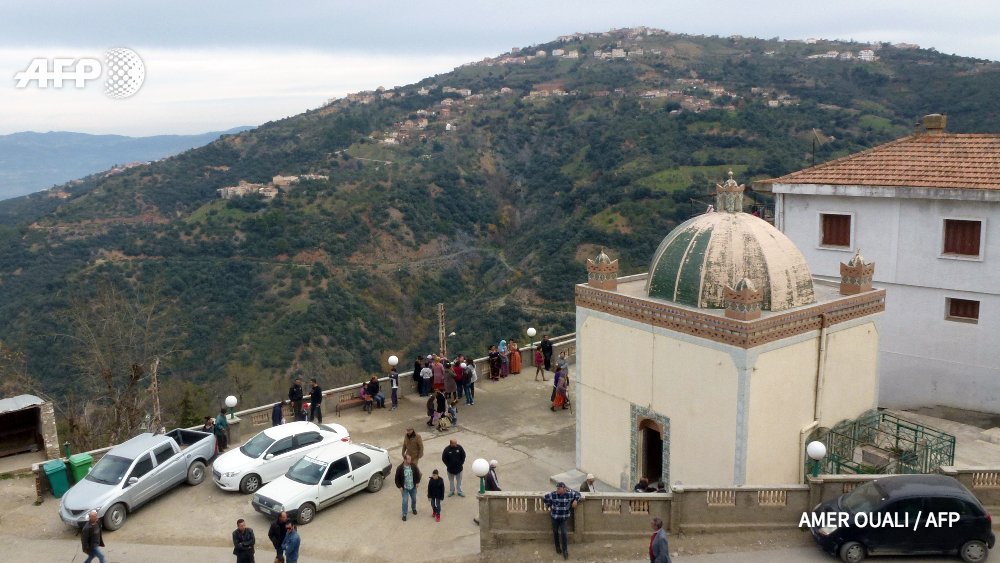
L'un des pères de l'indépendance de l'Algérie, devenu opposant intraitable au régime, va rejoindre pour l'éternité la terre qui a forgé son âme de révolté dans le village fondé par un illustre aïeul, poète et maître soufi.
Hocine Ait-Ahmed n'a pourtant que très peu vécu à Ait Ahmed, un petit hameau qui porte le nom de la famille, situé à 160 km au sud-est d'Alger, en haut d'une étroite vallée entouré de collines.
Au détour d'un virage, apparaît la coupole du mausolée qui abrite son fondateur cheikh Mohand Lhoucine, un personnage encore révéré plus d'un siècle après sa mort en 1901. Le mausolée où il est enterrée avec sa soeur est un lieu de pèlerinage qui ne désemplit jamais.
Partout en Kabylie, on jure encore par Cheikh Mohand l'amusnaw (philosophe, en berbère) qui éclairait par sa sagesse et son savoir toute la région durant la seconde moitié du 19e siècle. Il enseignait notamment que "la foi naïve triomphe toujours sur le calcul rusé".
De lui, "Hocine a hérité l'érudition et le sens intangible des principes", commente Boussad, un membre de la famille qui recevait vendredi les condoléances de centaines de personnes arrivant sur les lieux, une semaine avant l'enterrement.
"C'est toute l'Algérie qui perd Hocine et pas uniquement sa famille", répétait-il en souriant à tous les visiteurs, de tous âges et de tous milieux.

Thursday, April 17, 2014

Algeria: the elections that will change nothing

Algerians head to the polls on Thursday for a presidential election that in fact is not much more than a façade, because it is as good as certain that incumbent president Abdelaziz Bouteflika will win a fourth term in office. The president, who is 77 and who last year spent three months in a hospital in France to recover from a ministroke,  has appeared only rarely on television in recent months, looking frail. He almost never attended campaign events and is reported to have difficulty with his speech.      
Abdelaziz Bouteflika écoute le président sud-africain Jacob Zuma lors de sa visite à Alger, le 15 avril 2013 - AFP
Bouteflika (Photo AFP)
Bouteflika has been in power since 1999 when he was put forward as a candidate by the ruling FLN nationalist party. He is almost sure to win this time as well, thanks to the fact that he still has the backing of the party and the army generals behind it.
Bouteflika is more or less the mascot of the ruling generals and FLN-bosses as it was during his period in office that the terrible civil war of the 1990s came to and end, a war that started after the rulers in January 1992 cancelled the second round of the first free elections in the Arab world because the islamist party FIS was poised to win.

Sunday, March 23, 2014

Election campaign in Algeria starts without the main candidate


Cartoon in the newspaper Al-Watan: Someone look into the poster under the banner ''Vote Bouteflika'', and shouts: ''Uhuu, anybody there?'' 

Campaigning for Algeria's election opened on Sunday with the man expected to win, President Abdelaziz Bouteflika, starting his race not with a speech or a mass rally, but with a letter.
With questions lingering about the state of his health after a stroke last year, Bouteflika, 77, began his campaign writing to Algerians to say his condition would not stop him extending his 15 years governing the North African state.

Saturday, January 5, 2013

Ahmed Ouyahia, considered likely candidate for president of Algeria, steps down as party head

Ouyahia
One of Algeria's most prominent politicians, Ahmed Ouyahia, announced Thursday his resignation as secretary general of the National Democratic Rally. For much of the past year, several major figures in the party have been pushing for Ouyahia to step down. Ouyahia's resignation comes one year before presidential elections, for which he was not long ago considered to be a front-runner, because of his backing by the nation's powerful generals. Algeria regularly holds presidential and parliamentary elections, but true power is believed to be held by a shadowy collection of generals working behind the scenes.President Abdelaziz Bouteflika, in power since 1999, announced he would not run for a fourth term next year, leaving the race for the presidency wide open.
 Political analyst Ahmed Adimi of Algiers University, said Ouyahia was pushed out of power by the generals to clear the way for new faces ahead of elections to give the country's politics some semblance of change amid popular discontent. "The powers that be need stability in the parties of the ruling coalition but with new personalities at their head," he said. "Ouyahia's mission is over."
On Friday, the Algerian daily El-Khabar, reputed for its close contacts to security services, suggested that Ouyahia was pushed out because of his barely concealed presidential ambitions.
 Ouyahia represented Algeria in the U.N. Security Council in the 1990s before taking control of the National Democratic Rally in 1999 soon after it was formed. He was prime minister from 2003 to 2006 and again from 2008 to 2012 and was often seen as a rival to the president.

Monday, October 8, 2012

Chadli Benjedid, president of Algeria during a fateful period, dies at 83


L’ancien président Chadli Bendjedid est décédé samedi à Alger à l’âge de 83 ans des suites d’un cancer. Il avait été admis, il y a plus d’une semaine, à l’hôpital militaire de Aïn Naâdja. 

Updated. Former president of Algeria, Chadli Benjedid died on Saturday, 83 years old of cancer.  Benjedid, who succeeded Houari Boumedienne in 1979, was the president who after widespread unrest in 1988 liberalized the constitution, and transformed the system from a one party to a multi-party system with a free press.  However, he got in trouble after the islamist party Front islamique du salut (FIS) in December 1991 won the first round of the general elections.  Benjedid declared that he was ready to adopt the  'cohabitation' model of government, after the example of France where a leftist president (Mitterrand) was forced to cooperate with a rightist government under Prime Minister Chirac. After all the president in Algeria was powerful enough, as he, according to the Constitution, was personally in charge of the key portfolios of the Interior, Foreign Affairs and Defense. Also Benjedid may have considered two other things: 1) that the FIS already during local elections two years earlier got a majority in most municipalities and had proven to be a responsible factor, and 2) that the majority for the FIS was not, according to many,  so much a sign of a massive shift towards islamism of the Algerian people, as more a clear protest against years of mismanagement by the governing FLN-party, which had led to a huge shortage of jobs, general poverty and an immense housing problem.      
Benjedid's declaration that he was willing to 'cohabitate', however, was unexpectedly followed by a announcement, made by himself on television a few days later, that he stepped down. Although this was never openly stated, it was clear that Benjedid, himself a general, was forced to do so by his military colleagues, who were (and still are in a way) the real Algerian rulers, albeit off stage.
After Benjedid left, the second round of the elections to be held in January 1992 was annulled, the FIS was declared illegal, and  Benjedid's liberalisation was effectively frozen. I was in Algiers and I'll never forget the immense tension that was felt universally in the city after Benjedid's resignation. The veiled military coup was the beginning of a bloody conflict between islamists and the military which lasted about a decade and during which hundreds of thousands of militants, military and civilians lost their lives. In a way I'm still proud that I had warned that exactly this - a bloodbath of immense magnitude - was going to happen, in the reports I wrote for the Dutch newspaper Het Parool, for which I was reporting at the time. Most  of my colleagues wrote exactly the opposite: that leaving the way open for a electoral victory of the FIS was a sure way to disaster and that there was no alternative than to  put a halt to the electoral process.      

Benjedid himself  lived a life far from microphones and camera's ever since his departure from the scene. He has never given his own record of the eventful years 1988-1990, nor has he uttered a word about the quiet coup d'état that was behind his dramatic decision to leave his post. In fact the exact course of events is still largely unknown. In present day Algeria it's still all but a taboo.
  
The newspaper Al Watan (French) carries a more detailed in memoriam and biography.      

Saturday, May 12, 2012

Election fraud keeps Algerian government parties in power

Members of the Front des forces socialistes (FFS) of Hocine Ait Ahmed, the only socialist party in Algeria, demonstrate. The party obtained 21 seats.

The old government party FLN (Front de libération nationale) has obtained a majority with 220 seats in the election for the Algerian parliament. The RND (Rassemblement national démocratique) won 68 seats (6 more than before). And the Islamists of the Green Alliance (Alliance verte) were the big losers. They got no more than 48 seats, contrary to all expectations. However, the 'Commission nationale de surveillance des élections - whose duty it was to ensure a fair state of affairs during the elections - has accused the ministry of the Interior of fraud and of having pre cooked the results.

The results according to DNA (Dernieres nouvelles d'Algérie): 
Et le vainqueur est… le FLN. Le vieux parti FLN a obtenu jeudi 10 mai la majorité avec 220 sièges dans la nouvelle assemblée. L’ancien parti unique dirigé depuis 2007 par Abdelaziz Belkhadem a place 68 femmes dans l’hémicycle.
La deuxième place revient au RND du Premier ministre Ahmed Ouyahia avec 68 sièges dont 23 femmes. Le parti de M. Ouyahia a donc amélioré son précédent score de 2007 de 6 sièges( 62).
Les grands perdants de cette élection sont les frères musulmans de  l’Alliance Verte qui n’ont obtenu que 48 sièges. Une vraie tannée alors qu’on annonçait une déferlante islamiste sur l’assemblée.
Le Front des forces socialistes FFS de Hocine Ait Ahmed obtient  21 députés dont 7 femmes, deux de mieux que lors de l’élection d’octobre 1997 à laquelle il a participé.
Donné également grand favori, l'islamiste Abddellah Djaballah n'a pu récolter que 7 sièges dont un qui sera occupé par une femme. Idem pour l'ancien ministre de l'Industrie, Abdelamadjid Menasra, transfuge du MSP, dont le parti siègera avec quatre députés.
L’autre perdant de cette élection est le parti des Travailleurs (PT) de Louiza Hanoune avec 20 députés dont 10 femmes.
Les listes indépendantes on obtenu 21 sièges, le MPA d’Amara Benyounes 6 sièges et l’ANR 3 sièges.

So president Abdelaziz Bouteflika's National Liberation Front (FLN), a party heavily in crisis,  improved its share in the outgoing national assembly and got 220 of the 462 seats, while the National Rally for Democracy (RND) of Prime Minister Ahmed Ouyahia, a party close to the military and loyal to Bouteflika, came  second with 68 seats. These results mean that there will be no changes in the status quo. (Apart from the fact that the number of elected women rose to 145 from seven in the outgoing assembly - following the introduction of quotas.

 However the National Commission of Supervison of the Election (Commission nationale de surveillance des élections) acccused the minstry of the interior of fraud. Its president, Mohamed Seddiki, wrote in a declaration that the minister of the Interior, Dahou Ould Kablia published the results before the counting of the votes was even finished in the provinces of Algiers, Oran, Mostaganem, Bejaya and others.  So where did the figures the gobvernment prublished originate from, mr Seddiqi asked rethorically, if not from 'the laboratories of the ministry of the Interior:  
Alors que les membres de la commission étaient réunis vers 15 heures ce vendredi pour une première évaluation du scrutin tenu la veille, presque au même moment (15h30) le ministre de l’Intérieur, Dahou Ould Kablia, tenait une conférence de presse à Alger pour annoncer les résultats du vote.
« Nous sommes surpris que le ministre de l’Intérieur annonce les premiers résultats des élections vendredi 11 mai à 15 heures au moment même où de nombreuses commissions de wilaya à Alger, Oran, Mostaganem, Bejaia etc… procédaient encore au dépouillement et au comptage de ces résultats pour les consigner dans un procès verbal », écrit le président de cette instance.
A l’heure donc où le ministre annonçait la victoire écrasante du FLN (Front de libération) qui a obtenu 220 sièges sur 462, les comptes n’ont pas été finalisés à travers les quatre coins du pays.
D’où sortent alors les chiffres fournis par le représentant du gouvernement, sinon des laboratoires du ministère de l’Intérieur.

Update: See also the article by Jeremy Keenan on 15 May 2012 on the site of Al-Jazeera English.

Friday, May 11, 2012

Algeria: 57,1% did not vote

Under the headline ´´57,1 % d´abstention´´ the leftist Algerian newspaper Al Watan reported Friday:

 Le taux officiel de participation aux législatives d’hier est de 42,90% des 21,65 millions d’électeurs en Algérie et à l’étranger, a annoncé, hier dans la soirée, le ministre de l’Intérieur Daho Ould Kablia, en direct à la télévision d’Etat. Pour rappel, le taux officiel des dernières législatives de 2007 était de 36,51%, soit une hausse de huit points. Pour le détail, le taux de participation de la communauté algérienne à l’étranger a plafonné à 14% alors qu’il est de 44,38% au niveau national. 

So 42,9% took the trouble to vote, and 57,1% stayed at home. It was an improvement when compared with the numbers of the elections in 2007. But still it says it all. No Arab Spring yet in Algeria.

Saturday, April 16, 2011

Bouteflika promises a new constitution

 
Algerians watch their president Abdelaziz Bouteflika, who frail loooking and with a coarse voice, anounces that the constitution will be amended in a 20 minute speech in the 20 o'clock news. (AFP)  

ALGERIA - Algerian President Abdelaziz Bouteflika, who has been in power for 12 years, has promised to amend the constitution to "strengthen democracy".Bouteflika's speech was a response to unrest that broke out in January with strikes, marches and rioting echoing protests elsewhere in the Arab world. Earlier, in February, Bouteflika, who is 74 and not in good health, lifted the country's state of emergency.
The current constitution, adopted in 1996, was introduced to strengthen presidential law and ban religion-based parties following Algeria's murderous war between the military and Islamist militants, in which some 150,000 people were killed.
Bouteflika announced that a commisisson will be formed consisting of experts and active political forces to adopt a new constitution, the newspaper Al-Watan reported. Also he announced that the laws concering the formation of political parties would be revised, as well as the laws concerning the electoral process, in order to make it more 'transparant'.

SYRIA again has witnessed numerous protests for reforms or agains the rule of president Assad  On Friday thousands took to the streets in the capital Damascus. Security used teargas and batons to disperse the demonstration. Thousands of others were reported to have demonstrated in a number of other Syrian cities, including Deraa, Latakia, Baniyas and Qamishli - places where violence has been previously reported.
The protesters called for reforms, while some demanded the overthrow of President Bashar al-Assad. The protests, in Damascus and other cities, are believed to be the largest in a month of unrest in which about 200 people have been reported killed.
State media reported that "small demonstrations" had taken place in different parts of the country and security forces did not intervene. Mr Assad has promised to make some concessions while cracking down on dissent. 

JORDAN - Dozens of people have been injured as ultra-conservative Salafist Muslims clashed with pro-government supporters in Jordan's northern city of Zarqa.The police used tear gas to disperse the crowds, a police spokesman said. Six officers were stabbed and 34 others injured in the clashes, he added.
Meanwhile, up to 1,000 people protested in the capital Amman, calling for political and economic reform.
The Salafists have been demonstrating over the past few weeks to demand the release of 90 Islamist prisoners.They include Abu Mohammed al-Maqdessi, the former mentor of slain al-Qaeda leader in Iraq, Abu Musab al-Zarqawi, who was born in Zarqa.

Saturday, February 12, 2011

Algerian police succesful in quelling protests

 
Algerian police has succeeded in blocking mass protests on Saturday and in dispersing demonstrations in Algiers, Oran and Annaba. Other protests also took place in other places, like Gardaya in the south, but were equally stopped. According to the newspaper Al Watan scores of arrests were made in Algiers on the Place du 1er May, while at least 70 people were arrested in Oran and 30 in Annaba.  

Opponents of the government had called for mass protests to demand democratic change and jobs, but thousands of police in riot gear were moved to the capital to enforce a ban on the march. Checkpoinmt were set up on the roads leading to the city and trvallers by train weere greeted by a solid cordon of policemen that stopped them from entering Algiers proper, a method that the authorities have usee wit succces sinc at least the ate eighties and early nineties, when the islamist FIS party  was at th winning hand.
'I am sorry to say the government has deployed a huge force to prevent a peaceful march. This is not good for Algeria's image," said Mustafa Bouachichi, a leader of the League for Human Rights which is helping organize the protest.
A small number of protesters on May 1 Square, near the center of the city, shouted "Bouteflika Out!" and 'As shaab yourid ousqat al-nizam (the people want the downfall of the regime) some waving copies of a newspaper front page with the headline 'Mubarak has fallen!' Buth they were effectively squard in by massive
quantities of riot police.

Saturday, January 22, 2011

Police stop demonstration in Algiers

Algerian authorities have stopped a peaceful demonstration on Saturday of the Rassemblement pour la culture et la démocatie (RCD), a largely Berber party led by Saad Sadi. Enormous amounts of policemen blocked the way for the protesters, made it impossible for Saad Sadi to leave party heaquarters and stopped people who tried to join the demonstrations from outside Algiers. The protesters, demanding more freedom and democracy, carried Algerian flags  but also Tunisian ones. Eleven people were wounded, five were arrested. Last week saw demonstrations in several Algerian cities against high prices, low wages and unemployment. Demonstrations are forbidden in Algeria, that lives under a state of emergency since 1992.   

Sunday, January 9, 2011

Algeria anounces mass arrest of rioters

Algerian authorities have vowed to punish those responsible for nationwide food riots in which at least five people were reported killed and more than 800 injured. Press reports on Sunday quoted Dahou Ould Kablia,interior minster, saying that troublemakers "will not go unpunished".
Ould Kablia said around 1,000 protestors had been arrested, many of them minors, during the weekend disturbances. Out of the 826 people injured, the minister said 763 were police.
The government decided on Saturday to cut taxes and import duties on sugar and cooking oil. "Nothing can cast doubt on the resolute will of the state, under the direction of the president of the republic, to intervene whenever necessary to preserve the purchasing power of citizens in the face of any price increase," a government statement said.
The country has seen three days of unrest over the rising costs of living and unemployment. According to government figures unemployment stands at 10 per cent. Independent organisations put it closer to 25 per cent.
The number of killed climbed to at least five, after the 65 year old taxi-driver Sadek Benjedid died in hospital in Annaba (east of the country).He had been exposed to an overdosis of teargas the day before. One of the other people killed was named as 18-year-old Azzedine Lebza. He was shot dead in Ain Lahdjel in the M'Sila region, 300km from Algiers. Earlier another man was killed in the same M'sila region. In Bou Smail, a small town 50km west of Algiers, on Friday the 32-year-old Akriche Abdelfattah was killed. According to medical sources he had been hit in the face by a tear gas canister. A fifth man was killed in Tiaret, while defending his fathers bar against attackers.  
Minister Ould Kablia on Sunday announced that the riots were under control. Nevertheless the paper Al Watan reported unrest in several quarters of Algiers, in Bouira, Mascara and Tizi Ouzou, among other places. 

Saturday, January 8, 2011

Algeria: unrest during the night in Constantine, Skikda and Azzaba

The unrest in Algeria is not only continuing, but also spreading. The newspaper Al Watan says that the wilaya (governorate) of Constantine in the East, which had been relatively calm till this moment, lived a night of unrest, much like oin othere parts of the country the night before. Clashes erupted in Hamma Bouziane, in the city Constantine itself and several  other localities.  In Hamma Bouziane roads were barricaced with stones, branches of trees and burning tires. Communal buildings like the buro for the collection of taxes, the train station, and bus stops were attacked. In Zighoud Youssef, the protesters entered the technical high school and threw laptops out of the windows. In in several quarters of the city of Constantine, the situation was similar with roads blocked, tires burning and communal property destroyed.
According to El Watan also in the cities of Skikda and Azzaba, people went to the streets to protest.
(To be updated)

Friday, January 7, 2011

Second day of protests and clashes in several Algerian cities

Updated Friday evening.
Fresh disturbances broke out in Algeria on Friday as demonstrators and security forces clashed in the Algerian capital and other towns, after protests against steep hikes in basic foodstuffs and unemployment which according to the newspaper Al-Watan alreadu started on Monday.
One man of 18 was reported to be killed in Msila after he was shot by the police. In Biskra three policemen were wounded. In Algiers youths hurled stones and glass bottles at police, who responded with tear gas and water cannons. Clashes also erupted after Friday prayers in the town of Annaba, east of the capital, and Oran to the west, while the disturbances also reached Tizi Ouzou and Bejaia in the Berber region Kabylia which had hithero been quiet, and the southern city of Tebessa.
The national football league said that all top-level soccer matches scheduled for Friday and Saturday had been postponed. On its website the league said that also second class matches had been cancelled. Commerce minister Bendaba announced that a ministerial committee  will meet Saturday to find ways to halt the rise in the costs of basic food items that sparked the riots.
About 40 youths attacked several shops in Algiers' al-Biar area late Thursday, looting a restaurant and emptying a jewelry store before security forces arrived, local reporters and witnesses said. There was a second night of clashes in the volatile Bab al-Oued suburb, with police firing tear gas to disperse demonstrators, a witness said. One witness said youths had hurled Molotov cocktails.
Police positioned around mosques in Bab al-Oued, Belcourt and Bachjarrah, poorer areas of the city, in case of more unrest after Friday prayers, according to reporters on the scene. There was also extra security at a police station, a new shopping mall and a major hotel in an area near Bab Ezzouar airport, while a nearby university was surrounded by security forces.
Travelers said a road between the capital and eastern suburbs on the coast had been blocked since Thursday afternoon after youths set up barricades, also clashing with security forces.
In the Annacer-Diar al-Afia suburb, a Renault-Dacia car dealership showed signs of fire and residents said a public bus was also torched, although only burn marks on the road were visible by morning.
Protests led by small groups of young men have flared in several towns this week, linked to anger about a rise in the costs of basic food items by about 30 percent this month, unemployment and a lack of social housing.
About 75 percent of Algerians are under the age of 30, and 20 percent of the youth are unemployed, according to the International Monetary Fund.
Below video's of unrest in Bejaia (Kabylia), and clashes in Blida.


Thursday, January 6, 2011

Algerians follow example of Tunisia: street protests in Algiers and other parts of the country


Algeria’s angry youth violently clashed late on Wednesday with security forces in a number of cities over the rise of food prices, unemployment, and a perceived deterioration of basic government services.
Al Arabiyya tv and Al-Jazeera have both footage of  young rioters in the capital city Algiers hurling stones at security forces who responded firing tear gas and rubber bullets.  Eyewitnesses told Al Arabiya that rioters stormed the police headquarters near the building of the directorate general for national security in the neighborhood of Bab el-Oued in the capital. AlJazeera reported protests at the Martyrs' Square, Balkor, Bash Jarrah, Babal Wadi and Astawali.
In Oran, a major city on the northwestern Mediterranean coast of Algeria and the second largest city of the country, hundreds of young people took the streets and closed a number of streets, according to Al-Arabiyya. . Some of them threw animal bones in the streets and on government buildings. A young protester said bones were hurled as a message to the government "because it left nothing for us except bones."
The correspondent of Al-Jazeera reported that both in Jalfa in southern Algeria and Wahran in the west, also  violent rallies took place in protest over the deteriorating living conditions and rising prices.

Demonstrators posted videos on the internet of large fires burning in the street, police firing tear gas, and protesters throwing rocks.

The riots in the capital reportedly broke out in solidarity with the alleged suppression of protests in the cities of Zeralda and Esharaqa by paramilitary forces, says Al-Arabiyya. In Tibaza province, 70 kilometers west of the capital, 32 people were arrested following violent riots in residential areas and in the province’s major urban center.

Government-owned TV channels ignored the protests. They instead reported on the progress of government housing and infrastructure projects across the country.
Prices of some food products, like cooking oil and sugar, have increased by 150 percent during the rule of the ailing President Abdelaziz Bouteflika.

Friday, November 20, 2009

Soccer war Algeria - Egypt


The news is serious: Angry Egyptians were demonstrating on Friday for the second day in front of the the Algerian embassy in the Zamalek district in Cairo. The night before there were no less than 2000 people there, clashing with riot police, overturning two police cars and demanding that alle Algerians leave Egypt. Eleven policemen and 24 demonstrators were wounded.
The reason is soccer. Last week Egypt played Algeria. Both countries are arch rivals when it comes to soccer and the tension was high already then: the bus with the Algerian team was attacked on the way from Cairo airport to the  hotel en a few players were (lightly) hurt by broken glass.
Egypt beat Algeria 2 - 0. After that a play off was needed, because both countries ended wit the same amount of points in their pool. On wednesday night the two teams met again in the Sudanese capital Khartoum - on neutral ground. There Algeria beat Egypt 1-0. Thanks to a goal by defense player Antar Yahya it´s the Algerians that will go to Johannesburg in 2010. But afterwards there was more beating: Algerian fans chased Egyptians in the streets of Khartoum with knives and all sorts of weapons, Egyptian radio- and tv-reporters fled and were isolated for hours in a resataurant, the sons of president Mubarak had to take refuge in their hotel. People were wounded, one Egyptian girl reportedly lost an eye.
The next day Egypt summoned the Algerian ambassador and recalled its own ambassador from Algiers. The Egyptian football Federation condemned the behaviour of the Algerians and withdrew from the North-African Football Federation. It´s a full blown crisis. 


PS. What I almost forgot: after the first match the Algerian newspaper Al Shorouq reported that Algerians had been killed in Cairo (which wasn´t true). After that angry Algerian mobs burned Egyptian flags in the streets of Algiers (see video). As you can see on the above picture the Egypians yesterday answered in kind.