Sunday, January 12, 2014

The Revolution in Egypt is Alive But Not Well

fo2
July 2013: general al-Sisi announces the deposition of president Morsi.
  
By Noha Radwan
Last July, it appeared that the Egyptian revolution of 2011 had run its course. It was displaced by a  discourse of totalitarian ultra-nationalism that has left an entire nation, save for the supporters of the Muslim Brothers, enchanted with a soft spoken army general. Someone who takes it upon the armed forces to provide the Egyptians with the tender loving care the revolution has failed to provide, to paraphrase some of his own communiqués. Or so it appeared in July.
Six months later, some signs of a resurgence of the revolutionary spirit are becoming palpable. The hegemony of the discourse of “the people, the army, and the police united,” which would have been deemed a bad joke prior to June 2013 but reigned supreme among the masses hostile to the Brotherhood afterwards, is fraying. Strikes of the Egyptian blue collar workers have resumed. And a small core of committed individuals and groups such as the Revolutionary Socialists, 6 April, the Egyptian Center for Economic and Social Rights, and several others, who remain committed to the goal of a civil government dominated by neither the Brotherhood nor Mubarak’s old regime and his military, are still continuing on the road taken in 2011.

Saturday, January 11, 2014

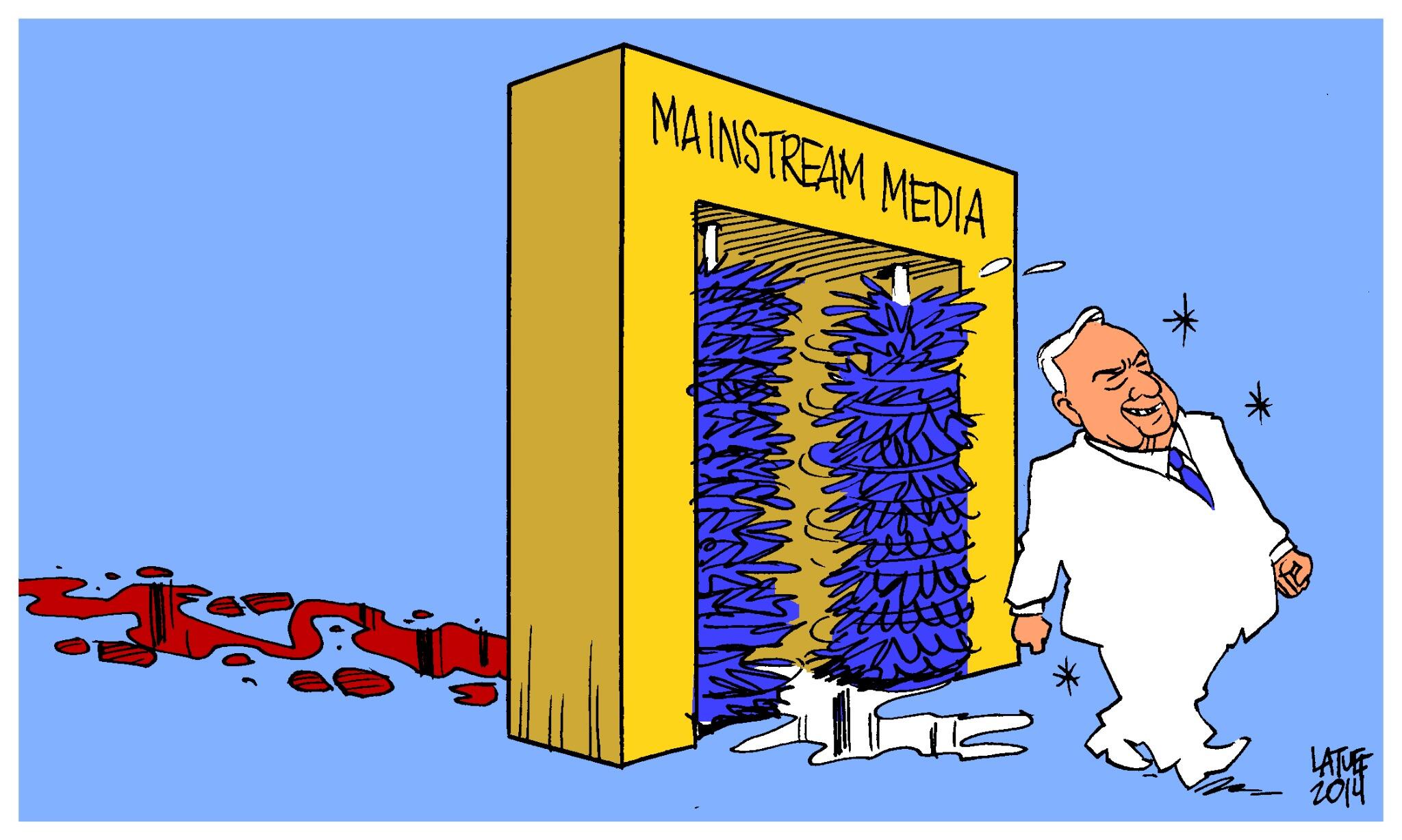
Sharon the ''man of peace''


 Today the man died who in 1982 engineered the butchery in the Palestinian camps of Sabra and Shatila in Beirut (about 3000 women, old people and children killed, according to the book that the journalist Amnon Kapeliouk of Le Monde diplomatique wrote about the massacre), who started the disastrous and unnecessary and bloody war in Lebanon in 1982, who was the commander of the infamous Unit 101 (Qibiya, and numerous killings in Gaza), and who was Israel´s prime minister in 2002 at the time of Operation Defensive Shield (and the onslaught on Arafats compound and the Jenin camp). And now that Sharon is dead, he is called a courageous man, and someone who ´´sought to become the architect of a peaceful future´´.  
This was expected, of course. It is because he withdrew from Gaza and supposedly made an offer of peace to the Palestinians. That he also started the building of ´The Wall´´ around the settlements on the West Bank, ostensibly for the purpose of incorporating them into Israel proper, seems to be somewhat forgotten. (As most people always have been misreading Sharon´s speech of 18 December 2003 at Hertzliya, where he announced his plans). It is therefor worth to remember what Dov Weisglass, Sharon´s close adviser at the time (2004), had to say about the withdrawal: 
"The significance of the disengagement plan is the freezing of the peace process," Prime Minister Ariel Sharon's senior adviser Dov Weisglass has told Haaretz.
"And when you freeze that process, you prevent the establishment of a Palestinian state, and you prevent a discussion on the refugees, the borders and Jerusalem. Effectively, this whole package called the Palestinian state, with all that it entails, has been removed indefinitely from our agenda. And all this with authority and permission. All with a presidential blessing and the ratification of both houses of Congress." 
 "The disengagement is actually formaldehyde," he said. "It supplies the amount of formaldehyde that is necessary so there will not be a political process with the Palestinians."
Unfortunately Sharon´s memory cannot easily be erased.  
 

Israeli settlements in Jordan Valley suffer from BDS

APTOPIX Mideast Israel Boycott Hits Home
A Thai worker sits in a back of a truck load with flowers in the fields of the West Bank Jordan Valley Jewish settlement of Petsael. (AP).

NETIV HAGDUD, West Bank (AP) — An international campaign to boycott Israeli settlement products has rapidly turned from a distant nuisance into a harsh economic reality for Israeli farmers in the West Bank's Jordan Valley.
The export-driven income of growers in the valley's 21 settlements dropped by more than 14 percent, or $29 million, last year, largely because Western European supermarket chains, particularly those in Britain and Scandinavia, are increasingly shunning the area's peppers, dates, grapes and fresh herbs, settlers say.
"The damage is enormous," said David Elhayani, head of the Jordan Valley Regional Council, which represents about 7,000 settlers. "In effect, today, we are almost not selling to the (Western) European market anymore.
Israel has played down the impact of the campaign of boycott, divestment and sanctions launched by Palestinian activists in 2005 to pressure Israel to withdraw from occupied lands.

Friday, January 10, 2014

Israel announces plans for almost 1.900 new housing units in occupied territory


Part of the settlement of Efrat, in the background the Palestinian village of Khirbet Abdullah Ibrahim (Reuters)  

Israel announced plans on Friday to build almost 1,900 new settler homes in the West Bank and East Jerusalem, settlement watchdog Peace Now said. The housing ministry announced the plans for 1,076 units in annexed East Jerusalem and 801 in the occupied West Bank, Peace Now spokesman Lior Amihai told AFP. Together the plans amount to 1877 new units. 
Last Monday Israel already announced plans for the construction of 272 new housing units in occupied territory. All in all this come down to 2149 units.
The paper Haaretz precises that tenders were released for the construction of 600 housing units in the settlement of Ramat Shlomo, a satellite of East-Jerusalem. In addition, also tenders were published for the construction of 532 units in other parts of East Jerusalem: 182 units in Pisgat Ze'ev, 294 in Ramot and 56 in Neve Yaakov. These last plots were marketed in the past but found no buyers at the time. They were now put back out on the market.
As for the West Bank the plans consisted of 227 housing units in Efrat, 78 in Alfei Menashe, 86 in Karnei Shomron, 40 in Ariel, 75 in Adam, 24 in Beitar Illit, 102 in Immanuel and 169 in Elkana.

Wednesday, January 8, 2014

Dutch pensionfund PGGM withdraws investments from five Israeli banks

Bank Leumi branch | Oranit Settlement | May 2011 | Photographed by Who ProfitsBank Leumi office in settlement Oranit. (Photo Who Profits)

A new achievement for BDS: the Dutch pension fund company PGGM, one of the largest such companies in the Netherlands with an invested capital of about 150 billion euro, has withdrawn its investments from Israel’s five largest banks because they have branches in the West Bank and are involved in financing construction in the settlements, Haaretz reports. Over the past few months, PGGM contacted Bank Hapoalim, Bank Leumi, Bank Mizrahi-Tefahot, the First International Bank of Israel and Israel Discount Bank and informed them that their ties with the settlements created a problem in view of the opinion issued in 2004 by the International Court of Justice in The Hague about the building of ´´The Wall´´ on the West Bank. In this opinion the Court judged that the settlements in occupied Palestinian territory are illegal and violate Article 49 of the Fourth Geneva Convention, as this article states that the occupying power is not allowed ´´to deport or transfer parts of its own civilian population into the territory it occupies.” The Israeli banks responded that Israeli law doesn’t allow them to cease providing service to entities connected to the settlements. Nor, given the daily reality in which the banks operate, would this even be feasible, according to Haaretz.

Tuesday, January 7, 2014

South Sudan peace negotiations have a difficult start

Members of South Sudan rebel delegation attend the opening ceremony of South Sudan's negotiation in Ethiopia's capital Addis Ababa, January 4, 2014. REUTERS/Tiksa Negeri
South Sudanese rebel delegation in Addis Abeba at the opnining of the talks. (Reuters)

South Sudan rejected rebel calls for an immediate release of detainees after the two sides met briefly for the first time on Tuesday seeking to end fighting that has left the world's newest state on the brink of civil war.
The Meetings in neighboring Ethiopia are aimed at brokering a ceasefire to halt three weeks of violence that has killed at least 1,000 people and driven 200,000 from their homes.The fighting, often along ethnic faultlines, has pitted President Salva Kiir's SPLA government forces against the rebels loyal to Machar.
The talks opened on Tuesday but quickly took a break for consultations in Juba about the fate of the 11 detainees, arrested last year over an alleged coup plot. The rebels had initially demanded their release before the negotiations.

Saturday, January 4, 2014

Fighting against ISIS in Anbar province of Iraq is still going on

 Sunni tribesmen seize buildings in Iraqi city
Members of the Iraqi Dulaim tribe in action in Falluja. (AFP)

Iraqi security forces and allied tribesmen have retaken areas in the central cities of Ramadi and Fallujah from Islamist insurgents. A correspondent in Ramadi for RFE/RL said police forces and their Sunni tribesmen allies had taken back police stations in several neighborhoods in the city that had been ransacked and occupied by militants. But he said some parts of Ramadi, the capital of Anbar Province, were still controlled by the insurgents, and fighting was continuing. He said security forces made less progress against insurgents in nearby Fallujah, where neighborhoods near the highway to Baghdad are controlled by the Al-Qaeda-linked rebels.
Many insurgents took part in Friday Prayers along Fallujah's main street, some carrying black Al-Qaeda flags. There was no clear count of killed and injured from the latest clashes, but some reports spoke of dozens of casualties.
The militants are trying to defend police stations and government buildings they seized on January 1-2, after army forces withdrew on the orders of prime minister Maliki, who hoped that calm would return after the trops left.

Major confrontation between ISIS and other Syrian rebel formations

 
A major confrontation has broken out between the Islamic State in Iraq and Syria (ISIS) and Syria’s other rebel militias, writes Joshua Landis  It is being led by a newly organized front, called the Front of Syrian Revolutionaries. But many other militias have also declared war on ISIS, insisting that it must abandon its attempt to establish a state and that its fighters must either integrate into Syria’s other militias or quite the country altogether. Fighting between Free Syria Army militias and ISIS has been widespread in the countryside of Aleppo and Idlib. Lanndis presents a map of who is fighting whom and where. (In order to see it and for the rest of the arcticle click here).

Reuters adds: One group of fighters battling ISIL was the newly formed Mujahideen Army, an alliance of eight brigades who accused the al Qaeda affiliate of hijacking their struggle to topple Assad.
They said ISIL fighters were "undermining stability and security in liberated areas" through theft, kidnapping and trying to impose their own brand of Islam, and vowed to fight them until ISIL was disbanded or driven out of Syria.

Fourteen people shot dead during demonstrations and clashes throughout Egypt

Supporters and opponents of ousted Egyptian President Mohamed Mursi clash at Nasr City district in Cairo, January 3, 2014. REUTERS- Mohamed Abd El Ghany
 Clashes in Nasr City, a district of Cairo. (Photo Reuters)

Egypt witnessed a day of violent clashes between supporters of the Muslim Brotherhood and the police at a level unparalleled in more than two months. The ministry of health said on Saturday that 14 people were killed and 62 injured in clashes across the country on Friday. 17 police officers were also injured, according to a senior security source.
Reuters reported that according to the Health Ministry five people were killed in different districts in Cairo. A security source said they died from bullet wounds. One of the five was a man who was shot dead by the protesters after he yelled insults at pro-Brotherhood demonstrators marching near his house, the source said.A male protester and a woman were shot dead in the coastal city of Alexandria, medical and security sources said. It was not clear whether the woman was a protester or an onlooker. Two were shot dead by police in the Suez Canal city of Ismailia after a march set off from a mosque after midday prayers, medical sources said. In the rural province of Fayoum, southwest of Cairo, three protesters, including a student, died from bullet wounds to the chest and head,local Health Ministry official Medhat Shukri told Reuters. Another university student was shot dead during clashes in the southern town of Minya.

Thursday, January 2, 2014

Darfur Bar Association demands due process in case of arrested blogger

Arja
The Darfur Bar Association (DBA) has demanded that the responsible authorities follow legal procedures with regard to the arrest of the Darfuri activist and blogger Tajeldin Ahmed Arja or release him immediately.Arja was detained on Tuesday, 24 December, on the orders of President Omar Al Bashir at a meeting of Presidents, Ministers, and Darfuri notables in the Friendship Hall in Khartoum. Arja openly criticised Al Bashir and the President of Chad, Idris Deby, holding them both responsible for the war and killings in Darfur.
The head of the DBA, Mohamed Abdallah El Doma, told Radio Dabanga that neither Arja's family nor his lawyer have not been allowed to visit him. The authorities have not disclosed his whereabouts or what he has been charged with.

Bomb in Hezbollah neighbourhood of Beirut kills five


(AFP).
 
Five people were killed and 75 others were wounded Thursday when a car bomb ripped through a neighborhood of the Beirut southern suburbs where Hezbollah enjoys broad support, security sources told The Daily Star. 
The car bombing in Haret Hreik, a densely populated neighborhood of the southern suburb, is the latest security incident to hit increasingly volatile Lebanon. The attacks are linked to the ongoing crisis in Syria, particularly Hezbollah’s military support there to President Bashar Assad.
The 4.15 p.m. blast caused plumes of black smoke to blanket the Beirut skyline as ambulances and paramedics rushed to the neighborhood.
Parked vehicles and buildings in the commercial, residential area were severely damaged in the blast.

Egyptian minister accuses Hamas of involvement in Mansoura bombing

The Egyptian minister of the Interior, Mohamed Ibrahim, has accused Palestinian Islamist movement Hamas of providing logistical support to a bomb attack on 24 December 2013 in Mansoura that killed 16 people and injured more than 130.
Egypt
Ibrahim
Ibrahim, who spoke to reporters at a press conference on Thursday, also claimed a Muslim Brotherhood member had admitted to involvement in various crimes in Mansoura and to having links with Hamas. According to Ibrahim, Amer Mosaad, a 30-year-old commerce faculty graduate who "belongs to the Brotherhood," has admitted entering the Gaza Strip via tunnels with Ahmed El-Sayed and Mohamed Ahmed, who are also Brotherhood members, as well as a Palestinian, Mohamed Mahmoud. The assailants communicated with Gaza-based Hamas,which is an ideological offshoot of the Egyptian Muslim Brotherhood, for help and support ahead of the Mansoura bombing, Ibrahim added.